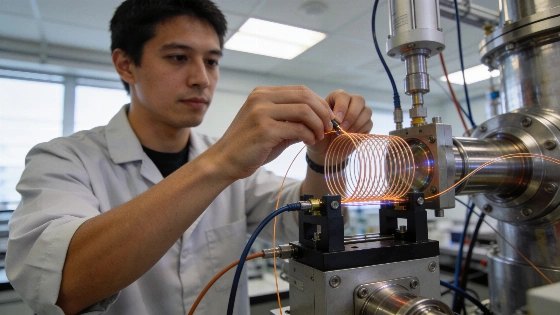
California has signed fusion and advanced nuclear legislation while directing $30 million toward quantum and deep-space research, including university laboratories, startup partnerships and semiconductor infrastructure.
California is turning quantum technology from a collection of university laboratories into a state-backed infrastructure project. On September 30, 2026, Governor Gavin Newsom signed legislation intended to accelerate the fusion industry and announced $30 million for quantum and deep-space research. The state's official announcement presents the package as a combination of research and development, commercialization planning, manufacturing capacity and public-private partnerships rather than as evidence that a commercial fusion plant is already operating.
The funding is intended to support university research hubs, public-private startup incubators and hardware supply-chain infrastructure spanning physical sciences and semiconductor manufacturing. That emphasis matters because quantum systems are constrained not only by algorithms but also by fabrication capacity, materials control, electronics, photonics and the ability to reproduce devices beyond a single laboratory. In practice, a useful quantum system requires coordinated control hardware, calibration, cryogenic or vacuum equipment, software and error-management methods.
California's Quantum California initiative, launched in 2025, is described by the state as a statewide network connecting universities, national laboratories, private companies, investors and policymakers. Its named research and industrial nodes include the UCLA Center for Quantum Science and Engineering, the AWS Center for Quantum Computing at Caltech, Microsoft Station Q and Google Quantum AI. The strategy also points to local critical-mineral production through MP Materials' rare-earth facility as part of an end-to-end hardware supply chain.
A separate regional investment adds a measurable Southern California component: UCLA reports $9.74 million for the SoCal Quantum Alliance for Development, or SQUAD, through the California Jobs First Regional Investment Initiative. The project spans Los Angeles, Orange County and San Diego, extending the program beyond a single campus and linking workforce, research and industrial-development goals across the region.
The announcement is therefore broader than a processor launch. It is a public attempt to assemble the institutions, materials and commercial pathways needed before quantum hardware can become a dependable technology. This type of systems approach is consistent with how major scientific infrastructures have developed at organizations such as MIT, NASA and CERN, where instruments, engineering teams, facilities and long-term funding must mature together.
Senate Bill 925, sponsored by Senator Jerry McNerney, directs the California Energy Commission to create a strategic plan, certification protocols and environmental-review frameworks for commercializing fusion energy and expanding advanced-fusion manufacturing. The measure establishes a planning and regulatory route rather than demonstrating a working fusion power system. Fusion research generally seeks to confine and heat a plasma sufficiently for nuclear fusion reactions, but a power plant would additionally require durable materials, heat extraction, fuel handling, reliable control systems and integration with the electricity grid.
Assembly Bill 2647, sponsored by Assemblymember Lisa Calderon, requires a statewide technical assessment of integrating advanced nuclear technologies into the electricity system. Its stated purpose is to examine how those technologies could support grid reliability as California pursues 100% zero-carbon electricity by 2045. The assessment is not a deployment decision and does not establish that any particular reactor technology will be used.
California has already connected fusion with energy policy through its Fusion Research and Development Innovation Initiative, which received $5 million for research and development in the previous year. The new laws expand the planning, commercial and manufacturing framework, but they do not report fusion-electricity output, net plant power, plasma-performance data or a construction schedule for a generating station.
Newsom also signed University of California-sponsored Senate Bill 895, placing the $7.5 billion California Science and Health Research Bond Act on the March 2028 state ballot. If approved by voters, the measure would fund public-university capital projects, medical innovation and emerging-technology research. It is a proposed bond measure rather than money already available to laboratories.
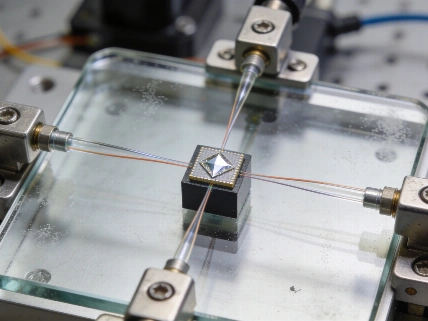
One of the most concrete quantum components is the UCLA Quantum Innovation Hub at the newly developed UCLA Research Park. Boeing has secured an industry partnership with the hub to work on physical-layer quantum networking, entanglement distribution over optical fiber and system design for space and defense communications.
The planned infrastructure includes an on-site entanglement-swapping testbed. Entanglement swapping creates correlations between systems that have not directly interacted by using measurements on other entangled systems. In a network context, it is a building block for linking multiple nodes, but a testbed is not a functioning quantum internet and does not remove optical-loss, detector or synchronization limitations.
Quantum links also face a basic engineering distinction: transmitting a classical signal is not the same as distributing an entangled state. Photonic loss, imperfect sources, detector noise, memory lifetimes and synchronization all affect whether a laboratory demonstration can scale to a network. These constraints are why experimental quantum-networking programs are evaluated through repeatable measurements of transmission, state quality and system reliability rather than through qubit count alone.
The state's broader network of research centers gives the policy package a practical focus. The UCLA hub and the other named university and corporate facilities are being positioned alongside semiconductor and rare-earth infrastructure rather than treated as isolated demonstrations. As an earlier report on quantum error-correction engineering illustrates, performance depends on the interaction between quantum hardware and classical control systems rather than on qubit count alone. The same systems perspective underlies work reported across the field in venues such as Nature, where device physics, control electronics and error characterization are often assessed together.
Nothing in the announcement establishes a quantum advantage, a fault-tolerant processor or a commercially operating fusion plant. The available material provides no qubit counts, gate fidelities, coherence times, network rates, fusion output or independent performance benchmarks. Those omissions are important: infrastructure spending can improve the conditions for experiments without proving that the resulting devices will outperform classical systems or operate reliably outside research settings.
The legislation does create a more defined public role. SB 925 addresses planning, certification and environmental review for fusion, while AB 2647 commissions a technical study of advanced nuclear integration. SB 895 creates a future ballot decision on research capital. Together with the $30 million allocation, the $9.74 million SQUAD investment and the UCLA-Boeing testbed, these actions connect policy, funding and technical facilities, but they remain different stages of development.
The strongest reading of California's move is not that the state has solved quantum scaling or fusion commercialization. It is that California is funding the less visible infrastructure on which those claims will eventually have to stand: research space, supply chains, network testbeds, regulatory processes and university capital. That is a more credible strategy than declaring a finished technology, but its success will be measured by reproducible hardware and useful system performance rather than by the size of the announcement.
In quantum networking, an entangled link is not the same as a usable network connection. Entanglement distribution requires controlled quantum states to survive transmission and measurement across physical channels, while entanglement swapping adds operations and sources of loss. A laboratory testbed can measure how those steps behave across multiple nodes, yet it does not by itself provide long-distance coverage, secure operation or faster-than-light communication. This distinction is central to judging California's program: the state is building the conditions for testing quantum infrastructure, not reporting that the infrastructure has already reached deployment.