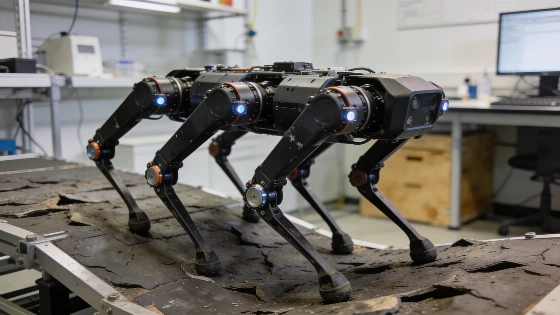
A research team has developed a six-legged robot that uses AI to learn walking strategies from stick insect movement data, enabling it to adapt to uneven terrain and physical damage in laboratory tests
A research collaboration between Tohoku University in Japan and VISTEC in Thailand has produced a six-legged robot that learns to walk by analyzing the movement patterns of stick insects. Rather than relying on pre-programmed gaits, the robot's control system uses machine learning to extract coordination strategies from biological data, aiming to improve adaptability on unfamiliar or unstable surfaces.
The system employs adversarial inverse reinforcement learning (AIRL), a method that allows the robot to infer the underlying reward structure guiding insect locomotion. Researchers trained the robot's controller using flat-ground walking data from Medauroidea extradentata, a species of stick insect, capturing the motion of 18 leg joints. Instead of directly copying each movement, the AI learned coordination principles that support stable walking. The AIRL approach was combined with proximal policy optimization (PPO), a reinforcement learning algorithm, to refine the robot's policy through simulated trials.
Testing Adaptability
During evaluation, the robot demonstrated stable walking patterns that resembled those of the stick insect. Notably, the controller adapted to changes in terrain despite being trained only on flat-ground data. When tested on uneven surfaces, the robot maintained stability, although its body experienced greater movement and its forward speed decreased slightly. The system adjusted leg timing and coordination, producing a wave-like gait that was not present in the original training data.
To assess resilience, researchers simulated mechanical damage by disabling one of the robot's six legs. The controller reorganized the remaining legs' movements and redistributed load to maintain balance, rather than persisting with the original gait. This response suggests the learned policy can generalize to physical changes not encountered during training, a key challenge for real-world deployment of legged robots.
Transfer and Real-World Testing
The team also investigated whether the learned reward structure could be transferred to a different robot model with altered body proportions and joint configurations. Directly transferring the original walking policy failed, but using the AIRL-derived reward enabled a new policy to learn coordinated movement on the new robot. The combined AIRL and forward-velocity rewards allowed the system to reach a functional walking strategy in 70,000 training steps, compared to 200,000 steps when using velocity-based reward shaping alone.
Preliminary physical tests were conducted on a RedMirror robot, which showed walking and body-coordination patterns similar to those observed in simulation. While these results are promising, the experiments were limited in scope and duration, and the system's performance under more varied real-world conditions remains untested. The research highlights the potential for biologically inspired learning to improve robot adaptability, but further evaluation is needed to establish reliability outside controlled environments.
Efforts to improve robot mobility are ongoing across the field. For example, recent demonstrations at the World Robot Conference in Beijing have showcased humanoid and quadruped robots tackling complex tasks in aviation and security, with technical progress and persistent challenges in real-world deployment highlighted in coverage of Chinese robotics firms' latest prototypes.
Numerical Context
The robot's controller was trained on movement data from 18 leg joints of Medauroidea extradentata, using AIRL and PPO algorithms. In transfer experiments, the AIRL-derived reward enabled a new robot model to achieve coordinated walking in 70,000 training steps, compared to 200,000 steps with velocity-based reward shaping alone. The system was evaluated in simulation and in preliminary physical tests on a RedMirror robot, but large-scale or long-duration field trials have not yet been reported.
Reinforcement learning is a machine learning approach in which an agent learns to make decisions by receiving feedback in the form of rewards or penalties. In robotics, this often involves training in simulation, where the robot explores different actions and gradually improves its policy based on performance. Inverse reinforcement learning extends this by allowing the system to infer the reward structure from observed expert behavior-in this case, stick insect walking patterns-rather than relying on manually defined objectives. While these methods can produce adaptable controllers, transferring performance from simulation to real-world hardware remains a significant challenge due to differences in physical dynamics, sensor noise, and unmodeled environmental factors.