

NASA established the Houston center on Nov. 1, 1961. Its campus grew from leased offices into a base for astronaut training and mission control, connecting Mercury-era facilities with work supporting the space station and Artemis
After Apollo 11 returned from the Moon, its astronauts spent three weeks in quarantine at a Houston laboratory designed to guard against possible lunar contamination. The Lunar Receiving Laboratory combined crew isolation with lunar-sample handling and scientific research. Construction began in August 1966, and employees moved into the facility in June 1967. Apollo 11, Apollo 12 and Apollo 14 astronauts completed their postflight quarantines there while scientists examined returned lunar material.
Building a Center
NASA established the Manned Spacecraft Center on Nov. 1, 1961. The agency had announced Houston as its site on Sept. 19, after evaluating locations nationwide. President John F. Kennedy's May 25 address to Congress set the goal of landing a person on the Moon and returning them safely before the decade ended. NASA determined it needed a dedicated field center for human spaceflight. Construction began in 1962, and the first employees moved to the new campus in late 1963 after working in 13 leased buildings in southeast Houston.
The first buildings took 18 months to construct. In 1973, the center became NASA's Lyndon B. Johnson Space Center, honoring the president for his support of the nation's space program. Johnson reached its 65th anniversary on Nov. 1, 2026.
Training for Flight
Johnson's training facilities changed as missions did. Building 5 began supporting crews with Gemini IV in June 1965, then gained Apollo simulators. Its later additions supported Space Station Freedom and International Space Station training; the facility now also contains Orion and Starliner simulators. NASA's broader human-spaceflight program developed capabilities step by step, from Mercury and Gemini flights through Apollo and later programs.
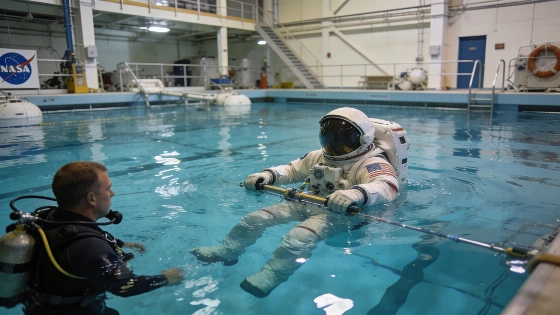
Spacewalk training moved through several pools. NASA began using neutral buoyancy for spacewalk training with Gemini XII in 1966, followed by the Water Immersion Facility in 1967. Training shifted to the Weightless Environment Training Facility in 1980. The Neutral Buoyancy Laboratory at the Sonny Carter Training Center began operations in 1997 and has supported shuttle and station training, spacesuit testing, and lunar-surface activities.
Building 9 has also adapted to new vehicles. Constructed from December 1965 through March 1967, it initially housed the Technical Services Facility. In April 1969, part of the building was converted into a simulated lunar surface with a Lunar Module mockup. Apollo 11 astronauts used the terrain to prepare for the first crewed lunar landing, and astronauts later trained with Building 9 mockups for all 135 space shuttle missions. The Space Vehicle Mockup Facility now includes training mockups of NASA's Orion spacecraft and commercial vehicles. It also houses the Active Response Gravity Offload System, known as ARGOS.
Johnson's underwater training infrastructure continues to support current spaceflight preparation. NASA reported in October 2026 that NASA astronaut Anil Menon and Canadian Space Agency astronaut Josha Kutryk trained at the Neutral Buoyancy Laboratory for a spacewalk to install roll-out solar arrays on the International Space Station. NASA mission managers had approved installation of a new array on the station's port-side truss.
Control From Houston
Construction of Building 30, home to Mission Control, began in 1963. By January 1965, controllers were monitoring uncrewed Gemini 2 and crewed Gemini 3 in a flight-following role. Houston took full control of Gemini IV in June 1965; NASA says the center has controlled every human spaceflight mission since. In 2011, the facility was renamed the Christopher C. Kraft, Jr. Mission Control Center.
Johnson's Low Earth Orbit Program covers International Space Station operations and commercial partnerships in low Earth orbit. The station's human story also includes crew traditions such as Halloween in orbit. For missions beyond low Earth orbit, Johnson houses the Moon Base Program and Orion Program. NASA's Human Health and Performance Directorate works with the Human Research Program on crew health and performance.
Johnson also hosts long-duration human-exploration research. NASA scheduled four volunteers to complete a 378-day simulated Mars mission at a facility inside the center, with their exit planned for Oct. 31, 2026. The habitat simulation examines operational and human factors relevant to extended missions away from Earth.
The Mission Control Center continues to support the space station around the clock and Artemis missions taking humans back to the Moon. Johnson's facilities have evolved from Apollo-era quarantine laboratories and lunar mockups into infrastructure for spacecraft training, spacewalk preparation, crew-health research and operations in low Earth orbit and beyond.







