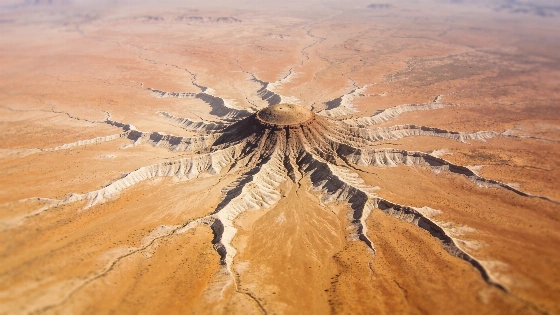
A satellite image of Western Australia's Spider Crater shows pale ridges radiating from a central dome. Geologists link the pattern to an ancient impact and evidence in shocked rock
Spider Crater looks less like a conventional impact scar than a stone spider sprawled across the remote Kimberley region of northwestern Western Australia. It is a heavily eroded remnant of an ancient impact structure: the radiating ridges are not the crater's original structure intact, but sandstone layers exposed after hundreds of millions of years of erosion.
A NASA Earth Observatory account describes the impact date as uncertain. Geological evidence from the region places the event broadly between about 900 million and 600 million years ago, in the late Precambrian. This is a regional age estimate, not a direct radiometric date of impact material.
NASA's Landsat 9 satellite captured the feature on September 20, 2026, using its Operational Land Imager (OLI). The image records the surface pattern; it does not, by itself, establish how the structure formed. The impact interpretation rests on geological evidence in the rocks as well as the landform's shape.
The full structure is oval, about 13 kilometers by 11 kilometers. Its distinctive central, spider-like portion spans roughly 4 kilometers. Light-colored sandstone ridges stand out against the surrounding terrain, tracing lines that extend from the central area. The measurements describe the overall landform, not a continuous bowl-shaped depression preserved across its full extent.
The distinction between observing terrain from orbit and working on it directly matters in planetary science. NASA's coverage of robotic lunar work concerns the latter; Landsat's image documents a terrestrial landscape from above.
Evidence of shock
For years, scientists considered a volcanic origin for the unusual formation. Field investigations instead identified shatter cones: fan-shaped fractures and grooves produced when exceptionally powerful shock waves pass through rock. Their presence throughout Spider Crater's central dome supports an impact origin, providing evidence that a satellite image alone cannot supply.
Geologists interpret the central dome as a central uplift, the raised part of an impact crater's floor formed as the ground rebounded after the initial shock. Shatter cones across this central area support that interpretation. The radiating ridges are sandstone layers that resisted erosion better than surrounding rocks in the impact zone. Erosion has shaped the feature visible today while exposing parts of the structure beneath it.
That reconstruction joins several kinds of evidence: the present-day landform, fractures identified in the field, and laboratory analysis of minerals in the sandstone. Each contributes a different constraint; none turns the visible pattern into a direct record of the impact itself.
Laboratory analyses of shocked quartz and zircon crystals from the sandstone may help researchers reconstruct the angle at which the meteorite struck. The impact angle remains an object of investigation rather than a settled measurement of the object's trajectory.
The impact's date is also unresolved. Estimates based on rocks in the region place it between about 900 million and 600 million years ago, in the late Precambrian. That broad range reflects uncertainty about when the structure formed; the Landsat image itself supplies no age measurement.
The case for an impact is supported by shock-related features in the rocks, while the age and some details of the impact remain estimates. Spider Crater's present appearance records both the original event and the long erosion that followed it.
A central uplift forms when rock displaced by an impact rebounds upward after the initial compression. In large impact structures, that movement can leave a raised central zone rather than a simple bowl. At Spider Crater, geologists interpret the radiating sandstone ridges as surviving traces of the impact structure, with erosion removing less resistant layers and leaving the spider-like pattern exposed.