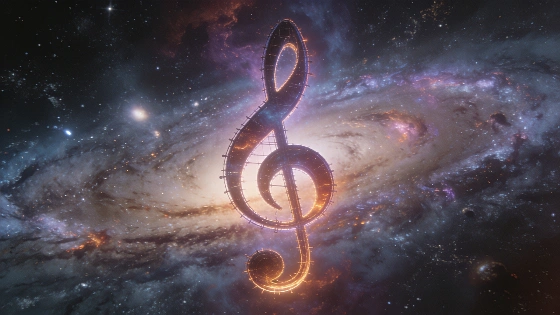
A multiwavelength view dated Oct. 14, 2026, shows the radio pattern alongside X-ray and infrared data. Chandra observations point to a black hole outburst followed by a galaxy-cluster collision
The radio structure appears in a composite view dated Oct. 14, 2026, alongside X-ray and infrared observations. Researchers interpret the pattern as the likely result of two events: an outburst from a supermassive black hole, followed by a collision between galaxy clusters. The object, catalogued as VLSS J0318.9+5755 and nicknamed the Treble Clef for its resemblance to a musical symbol, lies behind the Milky Way's disk, where stars, gas, and dust complicate observations.
A layered image
The image combines data from different parts of the electromagnetic spectrum. Its X-ray component is credited to NASA/CXC/INAF-IRA/A. Botteon et al.; UKIDSS-GPS supplied the infrared data, while ASTRON/LOFAR supplied the radio data. NASA/CXC/SAO/N. Wolk processed the image. The red Treble Clef is the distribution of radio-emitting plasma, not a visible-light outline of galaxies or hot gas.
Chandra and the German eROSITA X-ray telescope detected hot gas in the region, while infrared observations helped researchers examine the area behind the Milky Way. The wider observing set also included data from the upgraded Giant Metrewave Radio Telescope (GMRT). Together, the radio, X-ray, and infrared observations connect the radio structure with a pair of galaxy clusters in the process of merging.
Radio observations with LOFAR show a projected structure about 760 kiloparsecs across, with filaments around 8 kiloparsecs wide. Its radio spectral index exceeds 4 between 400 and 650 megahertz, a steep spectrum associated with an aged population of energetic electrons. The plasma's estimated age is about 190-200 million years.
Outburst then collision
The interpretation places the black hole outburst first. In the proposed sequence, the outburst expelled clouds of charged particles and magnetic fields at close to the speed of light. As the particles lost energy, the radio emission faded. The later collision of two galaxy clusters, which took place several hundred million years ago, may have compressed or re-energized this older plasma; shock waves from the merger could also have boosted the electrons. The clusters are now moving apart.
Researchers call the object a radio phoenix: an old radio-emitting cloud that becomes prominent again after its surrounding cluster environment compresses or re-energizes it. The study, led by Andrea Botteon of Italy's National Institute for Astrophysics (INAF), was published in Astronomy & Astrophysics. NASA's Chandra account describes the proposed history as a two-stage process.
Chandra's X-ray observations provide evidence for the cluster merger independently of the radio shape. After researchers removed a symmetrical oval component from the gas emission, the remaining X-ray glow was strongest on the left and right of the center, a pattern consistent with two components moving apart. The merger is dated broadly to several hundred million years ago; the 190-200-million-year estimate refers to the radio plasma, not the collision itself.
Galaxy images can show very different structures: Hubble's NGC 4698 view, for example, features spiral arms concentrated in an outer ring. That image offers a separate example of how observations reveal galactic structure; it does not provide evidence for the Treble Clef's origin.
What the image supports
The radio structure's steep spectrum makes the Treble Clef a promising target for future low-frequency observations, including with the LOFAR2.0 upgrade. Such observations could map variations in the age and energy of electrons across its filaments and further investigate the role of merger-driven shocks in reviving old plasma.
Radio waves are electromagnetic radiation, like visible light, but with much longer wavelengths. Radio observatories record signals that can be processed into maps of emission across the sky. In a composite image, those maps may be shown alongside observations made at other wavelengths; each layer traces different data, rather than colors a person would necessarily see with the unaided eye.