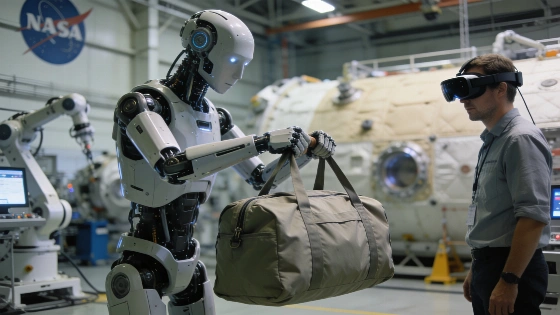
NASA's 16-member Dexterous Robotics Team is testing humanoid robots, robotic arms, and supervised autonomy for logistics, maintenance, and scientific work supporting a sustained human presence on the Moon and possible future missions to Mars.
A robotic arm that recognizes a spacecraft hatch, turns its latch, opens the door, and moves cargo bags is a practical test of NASA's lunar ambitions. At Johnson Space Center in Houston, engineers are developing machines intended to perform hand-like tasks in environments designed for people.
The test took place at the Integrated Mobile Evaluation Testbed for Robotics Operations, or iMETRO. Software developed by PickNik Inc. enabled a robotic arm to identify a hatch, grasp its handle, and transfer cargo between the hatch and a storage bin. Another project used a commercial robotic arm and camera to inspect and maintain a cold stowage freezer similar to those aboard the International Space Station.
These demonstrations do not show autonomous robots ready to run a lunar base. They show something more specific and more useful: individual hardware and software functions can be tested against physical mock-ups before NASA programs depend on them. In robotics engineering, this separation is important because perception, motion planning, grasping, and force control can fail for different reasons and must be evaluated under the physical conditions in which they will be used.
iMETRO combines open-source software and simulation tools with space vehicle and habitat mock-ups, house robots, and an outdoor rock yard. NASA describes the facility as a testbed available to agency programs and external partners for adapting terrestrial robotic technologies to human-supervised space exploration. Its intended applications include logistics, servicing, and scientific research. Users can test an entire robotic system or isolate one component, allowing engineers to identify whether a problem lies in perception, movement, control software, or the surrounding design.
The 16-member Dexterous Robotics Team sits within NASA's Robotic System Technology Branch, alongside work on mobility systems such as unmanned planetary rovers. Its members are divided broadly between mechatronics and software, but the division is porous: engineers commonly bring experience in mechanics or electronics as well as simulation and analysis. The team's work fits into a wider robotics research ecosystem that includes university laboratories and technical communities such as Carnegie Mellon University's robotics seminar program.
That combination matters because a robot working beside astronauts faces a different problem from a rover crossing terrain. The machine must operate around handles, doors, tools, storage systems, and other features built for human hands and bodies. A larger handle or better lighting may improve a robot's performance while also making the same habitat easier for people to use.
The team's stated purpose is not to replace explorers with machines. NASA team lead Shaun Azimi has framed the objective as making exploration safer and more sustainable by providing reliable robots for extreme environments. The intended division of labor leaves people responsible for decisions and activities that require human judgment while shifting hazardous, repetitive, or physically demanding tasks away from crew members.
Johnson's current work builds on two earlier humanoid projects. Robonaut 2 took part in robotics technology demonstrations aboard the International Space Station for seven years, while Valkyrie became NASA's first bipedal humanoid robot. NASA presents those programs as part of the technical heritage behind the current Dexterous Robotics Team.
Valkyrie remains a test platform rather than evidence that humanoid robots have entered routine space operations. Demonstrations such as handing a packed duffel bag to a team member are valuable because they expose the mechanical coordination required for grasping and carrying, but they do not establish long-duration reliability in lunar conditions.
The engineering challenge also extends beyond the robot itself. Habitat layouts, lighting, surfaces, storage systems, and access points all affect whether a machine can perceive objects and manipulate them. This is why the team's facility brings robot developers together with people designing lunar habitats and rovers instead of treating the robot as an isolated product.
NASA is using iMETRO for agency projects and for collaboration with external partners. The facility gives those partners concrete tasks to solve rather than asking them to guess what future space programs might require. It also lets habitat designers see which features obstruct robotic work before those features become embedded in a vehicle or outpost.
The near-term emphasis is technology for a sustained human presence on the Moon, with possible relevance to later Mars missions. NASA's September 2026 updates also describe continuing work on artificial intelligence and machine learning for lunar mapping and on tests of systems intended to support safer landings on the Moon and beyond. These activities indicate a continuing technology-development program, not a completed lunar robotic deployment.
For perspective on how space hardware can be tested through repeated physical or remote measurements rather than a single dramatic result, NASA's earlier radar coverage offers a useful contrast: iMETRO applies the same test-and-refine logic to machines intended to interact with spacecraft and habitats.
Johnson's robotics program is strongest where it stays concrete. A hatch that can be recognized and opened, a cargo bag that can be moved, and a freezer that can be inspected are measurable engineering tasks. The significance is not that humanoid robots have already transformed exploration, but that NASA is building the test infrastructure needed to discover which human environments can support them and which must be redesigned first.
Robotic performance is ultimately limited by the quality of its sensing and control. A camera supplies images, software turns those images into estimates of objects and their positions, and mechanical systems convert the estimates into force and motion. Every step introduces uncertainty, so a successful demonstration in a mock-up is evidence that a particular task can work under tested conditions rather than proof that the same behavior will remain reliable across every lunar surface, lighting condition, or maintenance problem.