Post-flight inspections found nine char-loss spots on Orion's heat shield compared with 103 on Artemis I. NASA links the smaller amount of damage to a changed reentry path, while material scans continue
Orion passed within 192 feet of its targeted entry interface before splashing down 0.59 miles from the predicted landing site off San Diego. NASA's post-flight engineering review found the spacecraft's heat shield performed in line with expectations, with substantially less cracking and char loss than on Artemis I.
Damage After Reentry
The heat shield faced extreme conditions on the return from the Moon. Orion reached 39 times the speed of sound, while temperatures outside the spacecraft exceeded 4,000 degrees Fahrenheit at their peak. The cabin stayed in the mid-70s Fahrenheit, according to NASA.
Engineers counted nine areas of char loss on the Artemis II heat shield dish, compared with 103 on Artemis I. NASA assessed that cracking and char loss together were reduced by a factor of ten. The review also found the spacecraft's aerodynamic and aerothermal performance, including its backshell protection, matched predictions based on preflight analysis and ground tests.
The comparison concerns the shield's observed condition and performance during this flight. It does not mean the surface was undamaged: engineers are still measuring how much material receded during reentry and comparing those measurements with predictions. The count of visible char-loss spots is a visual assessment; measuring the actual reduction in the shield's thickness is a separate part of the engineering work.
A Changed Reentry
The trajectory change followed NASA's investigation of the Artemis I heat shield, where engineers found unexpected cracking and loss of Avcoat after the uncrewed lunar test flight. That work included arc-jet testing of Avcoat at NASA's Ames Research Center in California's Silicon Valley to reproduce heating conditions and examine how the material behaved during lunar-speed atmospheric entry. For Artemis II, NASA shortened the maximum downrange distance Orion could travel between atmospheric entry and splashdown.
NASA's preflight analysis indicated that a shorter downrange flight would reduce the time the shield spent in the temperature range associated with the Artemis I damage. NASA attributed the roughly tenfold reduction in cracking and char loss on Artemis II to the shorter allowable downrange during entry. The reduced damage was consistent with that prediction.
The landing and entry figures also show how closely the flight tracked its targets: Orion crossed the entry interface within 192 feet of the planned point and splashed down 0.59 miles from the predicted site. Those navigation results do not by themselves explain the shield's condition; the comparison with Artemis I and the continuing material analysis address that question.
Inspection Still Underway
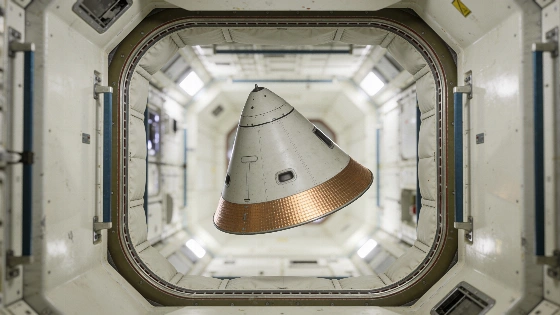
Orion's heat shield consists of 186 unique blocks of Avcoat, an ablative material designed to undergo controlled material loss during atmospheric entry. After recovery, specialists examined the shield and began extracting samples at NASA's Marshall Space Flight Center in Huntsville, Alabama. Work on internal X-ray scans began in August.
Engineers have also completed laser scans of the surface and are comparing them with preflight measurements to estimate material recession. Sample testing and thermal analysis remain underway, so the current performance assessment does not represent the end of the engineering review.
Inspection of the backshell, which is covered by 1,300 ceramic tiles, found expected performance across the crew module. Visual checks of areas around openings such as the windows and side hatch found no signs of overheating. NASA has also upgraded the Artemis III heat shield design to improve the uniformity and consistent permeability of its Avcoat blocks.
NASA says Artemis III is being prepared for a mission in low Earth orbit next year, with a rendezvous involving human lander test articles from Blue Origin and SpaceX. The agency identifies Artemis IV in 2028 as the beginning of future lunar landings. NASA's wider lunar research also includes a separate lunar materials study aimed at future habitat equipment.
An ablative shield protects a spacecraft by allowing its outer material to undergo controlled heating and material loss. Engineers assess that performance through inspection and measurements, then compare the results with predictions. For Artemis II, the reduced char loss is a clear comparison with Artemis I, while ongoing scans and sample tests will add detail about how the material behaved inside the shield.