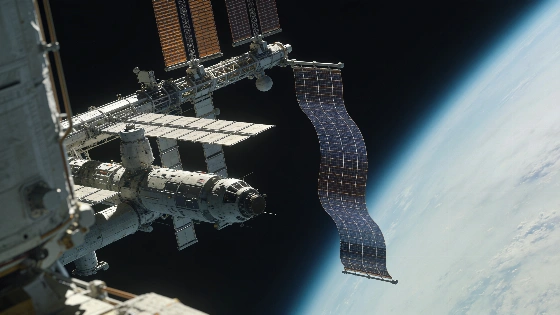
A compact array unfolds after installation outside the International Space Station. NASA says the completed eight-array upgrade will add more than 160 kW of power for the orbiting laboratory's research and operations
A compact cylinder carried to orbit can unfold into a solar panel after astronauts attach it to the International Space Station. The completed upgrade comprises eight Roll Out Solar Arrays, or IROSAs. NASA estimates the full set will add more than 160 kilowatts of electrical capacity, increasing the station's generation capability from roughly 160 kW to about 215 kW-an increase of up to 30%.
Power from orbit
Solar electricity supports the station's life-support systems and routine activities, as well as research conducted in orbit. That work includes investigations intended to improve life on Earth and help prepare for human exploration beyond low Earth orbit. NASA says the added capacity is intended to preserve power for station operations, research and its eventual controlled deorbit.
The new arrays supplement, rather than replace, the station's eight legacy solar wings, which were installed progressively from December 2000 to March 2009 along its 356-foot power truss. Long-term exposure to radiation and repeated thermal cycling has degraded the older panels' performance. Each IROSA can generate about 28 kW, according to NASA. Redwire, which built the arrays, describes each ROSA wing as providing more than 20 kW once deployed and as designed for more than 10 years of service.
A panel that unfurls
The arrays launch rolled into compact cylindrical packages. After installation, each unfurls like a yoga mat, using stored mechanical energy for deployment rather than a large motor-driven unfolding mechanism. The lightweight design reduces the mass and volume required at launch. Because the arrays can be mounted over existing solar wings, the older hardware can remain in place.
NASA tested the technology aboard the station in a 2017 demonstration. The first pair of IROSAs arrived on SpaceX's CRS-22 mission in June 2021. Another pair was delivered on CRS-26 in November 2022, followed by a third pair on CRS-28 in June 2023. Astronauts installed the first six during spacewalks, using the Canadarm2 robotic arm to position and support the hardware.
The final pair launched in the unpressurized trunk of a Dragon spacecraft on SpaceX's CRS-35 cargo mission, completing delivery of all eight arrays. Delivery and installation are separate milestones: the final two arrays are designated for power channels 2A on the port-side P4 truss and 3B on the starboard-side S6 truss. Their installation requires astronauts to attach structural support hardware known as MOD Kits before securing the arrays for deployment.
What the figures show
NASA estimates that the completed eight-array configuration will raise the station's generation capability from about 160 kW to approximately 215 kW. NASA also gives an output figure of about 28 kW for each IROSA, while Redwire describes each deployed wing as providing more than 20 kW. NASA says the eight roll-out arrays will increase available power by up to 30%.
These figures describe added generation capacity, not a measurement of electricity being produced at a particular moment. The arrays are intended to sustain electrical margins for life-support equipment, routine station operations and scientific experiments, while supporting the station's planned operational horizon and future controlled deorbit.
The station is one platform within a wider space-science program. In a separate report, Science Report examined a possible second-generation planet inferred from observations of a white dwarf, a distinct example of research based on instruments in space.
Solar arrays convert sunlight into electrical power that a spacecraft or station can use. Their output depends on the sunlight available to them, while the electrical system distributes power to onboard needs. Redwire says the six arrays already deployed have contributed to extending the useful operation of the orbiting laboratory toward 2030. The Redwire announcement describes the final pair's CRS-35 delivery as the completion of the station's power-modernization delivery campaign.