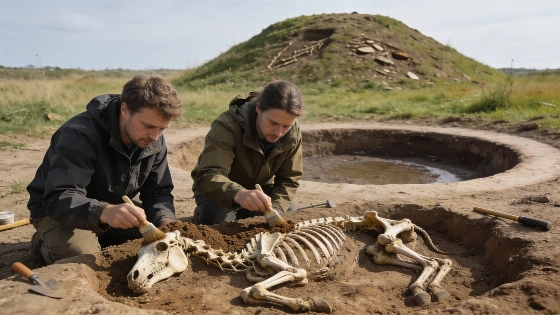
Archaeologists in Saxony-Anhalt have uncovered two young horse skeletons intentionally buried near a Late Bronze Age burial mound, offering rare evidence for the ritual deposition of valuable animals over 3,000 years ago
Archaeological excavations at Nauendorf in Saxony-Anhalt, Germany, have revealed the remains of two foals deliberately buried adjacent to a Late Bronze Age burial mound. The discovery, made during investigations preceding the SuedOstLink electricity transmission project, provides new evidence for the complex mortuary practices of prehistoric communities in central Europe.
Excavation Context
The site at Nauendorf preserves traces of settlement and funerary activity spanning the Late Bronze Age and Iron Age. Archaeologists identified the remnants of a circular ditch marking the location of a burial mound, although the mound itself had been leveled by later activity. Within the enclosure, two stone-lined rectangular graves oriented west to east were found, but both had been disturbed and largely emptied in antiquity. Only small fragments of bronze pins, a bronze ring, and pottery sherds remained, likely missed by ancient looters.
During further investigation, a deeper pit cut into the southeastern section of the ditch was excavated. Instead of human remains, the skeleton of a young horse was uncovered, lying on its right side. Expanding the excavation area revealed a second foal burial nearby, also carefully placed and aligned with the human graves. Both animals were positioned on their right sides with limbs naturally bent, and the arrangement of bones indicated that complete carcasses had been interred rather than selected body parts.
Dating and Interpretation
Radiocarbon dating of the foal remains produced calibrated ranges of 1212-1055 BCE and 1211-1052 BCE, placing both animals at the beginning of the Late Bronze Age. Osteological analysis determined that the foals were between five and nine months old at death. The burial of such young animals, especially in association with a monumental funerary structure, is highly unusual for this period and region. In one case, the hind legs of a foal were found nearly parallel, suggesting the animal may have been bound before burial, though the evidence does not establish the precise circumstances of death.
Complete horse burials from the Late Bronze Age are rare in central Europe. Previous finds in Saxony-Anhalt have included isolated horse bones or partial remains, but the Nauendorf discovery stands out for the preservation of two nearly complete juvenile skeletons associated with a single burial monument. Comparable cases from the neighboring Lusatian culture typically involve cremated horse remains placed in ceramic vessels, rather than inhumation of whole animals.
Horses and Social Status
By the Late Bronze Age, horses had acquired symbolic significance beyond their practical value as livestock. Archaeological evidence from rock art, decorated ceramics, and bronze harness fittings points to their association with mobility, wealth, and social prestige. The deliberate burial of two foals-animals with considerable future economic potential-suggests that their deposition was a meaningful act, possibly reflecting the status of the individuals originally interred beneath the mound or the importance of the funerary ritual itself.
The intentional placement and alignment of the foals with the human graves indicate a planned relationship between animal and human burial practices. However, the evidence does not establish whether the animals were killed specifically for the burial or died from other causes. The partial preservation of the skeletons, especially the skulls and long bones, is consistent with the young age of the animals and the effects of soil conditions over three millennia.
Comparative Evidence and Limitations
While horse remains are occasionally found in prehistoric funerary contexts across Europe, the Nauendorf foals represent an uncommon example of complete juvenile horse burials from the Late Bronze Age. The site adds to a growing body of evidence for the varied roles of animals in mortuary rituals, but the small sample size and disturbed context limit broader interpretation. The original human burials were heavily looted, and the absence of associated grave goods or inscriptions restricts conclusions about the identities or social roles of those interred.
Recent research in the region has highlighted the diversity of ritual and symbolic practices in prehistoric Europe. For example, the documentation of over 120 Latin inscriptions in a Roman-era cave sanctuary near Valencia, Spain, has provided new insights into cult activity and religious expression (see coverage of the Cova de les Dones inscriptions). The Nauendorf foals, while separated by more than a millennium and a different cultural context, contribute to ongoing debates about the meaning and variability of animal deposition in ancient mortuary landscapes.
One key limitation is the lack of direct evidence for the circumstances of the foals' deaths. Without clear signs of trauma or associated artifacts, it remains uncertain whether the animals were ritually killed, died naturally, or were selected for other reasons. The interpretation of ritual sacrifice must therefore remain provisional, grounded in the archaeological context rather than assumed from unusual burial alone.
Radiocarbon dating is a central method for establishing the age of archaeological finds, especially when stratigraphic context is disturbed or incomplete. The technique measures the decay of radioactive carbon-14 in organic material, such as bone collagen, and produces a date range that must be calibrated to account for fluctuations in atmospheric carbon over time. In this case, direct dating of the foal bones provided overlapping calibrated ranges, supporting their deposition during the early Late Bronze Age. However, radiocarbon dating cannot determine the exact year of burial or the specific circumstances of death, and results must be interpreted alongside archaeological and taphonomic evidence.