QuSecure's QuProtect R3 platform reached Technical Readiness Level 7 after live integration in U.S. Army tactical networks, marking a concrete step toward post-quantum cryptography in operational defense environments
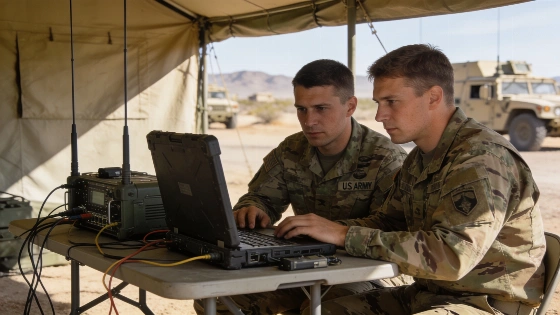
For the first time, a post-quantum cryptography platform has been integrated and operated within live U.S. Army tactical networks under field conditions, with QuSecure's QuProtect R3 system achieving Technical Readiness Level 7 (TRL-7) during Project Convergence Capstone 6 at Fort Irwin. This milestone signals that quantum-resistant cryptographic controls are no longer confined to laboratory prototypes or isolated testbeds-they are now being evaluated for real-world defense deployment.
Live Integration in Combat Environments
QuProtect R3 was embedded directly into Army-operated tactical networks during multi-domain maneuvers at the National Training Center. Unlike simulated or isolated demonstrations, this exercise subjected the platform to the operational noise, device diversity, and unpredictable conditions of active military communications. The system's ability to enforce quantum-resistant cryptographic protocols, automate the discovery of legacy or vulnerable encryption, and centralize cryptographic policy management was tested in a setting designed to reflect the complexity of modern battlefield networks.
Technical Readiness Level 7, as defined by U.S. defense standards, requires a system prototype to be demonstrated in an operational environment. For QuProtect R3, this meant not only surviving the integration process but also providing actionable cryptographic inventory and policy enforcement across live mission nodes. The platform's automated Cryptographic Bill of Materials (CBOM) function identified non-compliant algorithms, while its centralized control allowed administrators to update cryptographic standards-including NIST-approved post-quantum algorithms-without rewriting applications or disrupting mission workflows.
Benchmarks, Compliance, and Policy Deadlines
The demonstration arrives as federal agencies face binding deadlines under Executive Order 14412, which mandates migration of high-value assets to post-quantum cryptography for key establishment by the end of 2030 and for digital signatures by the end of 2031. QuProtect R3's field performance is positioned as a reference path for Department of Defense (DoD) network modernization, with the company reporting the highest score in the Post-Quantum Coalition Guide and successful maturation through the Army C5ISR Center's Small Business Innovation Research (SBIR) transition program.
Concrete figures remain limited by the classified nature of military field trials, but the company states that QuProtect R3 was deployed across enterprise, cloud, and air-gapped tactical networks, supporting cryptographic agility and zero-trust enforcement. The system's operational hardening was led by Joey Lupo and Brian Cunningham, with the platform now available for TLS modernization and cryptographic inventorying across federal and critical infrastructure sectors. This development follows earlier federal initiatives to migrate identity and financial systems to quantum-resistant standards, as reported earlier.
Technical Capabilities and Remaining Gaps
QuProtect R3's architecture is designed to allow dynamic selection and enforcement of cryptographic algorithms, including both classical and post-quantum standards, without requiring changes to existing applications. The platform's automated inventorying detects quantum-vulnerable encryption in real time, while its policy engine enables rapid response to evolving threat models. Zero-trust enforcement aims to mitigate both immediate cyber threats and the longer-term risk of "harvest now, decrypt later" attacks, in which adversaries collect encrypted data for future quantum decryption.
However, the demonstration does not establish that post-quantum cryptography is universally deployable across all military or civilian networks. The performance, interoperability, and resilience of these algorithms under sustained operational stress, especially in bandwidth-constrained or legacy environments, remain open questions. The absence of independently published technical data or peer-reviewed benchmarks limits external verification of the system's robustness and scalability. As with all cryptographic transitions, side-channel vulnerabilities, implementation errors, and supply-chain risks must be addressed before widespread adoption can be considered secure.
Operational Consequences and Industry Positioning
The Army's willingness to field-test post-quantum cryptography reflects a shift from theoretical risk assessment to practical engineering. With deadlines for quantum-resistant migration now less than five years away for key establishment, defense agencies are under pressure to validate not just algorithmic security but also the operational viability of new cryptographic infrastructure. QuSecure's TRL-7 achievement places it among the first vendors to demonstrate a deployable post-quantum solution in a defense context, but the lack of independent evaluation and the complexity of real-world integration mean that the path to full-scale adoption remains uncertain.
While the company's claims of readiness are notable, the true test will come as more agencies attempt to retrofit quantum-resistant controls into heterogeneous, legacy-heavy networks. The risk of overpromising is real: cryptographic agility and automated inventory are necessary but not sufficient for secure migration. Until independent audits and reproducible field data are available, the defense sector should treat such milestones as necessary steps rather than completed solutions. The operational field test of QuProtect R3 is a meaningful advance, but the engineering and verification challenges of post-quantum deployment are only beginning to surface.
Post-quantum cryptography refers to cryptographic algorithms designed to resist attacks from both classical and quantum computers. Unlike quantum key distribution, which relies on quantum physical effects, post-quantum algorithms are implemented in conventional hardware and software but are mathematically structured to withstand the computational capabilities of large-scale quantum computers. The transition to these algorithms is driven by the risk that future quantum processors could break widely used public-key encryption, exposing sensitive data collected today. However, the security of post-quantum algorithms depends not only on their mathematical design but also on robust implementation, careful migration planning, and ongoing evaluation as quantum hardware and cryptanalysis evolve.