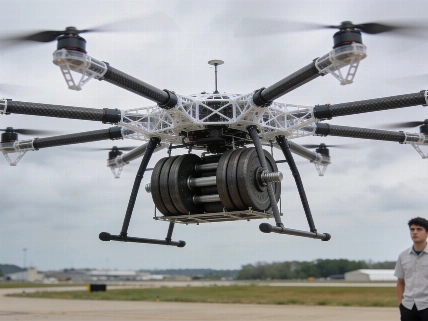
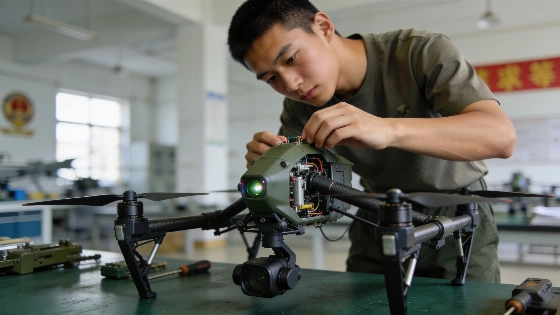
China's PLA has established new colleges for unmanned systems, artificial intelligence, engineering support and military oversight, signaling a long-term effort to turn emerging technologies into formal training and maintenance capabilities.
China's People's Liberation Army is turning drones and artificial intelligence into permanent military disciplines rather than leaving them to specialist teams. On September 30, 2026, the PLA Army Engineering University announced the creation of three new units, including the College of Unmanned and Intelligent Engineering, known in Chinese as "无人智能工程学院". The ceremony included the announcement of the order and the raising of the new college's flag.
That institutional choice matters more than the language of an "AI Army." The college is not evidence that the PLA has created an autonomous fighting force or that its systems have demonstrated battlefield superiority. It shows that Beijing wants a durable pipeline of engineers, technicians and officers able to integrate automated and networked technologies into military units.
The Army Engineering University was established in 2017 during a major military reform under Xi Jinping. Its role is to train engineering and technical specialists as well as command personnel for the ground forces. Placing an unmanned-systems college within that institution connects artificial intelligence with the less visible work that makes military technology useful: systems integration, maintenance, communications, testing and operator training.
Reports identify the other two new units at the university as the College of Combat Support Non-Commissioned Officers and the College of Equipment Support Non-Commissioned Officers. Their inclusion is significant because complex robotic systems depend on trained personnel long after procurement. The available reporting does not provide student numbers, budgets, examination results or evidence of operational deployment.
The College of Unmanned and Intelligent Engineering is expected to address drones, robotics, artificial intelligence, sensors and communications, together with the engineering required to connect those components inside operational units. In scientific terms, such systems combine perception, communications, control and decision-support layers. Failure in any one layer can compromise the whole system: a capable navigation algorithm is of limited value if a sensor is degraded, a data link is disrupted or an operator cannot interpret the system's confidence and limitations.
Modern autonomous machines also face the "sim-to-real" problem: performance in controlled training environments may not transfer reliably to dust, weather, cluttered terrain, radio interference or unfamiliar objects. Research associated with a Nature robotics study illustrates how advances in machine learning can expand robotic capability while still leaving questions about generalization, robustness and human supervision. Those scientific constraints are directly relevant to any military organization building curricula around unmanned systems.
China has used the terms "informationised" and "intelligentised" in defense policy for years. Xi has also called for broader military use of unmanned, intelligent technologies and networked information systems. The new college gives those ambitions a fixed institutional home and makes technical education part of the force's formal structure. The approach is consistent with a broader global shift in which organizations such as NASA and MIT treat human-machine coordination, reliability and system verification as central engineering problems rather than optional additions.
The practical challenge is not simply acquiring a drone or adding an algorithm. Military units need personnel who can operate equipment, interpret sensor output, maintain communications and respond when complex systems fail. They also need procedures for software updates, data management, cybersecurity and human authorization. The PLA's approach therefore treats technical competence as a manpower problem as much as a hardware problem. A similar distinction appears in earlier robotics reporting on machines whose capabilities depend on human supervision rather than independent operation.
The two new non-commissioned officer colleges address that support layer. The College of Combat Support will prepare personnel for battlefield systems, communications engineering, electronic warfare and reconnaissance. The College of Equipment Support will train technicians responsible for keeping weapons, vehicles, drones and electronics operational. The available accounts describe these as training and support functions, not as the creation of an autonomous combat arm.
Non-commissioned officers occupy a crucial position between enlisted personnel and commissioned officers. In technical forces they operate and maintain complicated equipment while translating senior commands into physical action. Their training can determine whether a sophisticated system works reliably in a unit or becomes an expensive liability that is difficult to maintain. This is especially important for robotic platforms, whose effectiveness depends on batteries, spare parts, calibration, secure links and timely repairs as much as on onboard software.
The announced institutional changes also include the College of Discipline Inspection Law and Politics at the National Defence University's Xi'an campus. Personnel trained there are expected to investigate misconduct, enforce military regulations and supervise officers. Its inclusion places corruption control, legal oversight and discipline alongside engineering and battlefield support in the PLA's wider modernization effort.
The measurable facts are institutional rather than technical: the PLA has announced new colleges at the Army Engineering University, including one focused on unmanned and intelligent engineering and two for non-commissioned-officer support training. Independent reporting confirms a profile centered on unmanned systems, artificial intelligence, robotics, sensors and communications. No drone success rate, AI benchmark, trial count, student enrollment figure or operational reliability metric has been disclosed.
That missing evidence sets the boundary of what can responsibly be claimed. The colleges demonstrate a commitment to training and organization but not the accuracy of battlefield sensing, the reliability of autonomous decisions or the quality of human oversight. They also do not establish that the PLA will replace soldiers with machines. The stated purpose is to embed skills for technologies Beijing expects to matter in future warfare.
The key concept here is institutionalization: a technology becomes a standing military capability only when people can train for it, operate it, maintain it and govern its use. A formal college can create that pipeline, but it cannot by itself prove that the resulting systems are safe, reliable or effective under combat conditions. The PLA's move is therefore best read as a serious investment in technical capacity rather than evidence of a finished AI-enabled force. That makes the schools strategically significant while leaving the decisive question unanswered: how these systems perform when conditions depart from training.