Archaeologists have recovered gold ceremonial belts, imperial coins, and a rare signet ring from a Byzantine shipwreck off Croatia's Mljet island, offering new evidence for elite travel and trade across the Adriatic in the early Middle Ages
Archaeological excavations off the Croatian island of Mljet have revealed a rare assemblage of gold regalia, coins, and luxury goods from a Byzantine shipwreck dating to the late 7th or early 8th century CE. The site, located nearly 140 meters below the Adriatic surface, preserves evidence for official travel and high-value cargo on a maritime route connecting Constantinople with northern Italy and the Adriatic coast.
Excavation and Context
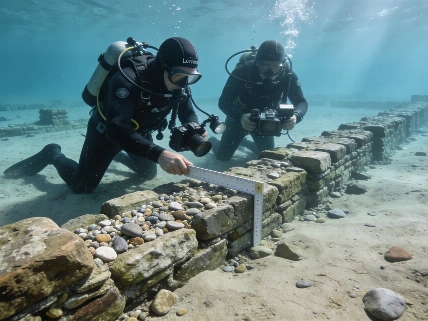
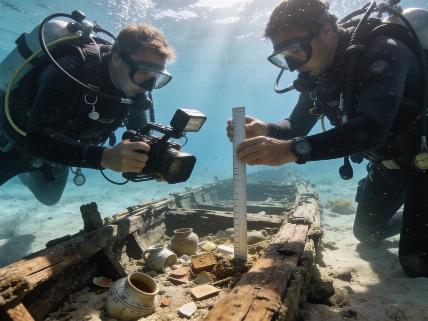
The shipwreck was first identified in 2014 during an underwater survey by the Croatian Conservation Institute. Amphorae scattered across a steep underwater slope initially signaled a Byzantine origin. Since then, annual excavation seasons have focused on detailed documentation and careful recovery, constrained by the technical challenges of deep-water archaeology and limited dive windows.
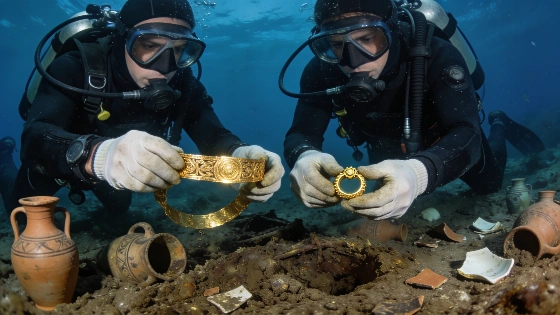
Among the most significant finds are four gold belt sets, each decorated with emeralds, rubies, and pearls, complete with ornate buckles and terminals. These belts are consistent with ceremonial dress worn by senior Byzantine officials. The recovery of such a complete set from a submerged context is unprecedented in the Mediterranean, according to the Croatian Conservation Institute's Department of Underwater Archaeology.
Imperial Artifacts and Cargo
The assemblage also includes a group of gold solidi-imperial coins-issued under four emperors of the Heraclian dynasty. These coins not only represent part of the ship's valuable cargo but also provide a numismatic basis for dating the wreck. Another notable artifact is a gold signet ring engraved with the portrait of a Heraclian emperor. Rings of this type functioned as official seals for authenticating imperial correspondence and were typically restricted to high-ranking civil or military officials.
The presence of such regalia and official insignia suggests that a senior representative of the Byzantine state may have been traveling aboard the vessel, or that these items were intended as diplomatic gifts. The ship's cargo was not limited to luxury goods: archaeologists also documented transport amphorae, ceramic bowls and jugs, merchant scales, and ivory gaming pieces, indicating a mixed cargo of commercial and elite items.
Trade, Connections, and Comparative Finds
Some artifacts from the Mljet wreck point to broader political and cultural connections. One gold belt set closely resembles an example recovered from an Avar burial on the Croatian mainland, raising the possibility of shared workshops or overlapping elite networks. This pattern of artifact circulation is consistent with evidence from other Mediterranean contexts, such as the movement of imported grave goods in pre-Roman Campania, as seen in the discovery of rare organic artifacts in a 6th-century BCE necropolis in southern Italy.
Byzantine shipwrecks from this period are rare in the Adriatic, with the only other securely dated example from the 11th century. The Mljet site therefore provides a unique opportunity to study early medieval maritime activity, elite mobility, and the movement of luxury objects across political boundaries.
Preservation, Limitations, and Ongoing Research
Excavation at the Mljet wreck is ongoing, with specialist analysis of the recovered materials expected to refine interpretations of the ship's route, cargo, and possible passengers. The depth and steepness of the site have slowed recovery and limited the number of artifacts that can be safely retrieved each season. While the gold regalia and coins are well preserved, organic materials and perishable cargo are less likely to survive in this environment, potentially biasing the archaeological record toward durable, high-status objects.
Researchers caution that, while the presence of imperial insignia and ceremonial regalia is consistent with official travel or diplomatic exchange, the evidence does not establish the identity or precise role of any individual aboard the vessel. Further analysis of the coins, belt sets, and associated finds may clarify the ship's function within Byzantine political and economic networks.
Understanding the significance of the Mljet shipwreck requires attention to the methods used for dating and contextual analysis. Numismatic evidence, such as the sequence and minting of gold solidi, provides a chronological framework, but must be interpreted alongside stratigraphic context and artifact associations. Deep-water sites like Mljet present particular challenges for archaeological recovery, preservation, and interpretation, making each season's findings provisional until further analysis is complete.