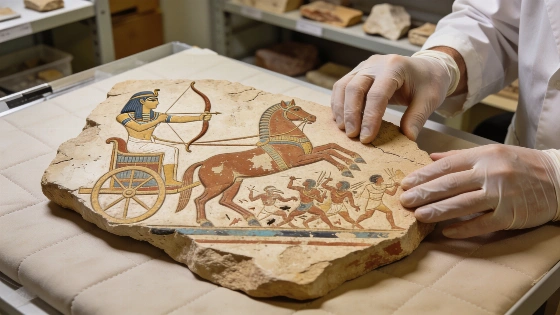
A painted sandstone relief from Luxor, created during the reign of Amenhotep II, depicts an Egyptian pharaoh defeating western Asian soldiers. Later reused in a temple foundation, the artifact offers insight into royal iconography and material reuse
An ancient painted sandstone relief fragment recovered from Luxor, Egypt, provides a rare example of royal battle iconography from the 18th Dynasty. The artifact, measuring approximately 61 by 115 centimeters, was originally crafted between 1427 and 1400 BCE, likely during the reign of Amenhotep II. Its preservation and later reuse highlight both the durability of Egyptian artistic traditions and the practical recycling of monumental materials in subsequent periods.
Discovery and Context
The relief was unearthed in 1912 by Egyptologist Herbert E. Winlock, who later served as director of the Metropolitan Museum of Art. At the time of its discovery, the block was found incorporated into the foundation of the unfinished mortuary temple of Ramesses IV, a ruler of the 20th Dynasty (1153-1147 BCE). This secondary context, several centuries after its original creation, likely contributed to the artifact's exceptional preservation, including the survival of vibrant pigments and detailed carving.
The original context of the relief is not fully reconstructable, but its iconography is consistent with large-scale scenes that once adorned temple or palace walls. The fragment depicts an Egyptian pharaoh in a chariot, armed with a bow, trampling and shooting at enemy soldiers. The upper right of the scene shows the chariot and horses, while three enemy figures are shown pierced by arrows, and another attempts to evade the oncoming horses.
Interpreting the Imagery
Analysis of the depicted enemies, including their pointed beards and distinctive clothing, suggests they represent western Asian adversaries-possibly ancient Syrians or the Hyksos, a Semitic-speaking dynasty that ruled parts of Egypt during the Second Intermediate Period. However, the relief is not a direct record of a specific historical battle. Instead, it reflects a broader tradition of portraying the pharaoh as the victorious defender of Egypt, a motif repeated throughout Egyptian monumental art.
While the scene may reference real conflicts between Egyptian rulers and Asiatic groups, the primary function of such imagery was ideological, reinforcing royal authority and divine favor. The reuse of the block in a later temple foundation demonstrates the continued value placed on these materials, both for their physical properties and their symbolic associations.
Material Evidence and Preservation
The fragment's survival is notable given the fate of many ancient Egyptian reliefs, which were often damaged, repurposed, or lost over millennia. The block's dimensions and the quality of its carving indicate it was part of a larger composition, now lost. Its preservation within the foundation of Ramesses IV's temple shielded it from weathering and human interference, allowing modern researchers to study its pigments and iconography in detail.
Comparable cases of artifact reuse have been documented elsewhere in Egypt and the wider Mediterranean. For example, the practice of incorporating earlier materials into later constructions is discussed in research on elite burial practices and trade in pre-Roman Campania, as seen in the study of an archaic necropolis in southern Italy.
Uncertainties and Limitations
Despite its excellent preservation, the relief's original architectural setting and full narrative context remain unknown. The absence of inscriptions or specific place names limits the ability to link the scene to a particular campaign or event. Attribution to Amenhotep II is based on stylistic grounds and the estimated date of production, but direct evidence is lacking. The identification of the enemies as Hyksos or Syrians is plausible but not definitive, as similar iconography was used for various foreign groups in Egyptian art.
As with many monumental fragments, interpretation is constrained by the loss of associated material and the secondary context of recovery. The relief's reuse in a later temple foundation, while aiding preservation, also removed it from its original narrative and spatial relationships.
Understanding the significance of this relief requires attention to the broader practices of Egyptian monumental art, the ideological role of royal imagery, and the complexities introduced by the reuse and movement of ancient materials.
Archaeological provenance refers to the documented origin and context of an artifact, including its location, stratigraphic association, and relationship to other finds. Secure provenance is essential for interpreting the function, meaning, and chronology of archaeological materials. When objects are recovered from secondary contexts-such as reused in later construction-their interpretive value can be reduced, as original associations and settings are lost. However, careful analysis of material, style, and comparative evidence can still yield important insights, especially when preservation is unusually good. The case of the Luxor relief fragment illustrates both the challenges and opportunities presented by artifacts with complex histories of use and deposition.