A new image from the Dark Energy Camera on the Blanco 4-meter Telescope captures the Corona Australis Molecular Cloud, highlighting both newborn stars and one of the oldest star clusters in the Milky Way
A detailed new image from the Dark Energy Camera (DECam) on the Victor M. Blanco 4-meter Telescope in Chile has captured the Corona Australis Molecular Cloud, a nearby region of active star formation, alongside a distant ancient globular cluster. The observation provides a rare view of both stellar birth and some of the oldest stars in the Milky Way within a single field.
Imaging a Stellar Nursery
The Corona Australis Molecular Cloud, located about 430 light-years from Earth in the constellation Corona Australis, is one of the closest regions where stars are actively forming. In this cold environment, with temperatures dropping to approximately -260°C, dense pockets of gas and dust collapse under gravity to ignite new stars. The DECam image reveals intricate structures, including dark dust lanes and glowing nebulae, that trace the ongoing process of stellar assembly.
On the left side of the image, the nebula NGC 6729 stands out. This region contains both a blue reflection nebula-where dust scatters starlight-and an orange emission nebula, produced when ultraviolet radiation from young stars ionizes surrounding gas. At the heart of NGC 6729 lies R Coronae Australis, a binary star system whose two stars orbit each other every 43 to 47 years, providing a dynamic laboratory for studying early stellar evolution.
Ancient Stars in the Same View
In contrast to the youthful stars of the molecular cloud, the upper right of the image features NGC 6723, a globular cluster located roughly 29,000 light-years away. Known as the Chandelier Cluster, NGC 6723 contains hundreds of thousands of stars, many of which formed more than 10 billion years ago-shortly after the Milky Way itself began to assemble. Astronomers have identified multiple populations of stars within the cluster, suggesting a complex formation history that is still being unraveled.
Both NGC 6729 and NGC 6723 are popular targets for astronomers and astrophotographers, but their location below the constellation Sagittarius means they are best observed from the Southern Hemisphere. With a sufficiently powerful backyard telescope, observers can glimpse the interplay of star formation and ancient stellar populations that the DECam image brings into sharp focus.
The Instrument Behind the Image
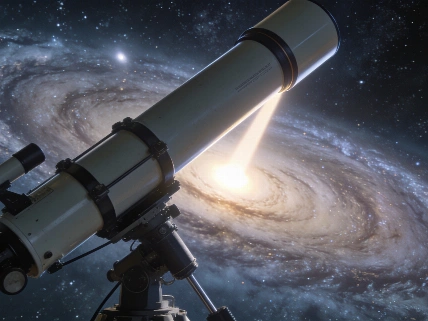
The DECam, operated by the National Science Foundation, is one of the world's most advanced wide-field astronomical cameras. Its 570-megapixel array, composed of 74 detectors and a 1-meter-wide lens, enables it to capture large swaths of the sky in remarkable detail. The instrument is designed to study dark energy by mapping the distribution of galaxies, but its sensitivity and field of view also make it ideal for imaging complex regions like Corona Australis.
Observations such as this complement other recent findings in extragalactic astronomy, including studies of how energetic outflows from supermassive black holes can drive turbulence far beyond their host galaxies, as seen in recent X-ray observations of quasar-driven winds. Together, these results help build a more complete picture of how stars and galaxies evolve across cosmic time.
Limits and Open Questions
While the DECam image provides a visually striking snapshot, it represents only a single moment in the ongoing processes of star formation and cluster evolution. The precise mechanisms that trigger the collapse of gas clouds, the role of magnetic fields, and the detailed history of globular clusters like NGC 6723 remain active areas of research. Further multi-wavelength observations and theoretical modeling will be needed to clarify how these environments shape the life cycles of stars.
Additionally, the interpretation of such images depends on careful calibration and understanding of the instrument's sensitivity, as well as the effects of interstellar dust and projection along the line of sight. As astronomers continue to refine their techniques, each new observation adds to the growing body of evidence about the structure and history of our galaxy.
To interpret images like the one produced by DECam, it is essential to understand how astronomical cameras collect and process light. Instruments such as DECam use large arrays of sensitive detectors to record photons across a range of wavelengths, often combining multiple exposures to increase signal-to-noise ratio and reveal faint structures. The resulting data must be carefully calibrated to correct for instrumental effects and atmospheric interference. By analyzing the color, brightness, and spatial distribution of features in these images, astronomers can infer the physical conditions and evolutionary history of the observed regions, while remaining mindful of the limitations imposed by projection effects and observational sensitivity.