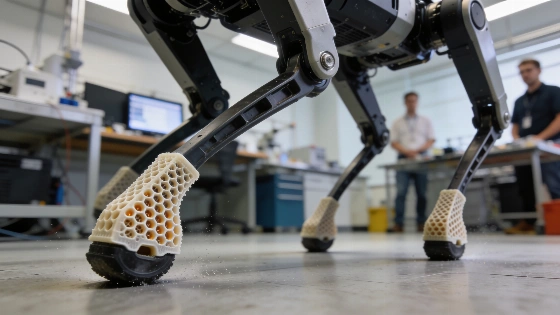
A research team at Seoul National University of Science and Technology has tested 3D-printed porous feet on a quadruped robot, reporting up to 6.2% lower battery consumption during walking tasks with a learning-based controller
Researchers at Seoul National University of Science and Technology (SEOULTECH) have developed and tested a new type of 3D-printed porous foot for quadruped robots, aiming to reduce energy consumption during walking. The design uses triply periodic minimal surface (TPMS) lattice structures, which are engineered to absorb and release impact energy as the robot moves. By integrating these feet with a deep reinforcement learning controller, the team reports a measurable reduction in battery power required for locomotion, without compromising stability.
Quadruped robots are increasingly used in industrial inspection, logistics, and search-and-rescue, but their energy demands remain a significant limitation compared to wheeled robots. Each step requires active motor control, leading to rapid battery depletion. The SEOULTECH team focused on the robot's feet-a component often overlooked in energy optimization-by replacing conventional solid or rubber feet with lightweight, porous TPMS variants. These structures are designed to deform under load, temporarily storing mechanical energy and releasing it during push-off, thereby reducing the net effort required from the robot's motors.
Mechanical Testing and Controller Integration
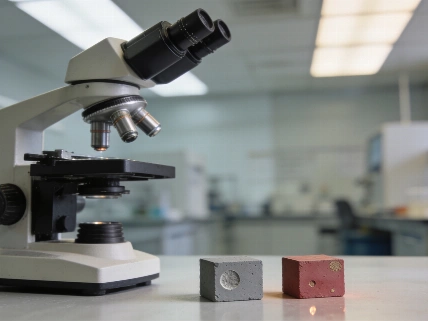
The researchers fabricated three hemispherical TPMS foot designs-primitive, gyroid, and diamond-using standard 3D printing techniques. Compression tests were conducted to evaluate their mechanical properties, including flexibility, impact absorption, and energy loss. The diamond structure with 60% relative density was identified as the most effective, balancing compliance and energy return while minimizing unwanted dissipation.
To fully utilize the elastic properties of the new feet, the team implemented a deep reinforcement learning (DRL) controller. Unlike pre-programmed gaits, the DRL system learned to coordinate motor actions with the compliant deformation and rebound of the feet, optimizing the robot's walking pattern to synchronize with the energy stored and released by the lattice structures. This approach aimed to minimize unnecessary motor work while maintaining balance and stability.
Evaluation and Results
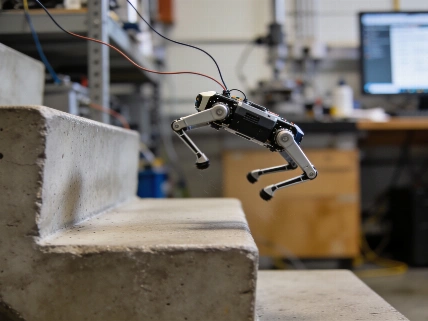
The system was evaluated on the RBQ-10 quadruped robot, a commercially available platform. Tests were conducted at walking speeds between 0.4 and 1.0 meters per second (0.9-2.2 mph). Compared to conventional solid feet, the porous TPMS feet reduced battery power consumption by 1.4% to 6.2%, depending on speed. The robot maintained stable locomotion throughout the trials, with no reported increase in corrective movements or instability. These results were achieved in controlled laboratory conditions, and independent replication has not yet been reported.
Unlike approaches that integrate springs or complex mechanisms into the robot's legs, shifting energy storage to the foot simplifies the mechanical design and may lower manufacturing costs. The use of standard 3D printing also suggests potential for rapid prototyping and adaptation to different robot models. However, the long-term durability of the porous feet under extended field use remains untested, and the reported efficiency gains are specific to the tested robot and walking speeds.
Context and Limitations
The combination of advanced lattice materials and learning-based control could offer incremental improvements in the operational efficiency of quadruped robots, particularly in applications where battery life is a critical constraint. The technology may be relevant for warehouse logistics, industrial inspection, and autonomous search-and-rescue, where extending operational time without increasing robot size or weight is a persistent engineering challenge. Related research has explored other methods for improving robot locomotion efficiency, such as predictive planning techniques for smoother movement, as seen in MIT's VLASH method (recently covered by Science Report).
It is important to note that the reported energy savings are based on laboratory tests with a specific robot and controller configuration. The results may not generalize to other robot designs, terrains, or operational environments. Further testing, including long-term durability studies and independent replication, will be necessary to establish the practical value and safety of porous TPMS feet in real-world deployments.
Reinforcement learning is a machine learning approach in which an agent-such as a robot-learns to make decisions by receiving feedback from its environment. In robotics, deep reinforcement learning can enable a controller to adapt to the physical properties of hardware, such as compliant or deformable components, by optimizing actions to maximize a defined reward (for example, energy efficiency or stability). This method differs from traditional control algorithms, which rely on fixed rules or pre-programmed gaits, and can allow robots to exploit the mechanical characteristics of new materials or structures. However, reinforcement learning in physical robots often requires careful safety constraints and extensive testing to avoid unsafe or unstable behaviors during training and deployment.