
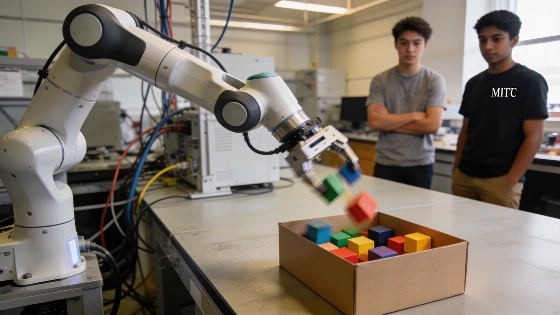
Researchers at MIT have introduced VLASH, a planning technique that lets robots predict their future positions, reducing pauses and improving speed in tasks like pick-and-place and dynamic manipulation
Researchers at the Massachusetts Institute of Technology have developed a new robot motion-planning technique, VLASH, designed to improve the speed and fluidity of robotic movements in both controlled and dynamic environments. Unlike conventional systems that plan actions based solely on a robot's current state, VLASH enables robots to estimate their near-future position and use this prediction to plan subsequent actions, reducing the delays and abrupt transitions that often limit robotic responsiveness.
VLASH operates by forecasting the robot's state after completing its current action sequence, then using this estimate to inform the next planning step. This approach is intended to address the instability and lag that can arise when robots rely on outdated sensor data or environmental observations. The method does not require additional computational resources compared to standard planning algorithms, according to the MIT team, and is compatible with existing robot control architectures.
Performance in Laboratory and Physical Tests
In a series of simulation and physical robot experiments, VLASH demonstrated measurable improvements in task speed and continuity. For pick-and-place operations, robots using VLASH completed tasks at roughly twice the speed of baseline systems, while maintaining a 90 percent accuracy rate-comparable to the best-performing conventional methods. In dynamic activities such as table tennis and Whack-a-Mole, the technique enabled robotic arms to react more quickly to changing conditions, with reported reaction speeds increasing by more than 30 times in some scenarios. These results were achieved without increasing computational overhead, suggesting that the method could be integrated into existing robotic platforms without significant hardware upgrades.
To further accelerate performance, the researchers introduced an additional method called action quantization, which groups larger chunks of movement along the same trajectory. While this approach led to a modest reduction in accuracy, it allowed robots to complete tasks two to three times faster overall. The team also developed a training-augmentation strategy that reorganizes and reuses existing training data, reducing training time by a factor of five without increasing computational demands.
Applications and Limitations
VLASH was evaluated in both simulated and real-world settings, including sorting, stacking, and rapid manipulation tasks. In one demonstration, a robot equipped with VLASH sorted colored cubes into a box at twice the speed of a baseline system, with accuracy remaining at 90 percent. The system's ability to handle rapid, unpredictable changes in the environment suggests potential applications in search-and-rescue, emergency response, and other time-sensitive domains. However, the current evidence is limited to laboratory and controlled physical tests; the method's reliability in unstructured or safety-critical environments remains to be established through further independent evaluation.
VLASH's focus on predicting near-future robot states distinguishes it from earlier approaches that rely on immediate sensor feedback or precomputed trajectories. This predictive planning is intended to reduce the lag between action segments, but it also introduces new dependencies on the accuracy of the robot's internal models and the stability of its environment. The MIT team acknowledges that while VLASH improves speed and responsiveness, there is a trade-off between acceleration and precision, particularly when using action quantization. The system's performance in highly variable or adversarial conditions has not yet been systematically tested.
Context in Robot Learning Research
The development of VLASH reflects a broader trend in robotics research toward more adaptive and anticipatory control systems. Similar efforts have focused on reducing training time and computational requirements for robots operating in unpredictable environments. For example, recent work from Georgia Tech introduced a machine-learning framework that enables a humanoid robot to walk across real-world surfaces with less training and lower computational cost, as described in this related report on efficient robot locomotion. These advances highlight the ongoing challenge of balancing speed, accuracy, and adaptability in robotic systems intended for real-world deployment.
VLASH remains a research-stage technique, with future work planned to integrate generative AI world models capable of predicting environmental changes more accurately. The potential for combining predictive planning with advanced perception and reasoning systems could expand the range of tasks robots can perform autonomously, but the safety, reliability, and oversight requirements for such systems will require careful evaluation before deployment in critical applications.
Robot motion planning is the process of determining a sequence of actions that moves a robot from its current state to a desired goal while avoiding obstacles and respecting physical constraints. Traditional planning methods often rely on the robot's current sensor readings and environment map, which can introduce delays if the environment changes or if the robot's state estimate is outdated. Predictive planning techniques like VLASH attempt to address this by estimating the robot's future state and using that information to plan ahead, potentially reducing lag and improving responsiveness. However, the effectiveness of such methods depends on the accuracy of the robot's internal models and the predictability of its environment, making robust evaluation essential for real-world use.