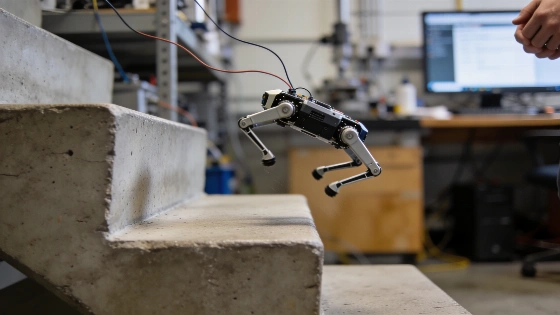
University of Washington engineers built DirectHop, a roughly one-gram robot that can hop over a stair-like obstacle, recover after landing and prepare for another jump without relying on a spring.
DirectHop can clear a standard stair step, land on its side, right itself and prepare for another jump. The palm-sized machine is not yet an independent explorer: it remains tethered to external power and cannot steer toward a destination. Announced by the University of Washington on September 23, 2026, the roughly one-gram robot addresses a basic problem in miniature robotics: how to cross obstacles without adding the weight and complexity of flight.
The prototype's most significant result is not the jump itself. By varying the electrical current delivered to its motor, the University of Washington team can set the robot's jump height with approximately one-centimeter accuracy. In reported experiments, the highest setting raised the center of mass by about 28.6 centimeters. A separate demonstration showed the robot clearing a 17-centimeter step with the help of a 45-degree inclined platform. These measurements describe laboratory demonstrations, not autonomous stair navigation.
DirectHop is an example of the kind of tightly constrained mechanical experiment also seen across research engineering at institutions such as MIT: one capability is isolated, measured and then tested against the limitations that would matter in a complete system. The work is scheduled for presentation at the IEEE/RSJ International Conference on Intelligent Robots and Systems on September 30, 2026.
Control without springs: Many small hopping robots borrow their mechanics from fleas. A spring stores energy and releases it rapidly, but the release can make jump distance difficult to regulate. Springs and mechanical latches also become more difficult to manufacture and operate as a machine shrinks.
DirectHop uses a different arrangement. A tiny electric motor is linked by fishing line to a tower mounted on the robot. As the motor accelerates, it winds the line and moves up the tower, pulling the body into the air. Three folding legs extend during the jump and help keep the motor aligned with the foot that launches the machine. The design lets the motor supply the jumping force directly rather than loading and releasing a spring, while the input current provides a direct way to vary the height.
That approach matters because a robot intended for repeated inspection cannot treat every obstacle as a one-off stunt. It needs a launch that can be adjusted, a landing it can survive and a mechanism that can reset without human handling. The University of Washington describes this as a way to avoid the added complexity associated with flight, stored-energy springs and mechanical latches.
Recovery after landing: DirectHop tends to tumble in the air, so the researchers added a roll cage that supports the machine when it lands on its side. The motor then travels back down the tower, shifting the robot's center of gravity until the body rolls onto its foot. The team reports that this self-righting maneuver succeeds 90% of the time.
That figure is useful but narrow. It describes the reported righting behavior of a prototype under the team's testing conditions, not a general reliability rate for field operations. The available description does not provide a trial count, confidence interval, range of surfaces or independent assessment of how the mechanism performs after repeated impacts. As in planetary robotics programs associated with NASA, survivability and repeatability would need to be evaluated across many more operating conditions before deployment claims could be made.
The roll cage was inspired by the shell shape of a box turtle, which can help the animal return upright. The engineering problem is more demanding than simply making a machine jump once: it combines launch control, body stability, impact tolerance and reloading for the next hop. A report in Nature would normally be expected to provide detailed methods and statistical context; the public project description instead emphasizes the prototype's design and demonstrations.
What the prototype cannot do: DirectHop is currently powered through wires and has no demonstrated ability to choose or reach a destination. It cannot yet identify a stair, calculate the required jump, align itself, land and repeat the sequence without additional hardware and control systems.
The University of Washington team is working toward onboard solar cells and a battery, a vibration motor for turning, retractable feet for changing the hop angle and a camera with electronics for navigation. Those are proposed additions to the research platform, not capabilities demonstrated by the existing prototype. The distinction is essential: a robot that can regulate a vertical hop is not automatically a robot that can navigate a building or another planet.
Readers can compare this prototype with an earlier robot report. DirectHop presents a different engineering challenge, but the same discipline applies: a controlled demonstration should be judged by what was tested and by what still requires human intervention.
Small machines in groups: The researchers estimate that a fully equipped version could cost about $10 to produce. That estimate is a target for a future configuration rather than the demonstrated cost of a deployable system. If the power, steering and navigation problems are solved, low-cost groups of these robots could be used for inspection in oil refineries, farm monitoring or exploration tasks where losing one machine would not end the mission.
That possible operating model changes the value proposition. A single robot does not need the endurance or versatility of a larger machine if a group can distribute the work and tolerate individual failures. Yet low unit cost would not remove the need for testing: tethered power, predictable surfaces and manual resets are very different from battery operation in cluttered or hazardous environments.
The numerical record is compact but concrete: DirectHop weighs about one gram, uses three folding legs, controls jump height to approximately one-centimeter accuracy and rights itself successfully 90% of the time in the reported tests. Its maximum reported center-of-mass rise is about 28.6 centimeters, and a 17-centimeter step was cleared using a 45-degree inclined platform. The planned fully equipped version is estimated at about $10, while the current prototype still relies on wired power and lacks directional steering. No battery endurance, navigation success rate or field deployment result is provided.
DirectHop is therefore best understood as a focused robotics experiment rather than a finished product. It demonstrates that direct motor-driven hopping can provide repeatable height control and that a lightweight recovery mechanism can return the robot to a launch position in many reported attempts. It does not establish autonomous inspection, planetary exploration or reliable stair climbing.
For this kind of machine, autonomy would mean more than moving without a person touching it. The robot would need to sense an obstacle, estimate its height and distance, select a launch point, control its attitude, recover after landing and handle failed attempts while carrying its own power and electronics. Until those functions are demonstrated together outside the tethered prototype, DirectHop's achievement is precise locomotion control-not independent operation.
The most important lesson is the restraint built into the result. DirectHop shows a credible route toward small hopping robots that can cross obstacles, but its present limits are decisive: no onboard power, no steering and no autonomous navigation. The University of Washington team says it has cleared the central hurdles demonstrated so far and is now pursuing autonomous power, steering and navigation. That makes DirectHop a promising mechanical platform for further testing, not evidence that inexpensive robot swarms are ready for refineries, farms or other planets.