
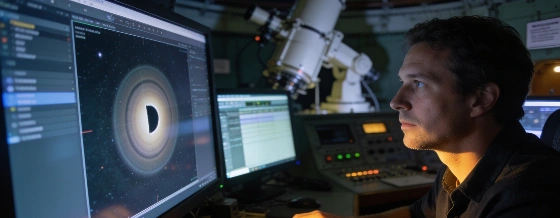
Astronomers have identified Elias 2-24 b, the youngest known exoplanet, using direct imaging techniques and archival data from the Keck Observatory. The planet is less than a million years old and still sits within its birth disk.
Astronomers have confirmed the youngest exoplanet yet found, Elias 2-24 b, by taking a fresh look at old data from the Keck Observatory. NASA estimates this planet is under a million years old, making it the youngest confirmed world so far. The team re-examined Keck data from 2018 and 2020, catching a rare glimpse of a planet in its earliest stage of development. (NASA technical briefing)
The researchers used coronagraphic observations, which block out a star's glare to reveal faint objects nearby. They focused on the star Elias 2-24, about 450 light-years away, surrounded by a thick disk of gas and dust. Earlier work with ALMA and the Very Large Telescope had spotted a gap in this disk, hinting at a possible planet. The Keck coronagraph provided the direct evidence needed to confirm a planet inside that gap.
To rule out background stars or imaging artifacts, the team combed through the Keck Observatory Archive for faint objects near seven young stars. The candidate's position stayed consistent across multiple datasets, which helped confirm it was a planet. This approach shows how valuable archival data can be for new discoveries in astronomy.
Independent estimates put Elias 2-24 b at about 54.9 ± 4.3 astronomical units from its star, sitting in a narrow gap in the protoplanetary disk. Its mass is between 1.9 and 4.0 times that of Jupiter, based on photometric data and 1 Myr isochrones. That makes it a gas giant at a very early stage. Its age-less than a million years-sets it apart from previous record holders, all of which were older than five million years. This planet offers a rare chance to study the earliest phases of planetary growth, a period usually hidden by the brightness and thickness of the surrounding disk.
The discovery combined data from several observatories, including ALMA, the Very Large Telescope, and Keck. This cross-instrument work highlights the value of collaboration and the role of major research centers like NASA and the European Southern Observatory in advancing exoplanet research.
Finding Elias 2-24 b exposes gaps in current theories of planet formation. Even the most advanced models, including those published in journals like Nature, have trouble explaining how a gas giant this size could form in under a million years. The result suggests that faster or different processes may be at work in the earliest stages of planet growth, pushing theorists to revisit their assumptions about timing and conditions.
Direct imaging of such young planets is rare, since most telescopes can't pick out faint objects hidden in bright disks. Mining archival coronagraphic data, as this team did, shows that important discoveries can still come from existing observations, especially when multiple instruments are used together.
NASA's upcoming Nancy Grace Roman Space Telescope will carry the most advanced coronagraph yet launched into space, which should improve the detection and study of young exoplanets. Elias 2-24 b was found at the edge of what current instruments can do, but future coronagraphs may reveal more planets in their earliest stages and allow closer study of their atmospheres. The Max Planck Society and other research groups are also working on new imaging techniques to further expand our understanding of how planets form.
Recent advances in disk imaging and direct detection are already changing what we know about how planets emerge from their birth environments. As reported earlier, even the earliest phases of planetary system development can leave measurable traces, challenging old ideas about the forces and timescales involved.
The discovery of Elias 2-24 b pushes the limits of current technology and shows the value of re-examining archival data. Astronomers have found a planet at a stage once thought out of reach. This result highlights the importance of direct imaging and collaboration across observatories, and points to the need for updated models that can explain rapid planet formation. As new instruments come online, the field is moving toward direct observation of planetary birth, changing how we study the origins of worlds.
Coronagraphy is a technique in astronomy that blocks a star's direct light, making it possible to spot much fainter objects-like exoplanets or disks-nearby. By using an opaque mask or advanced optics, coronagraphs cut down the star's glare so planets that would otherwise be lost in the background can be seen. This method is especially useful for studying young planetary systems, where the contrast between the star and its surroundings is extreme. The sensitivity and resolution of a coronagraph depend on the telescope's optics, the quality of the mask, and how stable the observing conditions are. As coronagraphic technology improves, astronomers expect to find and study even fainter and younger exoplanets, opening new windows on planet formation.