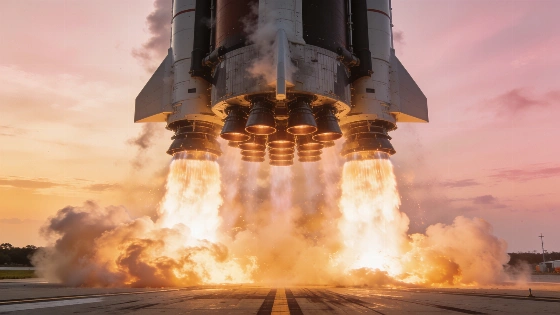
SpaceX's Falcon Heavy rocket has launched NASA's Nancy Grace Roman Space Telescope, sending the observatory on a million-mile journey to its operational orbit beyond Earth
With a surge of fire and a column of exhaust visible for kilometers, SpaceX's Falcon Heavy rocket propelled NASA's Nancy Grace Roman Space Telescope away from Earth on August 30, 2026. The launch marks a critical step for a mission designed to probe the universe's most elusive components-dark energy, dark matter, and distant exoplanets-using a next-generation space observatory.
Mission Objectives and Trajectory
The Nancy Grace Roman Space Telescope is engineered to address some of the most persistent questions in cosmology and exoplanet science. Its primary science goals include mapping the distribution of dark matter, investigating the nature of dark energy, and conducting a wide-field survey for exoplanets beyond our solar system. To maximize its observational stability and minimize interference from Earth, the spacecraft is headed for the Sun-Earth Lagrange Point 2 (L2), a gravitationally balanced region approximately 1.5 million kilometers from Earth. This location is shared by other major observatories, including the James Webb Space Telescope, and allows for continuous, unobstructed views of the cosmos.
Falcon Heavy's role was to deliver Roman to a precise trajectory toward L2. The rocket's three boosters, each powered by nine Merlin engines, generated more than 22 meganewtons of thrust at liftoff-enough to lift the 4,200-kilogram observatory and its support module beyond low Earth orbit. The launch was conducted from Kennedy Space Center, with all major milestones, including stage separation and payload deployment, confirmed by mission controllers.
Engineering and Launch Performance
Falcon Heavy is currently the most powerful operational rocket in the commercial sector, capable of delivering large payloads to high-energy orbits. Its configuration-three Falcon 9 cores joined side by side-enables it to transport scientific instruments that exceed the mass or volume limits of single-booster rockets. The 27 Merlin engines ignited in unison, producing a visually striking display as the vehicle cleared the pad. The launch vehicle's performance was closely monitored, with telemetry confirming nominal operation throughout ascent and payload separation.
SpaceX reserves Falcon Heavy for missions requiring exceptional lift capacity or complex trajectories. Previous missions have included the Europa Clipper spacecraft, the Psyche asteroid probe, and a demonstration flight carrying a Tesla Roadster. The Roman launch further demonstrates the rocket's reliability for high-value scientific payloads, though each mission's requirements are tailored to the specific mass, destination, and operational constraints of the spacecraft involved.
Commissioning and Scientific Prospects
Following separation from Falcon Heavy, the Roman Space Telescope began its cruise phase toward L2. The spacecraft will spend several months in commissioning, during which its instruments will be powered on, calibrated, and tested for performance. Only after this phase will routine science operations commence. Roman's wide-field instrument is designed to capture images and spectra across large swaths of sky, enabling statistical studies of galaxy clustering, gravitational lensing, and the search for exoplanets via microlensing events.
While the launch and initial deployment have proceeded as planned, the mission's scientific return will depend on the successful completion of commissioning and the long-term stability of its instruments. The Roman mission is expected to complement data from other observatories, such as those highlighted in reported earlier, by providing wide-field context and statistical power to studies of cosmic structure and evolution.
Limits and Remaining Uncertainties
Although the launch represents a major milestone, Roman's scientific impact will only be realized after its instruments are fully operational and its data are validated. The L2 environment offers thermal and observational advantages, but also presents challenges in terms of communication latency and the inability to service the spacecraft directly. Instrument calibration, detector stability, and data processing pipelines will all require careful verification before the mission's primary science goals can be addressed.
As with all space observatories, Roman's measurements will be subject to systematic uncertainties, including those arising from detector noise, cosmic ray hits, and calibration drift over time. The mission's ability to constrain dark energy and dark matter models will depend on the precision and accuracy of its wide-field surveys, as well as the integration of its results with complementary datasets from ground-based and space-based telescopes.
SpaceX's successful delivery of the Roman Space Telescope to its transfer orbit underscores the growing role of commercial launch providers in enabling ambitious scientific missions. However, the true test for Roman will come not from its launch, but from its ability to deliver robust, reproducible measurements that advance our understanding of the universe's most fundamental components. The mission's progress will be closely watched by the astrophysics community, with its ultimate value determined by the quality and reliability of the data it returns.
To understand why Lagrange Point 2 is favored for deep-space observatories, it helps to consider the gravitational dynamics involved. L2 is a location where the combined gravitational pull of the Earth and Sun allows a spacecraft to maintain a stable position relative to both bodies, minimizing fuel use for station-keeping. This stability, combined with a clear line of sight away from Earth's heat and light, makes L2 ideal for sensitive astronomical observations. However, the remoteness of L2 also means that any technical issue must be resolved remotely, placing a premium on robust engineering and autonomous fault management.