
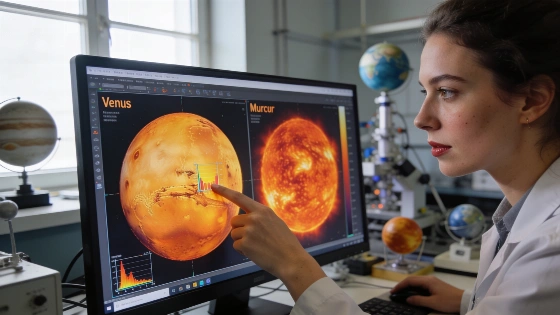
Venus's surface is hotter than Mercury's, despite being farther from the Sun. The reason lies in Venus's thick, heat-trapping atmosphere-not its distance from our star.
Venus has the highest surface temperature of any planet in the Solar System. NASA measurements put the average at about 467 °C (872 °F). This is surprising, since Venus orbits roughly 50 million kilometers farther from the Sun than Mercury does. The explanation isn't about distance, but about how each planet's atmosphere handles heat, as NASA's research shows (official Venus facts).
Atmospheric differences
Mercury, closest to the Sun, gets the most direct sunlight but has almost no atmosphere. Its thin exosphere lets solar energy hit the surface directly, heating the sunlit side up to about 430 °C (800 °F). But with nothing to trap the heat, temperatures drop fast after sunset, plunging to -180 °C (-290 °F) at night. This means Mercury's surface swings more than 600 °C between day and night, as confirmed by NASA and Britannica data.
Venus is different. Its atmosphere is thick-mostly carbon dioxide-and the surface pressure is about 93 times higher than Earth's (around 95 bar). This dense layer acts like a thermal blanket, trapping heat and keeping surface temperatures steady, day or night, across the whole planet. Both NASA and the European Space Agency point to Venus's carbon dioxide-rich atmosphere and its clouds of sulfuric acid as the main reasons for this heat trap.
The greenhouse effect at work
Venus's heat comes from the greenhouse effect. Sunlight, mostly visible and near-infrared, passes through the planet's thick clouds. Only about 3 percent of that energy reaches the surface, since the clouds reflect most sunlight back into space. The energy that does make it to the ground is absorbed and then re-emitted as infrared radiation.
Carbon dioxide in the atmosphere absorbs and re-radiates this infrared energy, trapping it and causing heat to cycle between the surface and lower atmosphere. This creates a planet-wide thermal blanket that keeps Venus extremely hot. Without this dense atmosphere, Venus would actually be cooler than Mercury, given its distance from the Sun and its reflective clouds. Studies in journals like Nature have explored how this runaway greenhouse effect works on Venus.
How Venus got this way
Venus's extreme greenhouse effect is tied to its geological past. Surface mapping and atmospheric studies suggest that volcanic and tectonic activity released huge amounts of greenhouse gases over time. This likely pushed Venus into a state where heat retention became self-sustaining, even without ongoing volcanic eruptions.
Venus's current climate is the result of a long period of atmospheric change. Its thick carbon dioxide atmosphere and reflective clouds are the legacy of these geological processes. Mercury, on the other hand, lost any early atmosphere it might have had. Its low gravity and closeness to the Sun let solar wind strip away gases. For more on Mercury's surface and history, see this detailed breakdown.
What the numbers show
Spacecraft and remote sensing have nailed down the key facts: Venus's surface averages about 467 °C, while Mercury's hottest days reach around 430 °C. Venus gets only about 29 percent as much sunlight as Mercury, but its atmosphere traps heat far more efficiently. The combination of high surface pressure, lots of greenhouse gases, and thick clouds keeps Venus hot and stable-something Mercury can't match without an insulating atmosphere. These findings come from NASA, ESA, and published comparative studies.
All this shows that a planet's temperature depends on more than just its distance from the Sun. Atmospheric makeup, pressure, and geological history matter just as much. Venus and Mercury prove that being closer to a star isn't the only factor in planetary heat. In Venus's case, it's the atmosphere-not solar distance-that makes it the hottest planet in the Solar System.