A carbon-capture system designed for future Mars resource harvesting is now helping breweries and other industries recover and purify carbon dioxide amid shortages and volatile supply.
A carbon dioxide shortage in 2021 threatened to disrupt Maine Beer Company's tank operations, bottling, kegging and centrifuge work. The brewery found an answer in technology first developed for a very different environment: NASA-backed systems intended to extract useful resources from the atmosphere of Mars.
The link between a Martian atmosphere and a brewing facility is chemical rather than geographical. NASA-funded work explored compact automated systems that could capture carbon dioxide and combine it with hydrogen to produce water for life support and methane for rocket fuel. Those same design principles could be rearranged to recover carbon dioxide generated during brewing and purify it for carbonation. An overview of this technology-transfer pathway appears in the NASA technology-transfer archive.
The technology emerged from Small Business Innovation Research contracts awarded by Johnson Space Center in Houston to Pioneer Astronautics beginning in the 1990s. Pioneer founder Robert Zubrin later created Pioneer Energy and adapted the underlying subsystems for oil and gas applications before the approach was applied to brewing. The work illustrates a recurring NASA engineering pattern: systems designed for extreme environments can become useful when their core functions-separation, purification and automated control-are matched to an Earth-based industrial problem.
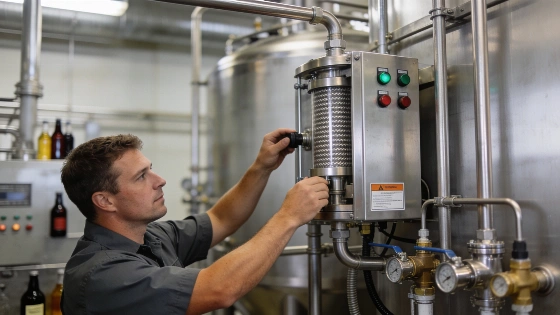
By 2015 the Craft Brewery Recovery System was already in production. The technology was later offered for licensing, while Earthly Labs, founded by Amy George in Austin in 2016, developed a small-scale carbon-capture system based on the same logic. In practical terms, the equipment treats carbon dioxide from fermentation as a recoverable process stream rather than a material that must simply be replaced with purchased gas.
Maine Beer Company turned to the technology after its carbon dioxide supplier ran short. Dave Love, the brewery's sustainability manager, described the operational risk: beer could potentially go stale in the tanks, and the brewery could lose the ability to use carbon dioxide for bottling, kegging or centrifuge operations. Recovering the gas on site gave the company a way to reduce dependence on an external supply during a disruption.
The pressure did not end with that incident. Earthly Labs identified shortages and supply volatility, including pandemic-related disruptions, as major drivers of interest in local carbon dioxide recovery. For breweries the practical value is direct: gas produced during fermentation can be captured, purified and returned for carbonation. The approach does not eliminate the need for quality control; food-grade reuse still depends on purification, monitoring and equipment designed for the relevant contaminants.
The episode fits a wider NASA pattern in which systems designed for spaceflight find terrestrial uses. Science Report has also followed NASA hardware moving toward scientific deployment in a gamma-ray instrument update, although the carbon-capture story concerns industrial adaptation rather than a space mission. In the broader scientific-technology landscape, the distinction resembles the translational logic often discussed in Nature: an engineering concept can move between fields, but its performance must still be evaluated in each new operating environment.
Earthly Labs expanded the system into wineries and distilleries before finding applications in other sectors. Energy companies can capture carbon dioxide produced as a by-product and sell it. Helium producers face a different separation problem: underground helium deposits occur mixed with gases including methane and carbon dioxide, so recovery equipment can help isolate the valuable helium stream. These applications share a common principle but do not imply identical equipment, gas purity requirements or economics.
In 2021 Chart Industries acquired Earthly Labs. Chart specializes in cryogenic equipment engineering, and NASA has indicated that the acquisition helped scale the technology for larger uses, including power plants. The reported applications therefore extend from small industrial facilities to larger energy operations without changing the core task: separating and purifying carbon dioxide from a process stream.
This is not evidence that Mars resource production is ready for deployment. The terrestrial systems use an engineering concept developed for a future planetary environment, but breweries and power plants operate under Earth conditions with different gas streams, infrastructure and commercial requirements. The documented achievement is technology transfer: compact automated resource-processing subsystems designed for Mars now support carbon dioxide recovery on Earth.
The strongest case is economic and operational rather than planetary. Maine Beer Company's shortage showed how an interrupted external supply could threaten routine production, while Earthly Labs' expansion demonstrates that recovered carbon dioxide has value across several industries. Chart's acquisition adds industrial scale, but the available account does not provide performance figures, emissions totals or cost comparisons, so the size of the environmental benefit cannot be quantified here.
That limitation matters. Capturing carbon dioxide for reuse can reduce the need to purchase externally supplied gas, but this account does not establish a complete life-cycle emissions balance for any application. What it does establish is more precise and more useful: NASA-funded Mars engineering produced subsystems that companies subsequently repurposed for real-world gas recovery, turning a resource challenge imagined for another planet into equipment with practical value on this one.