Hardspace: Shipbreaker turns derelict spacecraft into profitable scrap, but ESA's ClearSpace-1 shows why real debris removal must avoid fragmentation, stabilize tumbling targets, and control reentry
In Hardspace: Shipbreaker, the central challenge is turning a dead spacecraft into valuable material without being crushed, electrocuted, or losing money. Real debris removal begins with a more restrictive rule: do not break the target apart. The reason is physical rather than bureaucratic. A fragment created in orbit can remain a hazard for years, moving fast enough to damage an operational spacecraft.
Demolition is the danger
Games such as Hardspace: Shipbreaker and ΔV: Rings of Saturn make orbital salvage engaging by treating structures as collections of detachable parts. Lasers, explosives, cutting tools, and careful movement allow players to convert a large object into manageable pieces. Those mechanics reflect some real problems, including inertia, momentum, limited maneuverability, and the difficulty of working around a rotating object. They reverse the priority of an actual debris-removal mission, however.
Cutting or detonating a defunct satellite can produce a cloud of fragments with a wide range of sizes and velocities. The smallest pieces may be difficult or impossible to track while still carrying enough kinetic energy to damage spacecraft. A collision can then create more fragments, increasing the possibility of a cascading sequence known as the Kessler syndrome. For active debris removal, the safest target is therefore not a convenient pile of parts but an intact object whose motion and structure can be understood.
That principle also explains why a salvage economy remains largely fictional. Current missions are intended primarily to reduce the chance of future collisions and preserve access to useful orbital regions, not to generate profit from recovered metal. The policy challenge is linked to the wider regulation of launch and reentry activity, including debates over whether faster commercial operations should receive more limited environmental review.
Capture before disposal
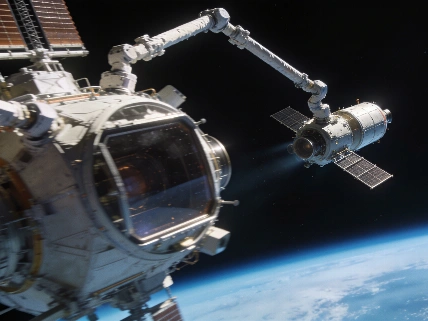
ClearSpace-1, developed for the European Space Agency, is designed to remove PROBA-1 from low-Earth orbit without first dismantling it. The servicer would be launched into an orbit slightly below the target, complete commissioning, and then perform a series of fly-around maneuvers. These passes provide more than a visual inspection: they help validate navigation systems and characterize how the client satellite is tumbling.
The capture system is intended to surround PROBA-1 with an enclosure before closing around it. This cage-like approach is meant to limit contact forces and prevent the target from being damaged during capture. Once the two spacecraft are secured, the combined system must be stabilized before it changes orbit. That sequence is closer to a controlled extraction than to a scrapyard operation.
The final objective is disposal through atmospheric reentry. ClearSpace-1 is designed to lower the orbit of the combined spacecraft so that both objects are destroyed in the atmosphere, while the servicer itself is also designed to demise during reentry. This is not the same as recovering material for reuse: the immediate engineering goal is to remove a collision risk without transferring that risk into a new orbit.
What games get right
The simulations are more accurate when they focus on motion. In orbit, a vehicle does not simply move toward a target and stop. It must match the target's position, velocity, rotation, and orientation while accounting for limited propellant and delayed measurements. A small velocity mismatch can cause a missed capture or an impact with the very object the mission is meant to secure.
Tumbling targets are especially demanding. A future servicer must synchronize its motion with several axes of rotation, then apply control inputs that reduce the target's spin without causing an uncontrolled separation. Navigation systems must also distinguish the target's movement from the servicer's own motion. These are the same practical constraints that make rotating components and drifting debris hazardous in Shipbreaker, even though the game allows far greater freedom to improvise.
Specialization is another point of contact. There is no universal orbital tool that works equally well on every dead spacecraft. Robotic arms, nets, harpoons, and enclosing mechanisms each impose different requirements on the target's shape, mass, attachment points, and rotation. A capture system must be designed around the specific object, rather than chosen from a general-purpose salvage inventory.
Orbit sets the rules
The largest difference between fiction and mission planning is the tolerance for failure. In a game, a failed cut can be retried. In orbit, debris travels at roughly 7-8 kilometers per second, so a single mistake can create a long-lived hazard field. That risk makes inspection, navigation, stabilization, and contact management central mission activities rather than preparation for the exciting part.
Disposal also depends on the orbital regime. In low-Earth orbit, lowering an object's altitude can eventually bring it into the atmosphere, where it burns up. In geostationary orbit, or GEO, reentry generally requires too much energy to be practical. End-of-life spacecraft are instead moved to a higher graveyard orbit, separating them from the heavily used operational region without eliminating the object.
Future missions are likely to use different architectures for these environments. Low-Earth orbit favors agile vehicles capable of repeated rendezvous and stabilization maneuvers. GEO servicing may involve larger spacecraft conducting slower, longer-duration relocation or maintenance operations. Across both regimes, autonomy and precision matter more than cutting power. The mission succeeds when the object remains controlled from approach through disposal.
Space salvage games make orbital work look like industrial labor because that is a clear and satisfying way to express risk, skill, and progression. Real debris removal is less permissive but more consequential. It treats every fragment as a potential future collision source, and its success is measured not by the value extracted from a spacecraft but by whether the orbital environment is left safer than it was before.
Orbital mechanics is the key concept behind this difference. A spacecraft in orbit is continuously falling around Earth, and changing its path requires a carefully timed change in velocity rather than a simple push toward a destination. Rendezvous therefore means matching position and velocity before matching rotation and orientation. The same principles govern a capture vehicle, a tumbling satellite, and the fragments that debris-removal missions are designed to prevent.