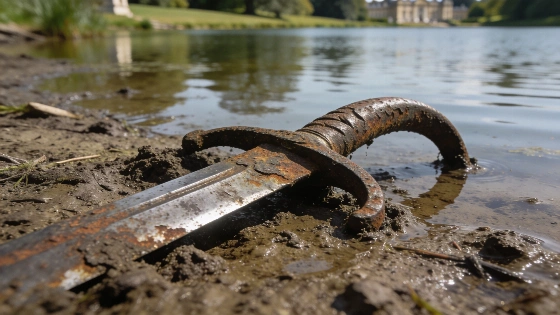
A heavily corroded sword, likely dating to the early 19th century, has been recovered from the receding waters of Chiddingstone Castle's lake in Kent, raising questions about its origin and deposition
Unusually low water levels at Chiddingstone Castle in Kent have revealed a corroded sword, believed to be around 200 years old, embedded in the mud at the edge of the estate's ornamental lake. The find was made by volunteers clearing debris after a period of prolonged drought, which has affected much of southern England and exposed previously submerged features.
Discovery and Condition
The sword was identified when a blade was seen protruding from the waterline during routine maintenance. Upon recovery, the artifact was found to have a curved, chipped, and heavily rusted blade, with a gilded hilt-possibly brass-decorated with a lion motif. The object's advanced corrosion and fragility have limited direct handling, and it is currently undergoing further examination to assess its age, material composition, and potential provenance.
Preliminary assessment by Chiddingstone Castle's curator suggests the sword may be a Victorian bandsman's sword, a type associated with military musicians in the early 19th century. However, the precise date and context remain uncertain, as the lake itself was constructed in the 19th century and the castle grounds have seen multiple phases of occupation and use.
Context and Uncertainty
The circumstances leading to the sword's deposition in the lake are unclear. Several scenarios are under consideration, including accidental loss, deliberate disposal, or association with military activity. The castle's last private owner, Denys Eyre Bower, was known to collect swords, but there is no record linking this specific artifact to his collection. Other possibilities include its connection to the Streatfeild family, who lived at the site in the 1800s, or to troops stationed in the area during World War Two.
Environmental factors played a key role in the find. The summer's exceptional dryness led to Kent and neighboring counties being declared in drought status, with July marking the driest month since records began in 1836. As water levels dropped, the lake's margins became accessible for the first time in decades, enabling the recovery of the sword and prompting renewed interest in the site's archaeological potential.
Material Evidence and Interpretation
The sword's design and decorative elements are consistent with early 19th-century military bandsman's swords, but without secure archaeological context or direct dating, its attribution remains provisional. The lack of associated artifacts or stratigraphic information complicates efforts to reconstruct its deposition history. Conservation challenges are significant, as the prolonged submersion and subsequent exposure have left the metal highly unstable.
Comparable finds from other British sites have sometimes been linked to ceremonial or symbolic deposition, but accidental loss and later disturbance are also common explanations for isolated weapons in waterlogged contexts. The Chiddingstone Castle sword joins a growing list of artifacts revealed by environmental change, echoing discoveries such as the Aspendos grave in Turkey, where drought conditions similarly exposed archaeological material (see related reporting).
Preservation and Future Research
Specialists are now assessing the sword's conservation needs and exploring non-invasive analytical techniques to clarify its composition and manufacturing method. Any attempt at restoration will require careful stabilization to prevent further deterioration. The find has also prompted a review of the lake's margins for additional artifacts, though no further significant material has yet been reported.
While the sword's presence in the lake remains unexplained, its recovery highlights the role of environmental change in revealing archaeological evidence. The case also underscores the interpretive limitations imposed by isolated finds lacking secure context, and the importance of integrating conservation, analytical, and historical approaches in artifact study.
Archaeological provenance refers to the documented origin and context of an artifact, including its precise location, stratigraphic association, and relationship to other finds. Secure provenance is essential for interpreting how, when, and why an object was deposited. Artifacts recovered without clear context-such as those found in secondary deposits or exposed by environmental change-can be authentic but often lack the information needed to reconstruct their original use or significance. This limitation affects the strength of historical and cultural interpretations, making careful documentation and, where possible, contextual analysis critical in archaeological research.