Vexlum has established a dedicated R&D laboratory in London to advance high-power semiconductor lasers for quantum computing and precision measurement, appointing Dr. Stefan Truppe as Managing Director of Vexlum UK
Vexlum, a developer of high-power semiconductor lasers spun out from Tampere University in Finland, has announced the launch of a dedicated research and development laboratory in London. The new facility marks the company's first permanent technical presence in the United Kingdom and is intended to support the growing demand for advanced laser systems in quantum computing and precision measurement. Dr. Stefan Truppe, an Associate Professor in the Department of Physics at Imperial College London, has been appointed as Managing Director of Vexlum UK and will lead the laboratory's technical and strategic direction.
Vertical-External-Cavity Lasers
The core technology at the center of Vexlum's expansion is the Vertical-External-Cavity Surface-Emitting Laser (VECSEL), a semiconductor-based platform capable of producing high-power, single-frequency laser output across visible and deep-ultraviolet (UV) wavelengths. VECSELs are valued in quantum science for their ability to deliver stable, narrow-linewidth light sources that can be tuned to the specific atomic transitions required for neutral-atom and trapped-ion quantum computing architectures. The company's flagship VXL laser system is designed as a compact, two-liter engine intended to replace larger optical instrumentation racks, offering a more integrated solution for laboratory and prototype quantum devices.
Laboratory Capabilities and Engineering Support
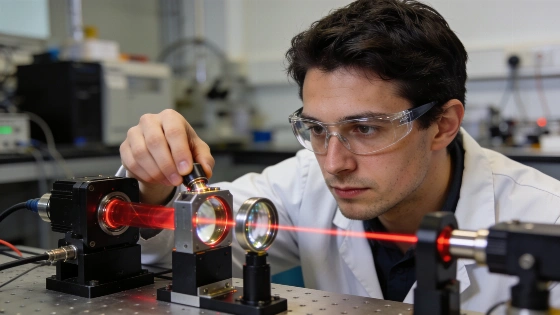
The London laboratory is equipped for laser testing, configuration, and technical validation, enabling Vexlum to provide localized engineering support and collaborate on joint product development with UK-based research groups. This move shifts the company's UK operations from a sales-focused presence to a technical hub capable of supporting experimental integration and troubleshooting. The facility is positioned to contribute directly to the UK's £2.5 billion National Quantum Strategy, which aims to accelerate the development and deployment of quantum technologies across computing, sensing, and metrology.
Technical Leadership and Quantum Applications
Dr. Stefan Truppe brings expertise in deep-UV laser cooling of atomic gases and diatomic molecules, a field that underpins many of the most demanding requirements for quantum control and measurement. His dual role at Imperial College London and Vexlum UK is expected to strengthen links between academic research and industrial development, particularly in efforts to address laser infrastructure bottlenecks that limit the scaling of quantum processing units (QPUs) and quantum sensors. Vexlum will continue to manufacture its semiconductor wafers and primary laser systems at its Finnish facilities, while the London site will focus on system validation and application-specific customization.
Integration with Quantum Research Ecosystem
The establishment of a technical laboratory in London reflects a broader trend of embedding advanced photonics and laser engineering within national quantum programs. As quantum computing hardware matures, the need for reliable, high-power, and wavelength-flexible laser sources has become a critical engineering constraint. Vexlum's approach is to provide modular, scalable laser engines that can be adapted to the requirements of different quantum platforms, including neutral-atom arrays, trapped-ion systems, and ultracold matter experiments. This mirrors the integration strategies seen in other quantum hardware sectors, such as the recent acquisition of HRL Laboratories by IBM to combine silicon-spin qubit expertise with superconducting quantum hardware, as discussed in Science Report's coverage of IBM's quantum hardware expansion.
According to company statements, the London laboratory will not replace Vexlum's core manufacturing in Finland but will serve as a technical interface for UK and European research partners. The company has not disclosed detailed performance metrics for the new facility, but the VXL platform is reported to deliver high output power with narrow linewidths suitable for quantum state preparation and measurement. The extent to which these systems can be integrated into large-scale quantum processors or deployed in field-ready quantum sensors will depend on ongoing engineering validation and reproducibility across different experimental setups.
In quantum computing and sensing, the performance of the laser system directly affects the fidelity of quantum state preparation, gate operations, and measurement. Key parameters include output power, wavelength stability, linewidth, and noise characteristics. For example, neutral-atom quantum processors typically require laser sources with linewidths below 100 kHz and output powers in the multi-watt range, while deep-UV applications for molecular cooling may demand even tighter spectral control. The ability to deliver these specifications reliably and reproducibly is a central challenge for any laser supplier targeting the quantum technology sector.
Vexlum's expansion into the UK is part of a wider effort to address the technical bottlenecks that currently limit the scalability and practical deployment of quantum devices. While the company positions its VECSEL-based systems as a solution to the complexity and footprint of traditional optical racks, the long-term impact will depend on the systems' performance in real-world quantum experiments and their compatibility with evolving quantum hardware standards.
Laser systems are a foundational component of many quantum technologies, providing the precise optical control needed for state initialization, manipulation, and readout. In quantum computing, the stability and spectral purity of the laser source set limits on gate fidelity and error rates, while in quantum sensing and metrology, laser noise and drift can constrain measurement precision. Engineering advances in semiconductor laser design, such as those pursued by Vexlum, aim to deliver higher power, narrower linewidths, and improved tunability in more compact and robust packages. However, the transition from laboratory demonstration to scalable, field-deployable systems remains a significant engineering and manufacturing challenge, requiring close collaboration between device developers, system integrators, and end users.