Researchers have modeled how certain white dwarfs feeding on companion stars can collapse into neutron stars if their mass and accretion rate fall within a narrow range, revealing a rare but physically distinct pathway for stellar evolution.
Neutron stars, some of the densest objects in the universe, are usually thought to form from the violent deaths of massive stars. But there is another, much rarer route: a white dwarf can collapse into a neutron star if it steadily pulls in enough material from a companion. New simulations from a team at ETH Zurich now clarify exactly when and how this transformation, called accretion-induced collapse (AIC), can happen.
How white dwarfs collapse
White dwarfs are the compact remnants left after stars like the Sun run out of fuel. Most are made of carbon and oxygen, but a smaller group forms with cores of oxygen, neon, and magnesium. According to the ETH Zurich study, only these oxygen-neon-magnesium white dwarfs can undergo AIC. Carbon-oxygen white dwarfs, by contrast, tend to explode as supernovae if they gain too much mass. The team confirmed this distinction through detailed simulations, in line with earlier results published in Nature.
For AIC to occur, the white dwarf must orbit close to another star and draw in material at just the right rate. If the flow is too slow, nova eruptions blow away the extra mass. If it's too fast, the system becomes unstable and collapse is prevented. Only within a narrow range can the white dwarf approach the Chandrasekhar limit-about 1.4 times the mass of the Sun-without being destroyed in a supernova. The collapse itself is triggered when electrons are captured by neon and magnesium nuclei, removing the pressure that holds the star up and causing it to implode into a neutron star.
What the simulations show
The models suggest that accretion-induced collapse is rare, but the exact frequency is still unknown. The resulting neutron stars are expected to have masses close to the Chandrasekhar limit, typically between 1.1 and 1.4 times the mass of the Sun, as reported by Mixvale and consistent with theoretical predictions from the Max Planck Society. However, neutron stars formed from regular supernovae can also fall in this range, so mass alone doesn't reveal their origin. This makes it difficult for astronomers to pick out AIC events among the wider neutron star population.
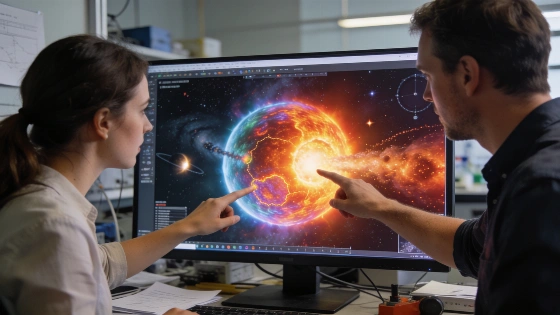
One clue may come from the way material is ejected during collapse. The simulations show that the heaviest elements are not expelled along the rotation axis, as once thought, but at mid-latitudes where magnetically driven outflows meet neutrino-heated winds. This means the appearance of an AIC event could depend on the observer's angle, a detail that may help guide future searches with telescopes like NASA's Chandra X-ray Observatory.
Researchers think that upcoming wide-field surveys, such as those by the Vera C. Rubin Observatory, could spot AICs as brief flashes in ultraviolet and optical light lasting two to three days, sometimes with X-ray and radio signals. But telling these events apart from other stellar explosions will require careful study of their light curves and spectra, likely involving collaboration with teams at MIT and other astrophysics centers.
Next steps in modeling
The ETH Zurich team's preprint on arXiv focuses on refining predictions for the light curves by modeling both radioactive heating and energy from the newborn neutron star. They also plan to test how different magnetic field shapes might affect the pattern of ejected material. The goal is to find more reliable ways to identify AICs in future surveys, with results expected to interest researchers publishing in journals like Science and PNAS.
While the idea of accretion-induced collapse has been around for decades, these new simulations offer the clearest picture yet of what's required for it to happen and what it might look like. The findings show how sensitive the process is to the white dwarf's composition and the rate at which it gains mass. Advances in modeling and instrumentation are now making it possible to study rare astrophysical processes that were once out of reach, much like recent progress in sterilization technology for space missions reported earlier.
Limits of stellar remnants
Stars like the Sun end their lives as white dwarfs, packing about one solar mass into a sphere the size of Earth. More massive stars-usually eight times the Sun's mass or more-go through further fusion, eventually forming iron cores that collapse in supernova explosions and leave behind neutron stars with masses between one and two solar masses. The Chandrasekhar limit marks the maximum mass a white dwarf can support before collapsing. Oxygen-neon-magnesium white dwarfs, being denser, need less extra mass to reach this point. But only a narrow range of accretion rates allows these stars to avoid destruction and instead collapse into neutron stars, making the process rare and hard to observe directly.
In accretion-induced collapse, a white dwarf gains mass from a companion until it can no longer resist gravity. Unlike the core-collapse of a massive star, which produces a bright supernova and a thick shell of ejected material, AIC leads to a much fainter and faster event. The lack of a massive envelope and the unique pattern of ejected neutron-rich material make these events difficult to detect, but also offer possible clues for future identification. Understanding the physics and signatures of AIC is important for mapping all the ways stars can evolve and for interpreting the variety of neutron stars seen in our galaxy.