ZuriQ and Infineon have validated a 3×3 two-dimensional Penning micro-trap with nine individually controlled ion qubits and are now pursuing larger modules, semiconductor fabrication and integrated photonics without yet claiming a fault-tolerant processor.
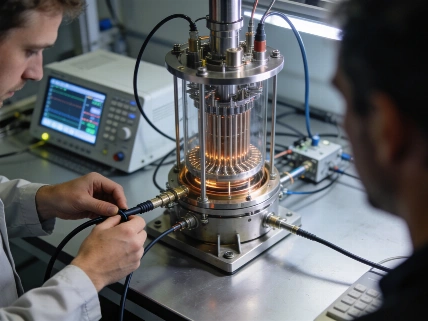
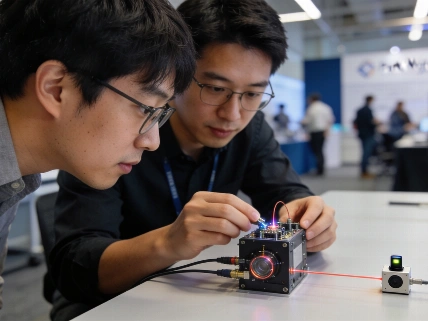
ZuriQ and Infineon have demonstrated a 3×3 array of nine individually controlled ion qubits in a two-dimensional Penning micro-trap. The result is presented as the largest 2D Penning trap array demonstrated to date and gives the companies a concrete hardware target for their expanded partnership. On 7 October 2026, the companies announced that the next phase would focus on scaling the validated architecture to substantially more qubits; the announcement did not report a completed larger array or provide a schedule for one. The official partnership announcement describes the nine-ion device as a feasibility demonstration.
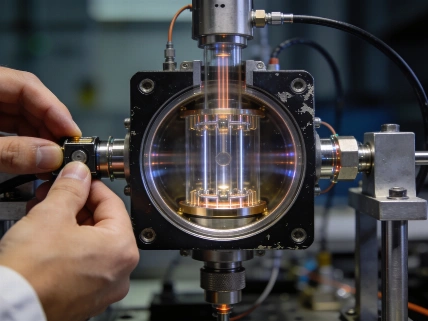
ZuriQ's design takes a different route. Its Penning micro-trap uses electric and magnetic fields to move ions across the chip in a two-dimensional layout, with the stated aim of avoiding the complex junction structures associated with scaling one-dimensional ion chains. The original description also distinguishes the architecture from conventional radio-frequency Paul-trap approaches. The proposed benefit is not simply a larger geometric grid: it is a different way of arranging transport, confinement and control electrodes so that scaling can be compatible with semiconductor manufacturing.
The physical qubits in this demonstration are individual trapped ions. They are not logical qubits protected by an error-correcting code, and the reported array does not establish a fault-tolerant processor. The available materials do not provide gate fidelities, readout fidelities, coherence times, operating temperatures, circuit depths, error rates, logical-qubit measurements or a statistical uncertainty analysis. Consequently, there is no reported sample size beyond the nine-ion array, confidence interval, p-value or computational benchmark from which stronger performance claims could be inferred.
No computational benchmark or comparison with a classical computer is reported. The demonstration therefore supports a claim about trap-array architecture and control rather than quantum advantage or useful computation. It also does not show that the array has performed a fault-tolerant algorithm or solved a materials, logistics or healthcare problem. As in discussions published in journals such as Nature, a credible assessment of a quantum processor requires more than the number of physical qubits: it requires transparent measurements of control errors, correlations, calibration drift and logical performance.
The result is best read alongside the broader hardware challenge discussed in an earlier hardware analysis: qubit count is only one part of processor capability. Connectivity, calibration stability, control error, measurement quality and the overhead of error correction determine whether a physical array can support a useful machine.
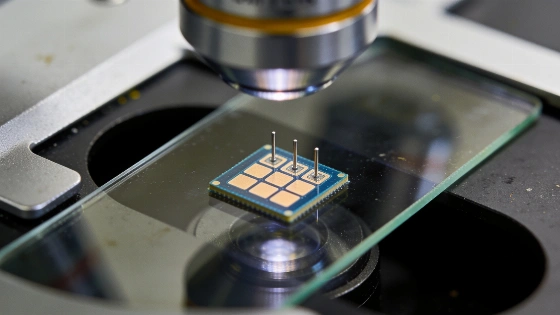
That combination targets a real bottleneck in trapped-ion engineering. A larger array needs more electrodes, optical access and control connections without allowing those additions to introduce unacceptable heating, crosstalk or calibration drift. The available announcement does not report device yield, wafer-scale reproducibility, packaging loss, optical coupling efficiency or the number of control channels required, so the manufacturing case remains a development objective rather than an established production capability. Work at institutions such as ETH Zürich illustrates the value of close integration between quantum-device physics and engineering, but it does not substitute for production data.
ZuriQ's scaling effort follows the company's $25.5 million (€22.4 million) seed round completed in July 2026 and led by Quantonation. ZuriQ co-founder and CEO Pavel Hrmo said the Infineon collaboration is intended to make the company's technological achievements scalable and suitable for industrial use, bringing development closer to practical quantum-computing applications. That financing and stated ambition provide context for the expansion, but investment is not evidence that the engineering hurdles have been solved.
The partnership's stated destination is scalable hardware for fault-tolerant quantum computing. The announcement also mentions possible scaling directions involving modules of up to 40 ions and QPUs with thousands of qubits. These figures are architectural targets rather than demonstrated results. Fault tolerance would require logical qubits, an error-correcting scheme, repeated syndrome measurements and logical performance that improves as additional physical resources are applied; none of those results is supplied here.
The significance of the nine-ion array is therefore narrower and more credible than the language of industrialization might suggest. ZuriQ and Infineon have shown a promising two-dimensional trapped-ion device concept and are now aligning it with commercial semiconductor and packaging processes. The partnership deserves attention because fabrication and integration are central constraints, but the evidence currently supports progress toward a manufacturable platform rather than a manufacturable quantum computer.
A physical qubit is one controllable quantum system such as an individual ion. A logical qubit stores information across multiple physical qubits so that error syndromes can reveal and correct some faults without directly reading the encoded state. Nine controlled ions can demonstrate an important control architecture while remaining far from the resource scale and performance evidence needed for fault-tolerant computation. That distinction is why this result is best judged as an architectural and fabrication milestone rather than proof of practical quantum utility.