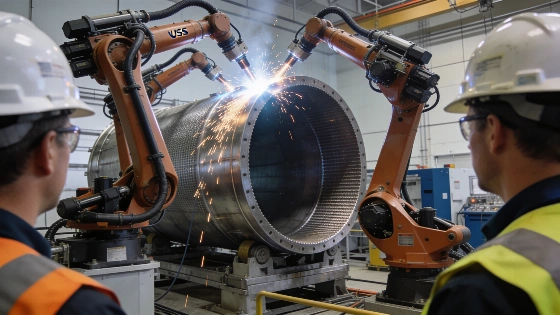
Oak Ridge and Idaho National Laboratories have demonstrated wire arc additive manufacturing to produce steel pressure vessels for nuclear energy, aiming to address US forging capacity limits and accelerate component qualification
Oak Ridge National Laboratory (ORNL) and Idaho National Laboratory (INL) have jointly demonstrated the use of wire arc additive manufacturing-a form of large-scale metal 3D printing-to produce industrial pressure vessels intended for nuclear energy applications. The research addresses a persistent bottleneck in the US supply chain: limited domestic capacity for forging the massive, high-integrity steel components required by advanced nuclear reactors. As the US considers expanding its nuclear fleet, the ability to manufacture these vessels domestically has become a strategic concern.
In a recent demonstration, ORNL engineers used a system called MedUSA, which coordinates three robotic arms, to fabricate a steel pressure vessel measuring approximately 0.9 meters by 1.5 meters. The process involves melting steel wire with electric arcs, layer by layer, to build up complex, enclosed structures. The team selected a steel alloy relevant to nuclear environments and produced a vessel with dimensions and enclosure features comparable to those used in reactor systems. This marks an early-stage proof of concept for additive manufacturing of components traditionally produced by forging, a process that requires specialized facilities and long lead times.
Pressure vessels are critical safety components in nuclear and other energy sectors, designed to maintain structural integrity under extreme pressure, temperature, and corrosive conditions. Manufacturing quality is paramount, as failures can have severe safety and operational consequences. While the demonstration confirms that large, enclosed vessels can be printed using wire arc additive manufacturing, the process must still be validated against the demanding standards of nuclear service. This includes verifying that printed components can withstand years of exposure to high temperatures, radiation, and mechanical stress without degradation.
Digital Monitoring and Qualification
The laboratories plan to integrate digital engineering and real-time monitoring into the manufacturing process. By tracking the evolving shape and material properties of each component as it is printed, engineers aim to generate a comprehensive digital record of the vessel's formation. This approach, sometimes described as producing "born-qualified" components, could allow for earlier assessment of whether a part meets performance requirements, potentially reducing the need for lengthy post-manufacture testing. However, the effectiveness of this method for nuclear-grade components remains to be established through further research and regulatory review.
INL brings expertise in nuclear materials, digital engineering, and data science to the project, supporting efforts to evaluate component performance during production. ORNL has previously applied similar digital manufacturing techniques to produce neutron sensor brackets for Antares Nuclear's R1 Mark-0 microreactor, which achieved initial operation at INL in June. These prior efforts provide a foundation for scaling up to larger, more complex components, but the transition from demonstration to routine production will require extensive validation.
Scale, Evidence, and Remaining Challenges
The printed pressure vessel produced by ORNL measured roughly 0.9 meters in diameter and 1.5 meters in height, using a steel alloy selected for nuclear relevance. The MedUSA platform's three robotic arms coordinated the deposition of molten steel wire, enabling the construction of a fully enclosed vessel. While the demonstration establishes the feasibility of printing large, structurally complex components, it does not yet confirm that such vessels meet the full suite of mechanical, thermal, and radiation-resistance requirements for nuclear service. Qualification for deployment will require extensive testing, including destructive and non-destructive evaluation, long-term aging studies, and regulatory approval.
Current US forging capacity for large nuclear components is limited, with few domestic facilities able to produce the required parts at scale. Additive manufacturing could provide an alternative route, but only if printed components can be shown to match or exceed the reliability and safety of forged vessels. The integration of digital monitoring and data-driven qualification may accelerate this process, but regulatory acceptance will depend on robust evidence from repeated trials and independent assessment. The immediate focus remains on nuclear energy, but similar manufacturing challenges exist in aerospace, defense, chemical processing, and oil and gas sectors.
Wire arc additive manufacturing is not fully automated; it requires significant engineering oversight, process control, and post-processing to ensure quality. The current demonstration represents a research-stage advance rather than a deployable manufacturing solution. The transition to commercial production will depend on the ability to consistently produce components that pass the most stringent safety and performance standards in the energy sector.
Wire arc additive manufacturing is a robotic process that builds metal structures by melting and depositing wire feedstock in successive layers. Unlike traditional forging, which shapes metal under high pressure, additive manufacturing enables the creation of complex geometries and internal features that may be difficult or impossible to achieve with conventional methods. However, the process introduces new variables, including layer bonding, residual stress, and microstructural variation, all of which must be controlled and characterized to ensure component integrity. In safety-critical applications such as nuclear energy, regulatory authorities require extensive evidence that new manufacturing methods do not introduce unacceptable risks. The adoption of additive manufacturing for pressure vessels will depend on the ability to demonstrate consistent, verifiable quality and to integrate digital records into the qualification process.