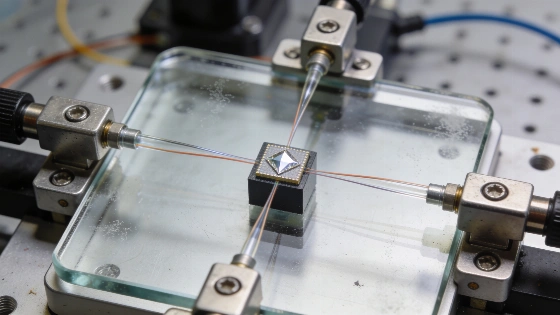
A three-year NSF award, beginning June 1, 2026, will fund a Stony Brook and University of Hawaiʻi collaboration on entangled sensor nodes using squeezed-light photonics and diamond spin centers under realistic noise.
A $600,000 National Science Foundation grant will support a three-year effort to design distributed quantum sensors rather than optimize one isolated detector. Researchers at Stony Brook University and the University of Hawaiʻi at Mānoa will study how entangled nodes can work together to detect weak signals that vary across space. Stony Brook says the project began on June 1, 2026, and is being conducted through the NSF's Foundations of Emerging Technologies program.
The university describes the effort as a quantum intelligent sensor network, a term that emphasizes coordinated measurement by spatially separated nodes. The project is co-led by Stony Brook Assistant Professor Hyeongrak "Chuck" Choi and University of Hawaiʻi at Mānoa Assistant Professor Bo-Han Wu. An official university announcement presents the award as foundational research rather than a completed technology demonstration.
The central claim is not that a field-ready quantum sensor network has already been built. The award funds research into the principles needed to build and evaluate one. That distinction matters because the performance of a network depends not only on the sensitivity of individual devices but also on node placement, synchronization, communication pathways, calibration, and the preservation of quantum correlations across the system.
The proposed architecture initially combines continuous-variable squeezed light with integrated optical components. Squeezed states redistribute quantum uncertainty between measurement variables, potentially reducing noise in the quadrature used for a particular measurement. Any such benefit is conditional: optical loss, imperfect detection, phase instability, and environmental fluctuations can reduce or eliminate the advantage before the signal is processed.
The project also considers complementary metal-oxide-semiconductor integrated diamond spin color-center nodes. Defects in diamond can provide localized quantum states that respond to external conditions such as magnetic fields, while CMOS-compatible integration offers a possible route toward compact control and readout hardware. Stony Brook says that principles developed in the photonic phase are intended to extend later to diamond spin-based quantum sensors; the announcement does not report a completed hybrid device.
Stony Brook's team will use information-theoretic tools, including quantum Fisher information, to calculate fundamental sensitivity limits. In practice, this framework helps separate the information a quantum state can carry about an unknown parameter from the losses introduced by preparation, transmission, control, and readout. The researchers will also examine network topology, optical loss, phase noise, and entanglement distribution to determine whether a distributed system can outperform a classical one under realistic conditions.
Topology is important because a network's connectivity determines how information and quantum correlations move between nodes. A configuration with long or lossy optical paths may perform worse than a simpler arrangement even when each sensor is individually capable. Phase noise can make independently generated optical fields appear less coherent, while photon loss can convert a carefully prepared quantum state into one that offers little practical improvement. These constraints are familiar to precision-instrument communities ranging from CERN detector development to NASA measurement systems, although the proposed network addresses a distinct quantum-sensing problem.
The Hawaiʻi team will lead computational modeling and continuous-variable photonic optimization. Its work will include specialized quantum error-correction strategies intended to preserve sensing capability when environmental noise and hardware imperfections disturb the network. Error correction in this setting is not automatically equivalent to fault-tolerant quantum computing: the relevant question is whether a correction protocol preserves useful information about a physical parameter without consuming more resources than the sensing advantage justifies.
That trade-off has been explored across quantum-information research, including work associated with MIT and results discussed in peer-reviewed literature such as Nature. For this project, however, the relevant benchmarks remain to be established. The announcement does not state that the proposed strategies have already protected a working sensor, achieved a measured error rate, or demonstrated an advantage over a classical instrument.
The grant totals $600,000 over three years. The researchers identify environmental ocean monitoring, disaster preparedness, magnetic-field imaging, and resilient communications as possible long-term deployment areas. These are prospective applications rather than demonstrated outcomes. The project's immediate task is to determine what combinations of sensor physics, network design, noise control, and computation could make such applications technically credible.
The grant also includes education and workforce-development activities at both institutions. Stony Brook says the effort will support student research, outreach, new course materials, and open-source software tools. Those activities are significant because quantum sensing requires expertise spanning optics, solid-state physics, information theory, control engineering, and scientific computing rather than a single narrowly defined specialization.
The project also connects with AI-driven quantum work at Stony Brook's AI Innovation Institute, or AI3, where researchers are exploring relationships between neural networks and physical quantum intelligence. In practical terms, the new effort places the hard measurement problem first: how to preserve useful information across several imperfect nodes before any algorithmic layer can make the network appear intelligent.
This focus is consistent with the infrastructure challenge described in an earlier security report: quantum technology advances through complete systems rather than a single attractive component. For quantum intelligent sensor networks, that system would need calibrated sensors, stable optical connections, controlled noise, reliable readout, and a defensible baseline against classical sensing.
Nothing in the announcement establishes that entanglement will survive the intended operating environment or that the network will outperform the best classical alternative. It establishes a funded research program with a defined technical agenda and named limitations. That is a credible reason to watch the work, but not evidence of quantum advantage or deployment readiness.
Entanglement means that the joint quantum state of separate nodes cannot be fully described as independent local states; it does not provide faster-than-light messaging or guarantee better sensing in every environment. A quantum sensor is useful only when the nonclassical resource survives preparation, transmission, control, and readout with enough margin to beat practical noise. This award is valuable because it targets that complete chain, and its success should be judged by measured network sensitivity under loss and noise rather than by the presence of quantum components alone.