University of Stuttgart researchers are designing SCALAR and COBRAS to assemble timber modules and lightweight space frames with coordinated robot teams while testing whether automation can reduce waste and site labor
Construction robots are being designed to work as teams rather than as isolated machines. Researchers at the University of Stuttgart are developing SCALAR and COBRAS as two distinct systems that could assemble buildings with less human intervention, but neither project has yet demonstrated a finished autonomous construction operation.
The distinction matters. These are three-year research programs scheduled to begin in November 2026, not commercial building systems. Their central test will be whether machines can coordinate physical assembly reliably in the dust, poor lighting and changing conditions of a construction site while using materials more efficiently. As in robotics programs associated with NASA and MIT, the key engineering question is not whether a machine can move, but whether it can perceive uncertainty, plan around it and remain safe when the physical environment differs from a digital model.
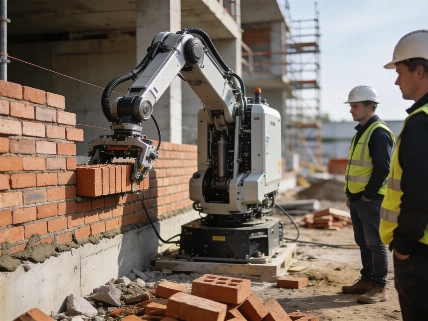
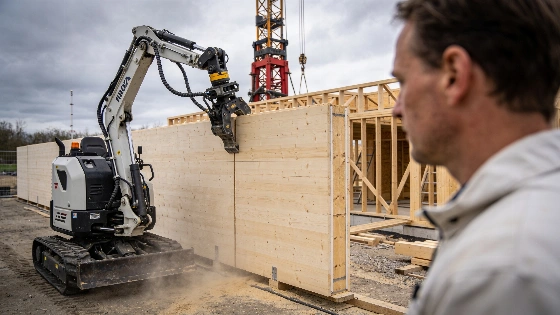
SCALAR targets modular timber construction. Coordinated by the University of Stuttgart's Institute for Computational Design and Construction, the proposed system would combine universal connections, digital design and a multi-scale robotics platform for assembling prefabricated timber modules. Retrofitted cranes would move components and place them approximately, while mobile robots would perform the more precise assembly work.
That division of labor is technically significant. A crane can provide reach and lifting capacity, but it is not suited to every fine adjustment at a joint. Mobile robots could handle those adjustments if their sensors and control software can locate components accurately and maintain safe coordination with larger machines. The researchers plan to simulate assembly in a virtual environment before using a digital control system to coordinate operations in real time.
SCALAR is intended for new buildings and renovation projects involving existing structures. Its partners include the University of Stuttgart's Institute for System Dynamics, the Austrian Institute of Technology and crane manufacturers Liebherr and Jekko. The project's practical bottleneck will not be the existence of a crane or a mobile robot individually. It will be dependable perception and coordination when dust, dirt and difficult lighting degrade sensor performance. The project's institutional and industrial structure is summarized by the Stuttgart design institute.
In a construction setting, perception is a chain rather than a single measurement. Cameras, depth sensors and position data may each provide incomplete or inconsistent information, so the control system must estimate where a component is, whether it is supported and whether a planned movement remains safe. That makes error recovery and human supervision part of the research problem, not merely operational details to be addressed after the robots are built.
COBRAS takes a different approach. It will investigate teams of identical electrically powered mobile robots assembling space-frame structures made from interconnected components. Space frames can span large areas with relatively little material, and their modular parts may be dismantled and reused. Their many individual connections also make assembly labor-intensive.
Instead of directing every machine through a single central controller, COBRAS proposes swarm intelligence: the robots would coordinate dynamically as a group. Identical machines could make a team easier to expand or reduce for different projects. If one robot needs maintenance, the stated aim is for the others to continue rather than stop the entire assembly process.
That promise remains a design objective rather than a measured result. COBRAS will need to show that decentralized coordination can handle errors, changing work conditions and disassembly as well as initial construction. The project also plans digital design methods that reduce material use while improving structural performance, with components developed specifically for robotic assembly and removal.
COBRAS brings together the University of Stuttgart's Institute for Structural Engineering and Structural Design, the Reconfigurable Robotics Lab at EPFL in Switzerland and the IRIDIA artificial intelligence research laboratory at Université Libre de Bruxelles. The work is therefore not simply a matter of adding navigation software to existing machines. The structure, joints, robot behavior and digital planning must be designed as one system. This systems perspective is consistent with the reconfigurable-robotics research agenda described by the EPFL robotics laboratory.
For COBRAS, identical robots could simplify fleet management because the machines share hardware and operating assumptions. That does not remove the need for experimentation: a decentralized team must still decide how to allocate tasks, avoid collisions, respond to a blocked route and determine when a partially assembled structure is stable enough for the next operation. No performance values, failure rates or trial counts have yet been reported for the proposed system.
Both projects received support through the European Innovation Council's EIC Pathfinder Challenge. Each was awarded approximately €4 million, according to the supplied project information. The funding supports research into robotic construction methods; it does not establish that either system is ready for routine construction or that the proposed productivity and sustainability benefits have been achieved.
The stated combined funding is approximately €8 million if the two figures of about €4 million are accurate. The measurable facts are otherwise limited but clear: there are two projects, each planned for three years, each receiving approximately €4 million, and both are scheduled to start in November 2026. SCALAR concerns autonomous assembly of prefabricated timber modules using cranes and mobile robots. COBRAS concerns teams of identical electric mobile robots building reusable lightweight space frames. No success rate, trial count, construction time, failure rate or independent field evaluation is reported.
This is a more useful reading of the announcement than treating "autonomous" as a binary condition. SCALAR would assign different tasks to different machines and use digital coordination. COBRAS would study robots coordinating as a group. The supplied information does not specify how much human monitoring, intervention, resetting or approval will be required during actual construction, so the projects cannot yet be described as independent replacements for site workers.
The University of Stuttgart's approach joins architecture, engineering, materials science, digital planning and robotics. That integration is necessary because construction automation fails at the interfaces between those disciplines: a component must be designed for robotic handling, a joint must tolerate assembly variation, and a control system must respond when the physical environment differs from the digital plan. The projects also put circular construction at the center by exploring modules and components that can be dismantled, reused and adapted.
For claims about efficiency or sustainability, the relevant evidence standard would resemble the transparent reporting expected in journals such as Nature: defined test conditions, repeatable measurements, clear baselines and explicit accounting of failures. At present, the project descriptions establish research goals and participants, not peer-reviewed performance results or statistically validated reductions in labor, waste or construction time.
Readers tracking the wider movement toward supervised machines can compare this industrial direction with earlier robot testing, where the defining issue is not motion alone but the division of decisions between people and machines. On a construction site, that division will affect safety as much as efficiency: the more varied the environment, the more important it becomes to know which actions are automated, which are approved by people and which require intervention.
SCALAR and COBRAS remain proposals for systems that must still be developed and tested. The announcement establishes funding, participants, research goals and planned start dates. It does not establish that timber modules can already be assembled autonomously, that a robot swarm can recover from failures, or that reusable structures will reduce construction waste in practice.
Sensor performance will be one of the most concrete tests. Construction sites combine changing illumination, airborne dust, dirt, occlusion and moving equipment. A control system that works in simulation may still need to cope with imperfect observations and mechanical variation in the physical world. Until the projects report trials under those conditions, claims about faster or safer construction should be treated as objectives rather than outcomes.
Robot teams could eventually make construction more adaptable, but the strongest fact today is narrower: Stuttgart has funded two different research paths toward coordinated physical assembly. That is a credible engineering agenda rather than proof of autonomous building. SCALAR and COBRAS deserve attention because they target the hard parts of deployment-coordination, sensing, modular design and recovery from machine failure-and the industry should judge them by repeatable site tests rather than by the ambition of their designs.
Sensor fusion is the process of combining readings from multiple sensors to estimate what is happening in the physical environment. In construction robotics, that estimate can be affected by dust, lighting, blocked views and moving machinery. A digital model can coordinate planned actions, but it cannot by itself guarantee that the real site still matches the plan. That is why simulation and digital control must be validated against physical trials before they can support claims of reliable autonomy.
These projects signal a serious shift in engineering priorities from single-machine automation toward coordinated construction systems, but they do not yet signal automated building at scale. The decisive evidence will be published performance under real site conditions, with human involvement and failures documented clearly. Until that evidence exists, SCALAR and COBRAS are promising research programs-not working substitutes for human construction teams.