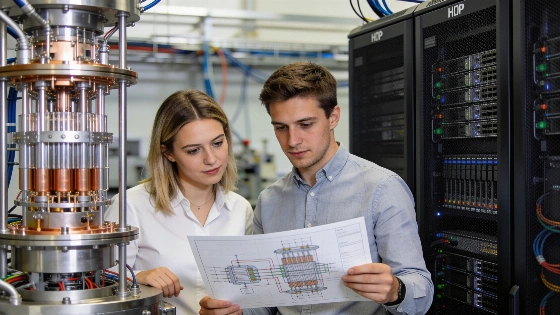
FormationQ and the STFC Hartree Centre have launched a partnership to address technical and workforce barriers to quantum computing and AI adoption in UK industry, focusing on hybrid workflows and scalable pilot projects
FormationQ and the STFC Hartree Centre have announced a strategic partnership aimed at accelerating the integration of quantum computing, artificial intelligence (AI), and high-performance computing (HPC) within UK industry, public sector, and research organizations. The collaboration is designed to address persistent technical and workforce challenges that have slowed the transition from laboratory quantum devices to operational deployments in sectors such as healthcare, manufacturing, logistics, and energy.
Hybrid Quantum-AI-HPC Workflows
The partnership will focus on developing hybrid workflows that combine quantum computing architectures with classical HPC and AI systems. This approach is intended to enable organizations to tackle complex optimization, simulation, and materials science problems that exceed the capabilities of conventional computing alone. While quantum hardware remains in a pre-commercial phase, the integration of quantum resources into existing computational pipelines is seen as a necessary step for evaluating practical utility and identifying bottlenecks in real-world applications.
Addressing Workforce and Infrastructure Gaps
One of the most significant barriers to quantum adoption is the shortage of skilled personnel capable of designing, operating, and maintaining quantum-classical systems. According to recent policy studies and industry surveys, more than 40% of organizations cite a lack of quantum-ready talent as a primary obstacle. The FormationQ and Hartree Centre initiative will engage UK universities, research institutions, and industry partners to develop standardized training and deployment frameworks. This includes structured adoption pathways, pilot projects, and proof-of-concept demonstrations intended to bridge the gap between academic research and scalable enterprise solutions.
Technical Integration and Ecosystem Development
The collaboration will leverage the Hartree Centre's computational infrastructure, which is part of the Science and Technology Facilities Council (STFC) and UK Research and Innovation (UKRI), as well as FormationQ's existing partnerships with academic and institutional organizations such as the Cavendish Laboratory at the University of Cambridge, The King's Foundation, and the Jane Goodall Institute. By integrating university pipelines and international partner networks, the partnership aims to create a more cohesive ecosystem for quantum technology development and deployment. This mirrors efforts seen in other regions, such as the evaluation of hybrid quantum-classical workflows for finance by ORIENTOM and Fondazione LINKS, as described in Science Report's coverage of quantum algorithm testing in financial modeling.
Commercialization Barriers and Measurable Outcomes
Despite advances in quantum hardware, integration bottlenecks remain a central challenge. These include aligning quantum devices with existing IT infrastructure, ensuring interoperability with classical systems, and managing the high cost and complexity of quantum hardware operation-often requiring cryogenic environments and specialized control electronics. The partnership's pilot and proof-of-concept projects are expected to provide measurable data on workflow performance, error rates, and resource requirements, informing future investment and policy decisions. However, the transition from demonstration to scalable, fault-tolerant quantum computing remains a long-term objective, with current efforts focused on identifying applications where hybrid approaches can deliver incremental value.
Understanding the distinction between physical and logical qubits is essential for evaluating progress in quantum computing. Physical qubits are the actual quantum systems-such as superconducting circuits or trapped ions-that can be individually controlled and measured. Logical qubits, by contrast, encode information redundantly across multiple physical qubits using error-correcting codes, allowing for the detection and correction of errors that arise from noise and decoherence. Achieving reliable logical qubits with low error rates is a prerequisite for fault-tolerant quantum computing, but current hardware typically operates with only physical qubits and limited error mitigation. As a result, most near-term applications rely on hybrid quantum-classical workflows, where quantum processors are used for specific subroutines within a larger classical computation.