Astronomers have resolved asteroid 44 Nysa as the first known triple-lobed body in the main belt, using adaptive optics on major ground-based telescopes. The object also hosts a small moon, raising new questions about asteroid formation and evolution.
High-resolution imaging has revealed that asteroid 44 Nysa, long observed as a bright point in the main asteroid belt, is not a simple or even double-lobed object but instead appears to consist of three distinct lobes joined together. This unusual structure, observed with advanced adaptive optics systems on the Large Binocular Telescope (LBT) in Arizona and the Very Large Telescope (VLT) in Chile, marks the first time a triple-lobed asteroid has been identified in the solar system. The same observations also detected a small moon orbiting Nysa, adding complexity to the system and challenging existing models of asteroid formation.
Resolving Nysa's Shape
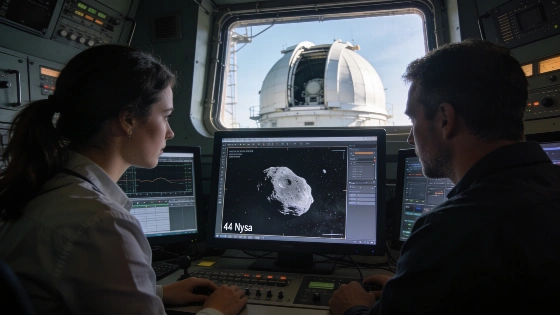
Previous studies of 44 Nysa, discovered in 1857, had suggested a bi-lobed shape, similar to other contact binaries in the asteroid belt. However, the latest campaign combined the Italian-built SHARK-VIS instrument on the LBT with the SPHERE instrument and ZIMPOL polarimeter on the VLT, both employing adaptive optics to counteract atmospheric distortion. The resulting images, further sharpened with custom processing techniques, revealed a body measuring approximately 75 kilometers across at its widest, with two pronounced valleys encircling the asteroid. These features are interpreted as the necks between three connected lobes, making Nysa the first candidate for a contact trinary asteroid.
Obtaining such detail required not only high-contrast imaging but also the removal of the bright halo produced by scattered light, which can obscure faint companions or surface features. The team's approach enabled them to distinguish the asteroid's irregular outline and to identify the subtle structures that define its lobed morphology.
Discovery of a Small Moon
In addition to its unusual shape, Nysa was found to host a small satellite, provisionally designated S/2026 (44) 1. The moon measures about 1 kilometer in diameter and orbits at a minimum distance of 170 kilometers from the primary. Its presence was confirmed by independent detections during two separate observing runs, allowing astronomers to track its motion relative to Nysa. Detecting such a faint object so close to a much brighter primary required specialized high-contrast imaging techniques, similar to those used in exoplanet searches.
The identification of a moon provides a rare opportunity to measure the mass and density of Nysa directly, as the satellite's orbital parameters can be used to constrain the system's gravitational field. This information will be critical for testing competing models of Nysa's origin and internal structure.
Formation Scenarios and Open Questions
The origin of Nysa's triple-lobed structure remains uncertain. One favored explanation is that Nysa is a contact trinary, formed from three separate bodies that gently merged under mutual gravity. An alternative scenario involves a past collision with a larger asteroid, which could have deformed Nysa's mantle and produced its current shape. In either case, the lack of a family of similar asteroids in the vicinity is puzzling, as such events often produce multiple fragments with shared composition.
Further analysis of the moon's orbit will help determine Nysa's mass and bulk density, offering clues to whether the asteroid is a loosely bound aggregate or a single, highly irregular body. The findings also have implications for understanding the building blocks of the inner planets, as Nysa is classified as an E-type asteroid, rich in the silicate mineral enstatite and highly reflective. E-types are thought to have formed close to the Sun and may preserve information about the early solar system.
Context in Asteroid Research
The discovery of Nysa's complex structure and satellite comes amid renewed interest in asteroid morphology and evolution. Recent missions and observations, such as the Hayabusa2 flyby of asteroid Torifune, have highlighted the diversity of small bodies and the challenges of interpreting their shapes and histories. The new results for Nysa, currently available as a preprint on arXiv and submitted to Astronomy & Astrophysics, underscore the value of high-resolution ground-based imaging in complementing spacecraft data and expanding our understanding of asteroid populations.
Adaptive optics is a technology that compensates for the blurring effects of Earth's atmosphere, allowing ground-based telescopes to achieve image sharpness approaching that of space-based observatories. By rapidly adjusting the shape of a deformable mirror in response to atmospheric turbulence, adaptive optics systems can correct distortions in real time. When combined with high-contrast imaging and advanced data processing, these systems enable astronomers to resolve fine details on distant objects such as asteroids, moons, and exoplanets-capabilities that are essential for studying the structure and evolution of small bodies in the solar system.