EPFL researchers developed FiberMotor, a 1-3-millimeter electrostatic actuator made from two hollow fibers and copper electrodes. Applying voltage makes one fiber slide inside the other, producing quiet bidirectional linear motion for textiles and soft robotic devices.
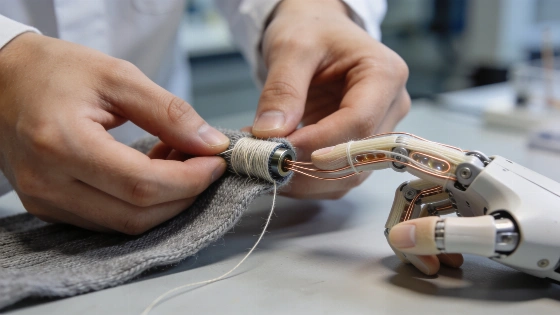
A bundle of four FiberMotors lifted a 46-gram chocolate bar and flexed a tendon-driven robotic finger in laboratory tests. The result is modest in scale but significant in design: researchers at EPFL demonstrated a linear actuator that can be built into a thread-like structure rather than assembled around gears and rigid transmission parts. The work was reported by Sylvain Schaller and Herbert Shea in Advanced Materials under the title Fiber-Format Flexible Linear Electrostatic Motors; the peer-reviewed article is identified by DOI 10.1002/adma.75156 and described in an EPFL research report.
Herbert Shea's laboratory characterizes FiberMotor as a first sliding motor in fiber format. The device is designed to be flexible, quiet and bidirectional, but it is not an autonomous robot or an artificial muscle with independent decision-making. It is an electrically driven mechanical actuator whose movement begins when voltage is applied. Its significance lies in where the motor can fit: inside flexible clothing, wearable support systems and soft robotic mechanisms that conventional actuators often make too bulky.
The device measures between 1 and 3 millimeters in diameter and contains two concentric hollow fibers. Thin insulated copper wires are wrapped around each fiber, forming electrodes that are only slightly thicker than a human hair. When voltage is applied, electrostatic forces act across the structure and drive relative motion between the fibers. The inner fiber slides repeatedly inside the outer one in a telescoping, reciprocating movement, producing linear travel directly rather than first creating rotation and converting it through gears.
That architecture also makes the actuator backdrivable. If an outside force pushes or pulls against the motor, the fibers can move relative to one another instead of locking into a rigid position. For a wearable system this matters because a user's limb can impose forces that do not match the actuator's intended movement. Backdrivability could allow a garment or soft exosuit to respond more naturally, but the reported work does not establish a completed assistive system or a human performance trial.
The reported laboratory measurements provide a useful boundary for the claim. One FiberMotor supported a stationary load of roughly 75 grams. Four combined actuators lifted the 46-gram chocolate bar and moved a tendon-driven robotic finger. These tests show that the fibers can generate enough force for some small soft-robotic tasks; they do not establish durability, long-term reliability, comfort on the body or safe operation during unpredictable human movement.
The researchers say the motor's range is determined mainly by fiber length rather than by how far an active material can stretch or contract. That gives the design a different operating principle from many artificial-muscle technologies. It also creates a practical engineering question: longer fibers may provide more travel, but the reported work does not establish how performance changes with length, repeated cycling, electrode degradation or environmental exposure.
The team incorporated FiberMotors into a prototype garment shaped around a knee. EPFL has identified a broader concept in which many such actuators could be woven into fabric to support movements including leg flexion and extension. Their thin profile could allow several actuators to be distributed across clothing instead of concentrated in a single rigid housing. That arrangement may help apply force at multiple points, although the reported work remains a prototype demonstration rather than evidence of a wearable device ready for routine use.
EPFL's Soft Transducers Laboratory previously developed a fiber-shaped pump intended for textile integration. The new motor extends that laboratory direction from fluid movement to direct mechanical actuation. The technology is also being commercialized through Elecsyor, a startup founded by one of the team members, but the available reporting does not describe a commercial product, independent testing or deployment outside the laboratory.
The design occupies a different niche from larger robotic mechanisms. Where coordinated machines such as those described in earlier robotics coverage move through construction environments, FiberMotor is intended to disappear into the material around a person or a soft mechanism. Its advantage is not autonomous behavior; it is the possibility of placing electrically controlled motion where conventional actuators are difficult to install.
The researchers are now working on thinner electrodes made largely from insulating materials and on improved motor materials. They identify soft exosuits, virtual-reality haptic wearables and lightweight prosthetic devices as possible applications. Future versions could use feedback about a wearer's position and movement to adjust actuation, but that capability is described as development work rather than a demonstrated feature. Any future claims would need the detailed methods, uncertainty estimates and repeatability data expected in high-impact engineering literature such as Nature or Science.
The reported experiments do not establish how the motor behaves after extended use, under sweat and washing, during rapid changes in load or when integrated with a complete garment. They also do not show how a control system would detect a wearer's intent or prevent excessive force. Those issues are central to any assistive wearable: a flexible actuator can be mechanically compliant while the overall system still produces an unsafe command.
That distinction matters because silent movement is not the same as safe movement, and bidirectional operation is not the same as intelligent assistance. A future exosuit would need sensing, control limits, failure handling and human oversight in addition to the motor itself. FiberMotor has demonstrated a compact way to produce linear motion; it has not demonstrated a finished wearable robot.
Backdrivability describes a mechanical property rather than a guarantee of safe human-machine interaction. It means external force can move the actuator's parts, which may reduce mechanical resistance when a person moves against the system. Controllers and sensors would still determine how much force is applied and when it stops. On the evidence reported here, FiberMotor is a credible actuator prototype with a clear advantage in form factor, but its industrial and wearable importance will depend on durability and controlled integration rather than on the laboratory lift alone.