A North Carolina State University prototype uses two actuators and four elastic wings to move vertically, horizontally, and rotationally underwater while relying on structure rather than additional motors.
A soft underwater robot can rise, hover, travel forward or backward, and spin around its axis with only two actuators. That compact result comes from four elastic wings and a body designed to make the water and the machine's own structure do part of the control work. The demonstration was independently reported on October 7, 2026, but no later evidence of commercial production, routine field deployment, or additional validated trials has been reported.
The prototype was developed by researchers at North Carolina State University and was inspired by feather stars. These marine invertebrates coordinate their limbs to move in several directions and remain suspended in the water. The robot does not reproduce that biology in full; it borrows the arrangement of distributed flexible appendages and uses their passive motion to expand what two actuators can achieve.
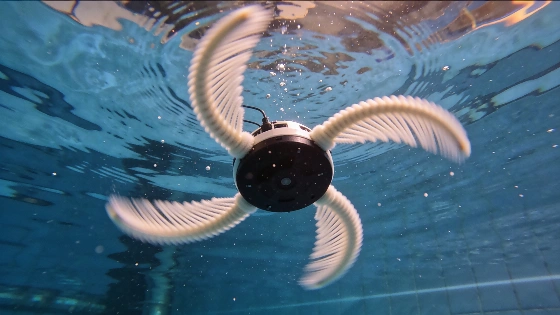
The construction consists of a central disk, two actuators, and four flexible wings. Each wing is described as monostable: it bends when the actuator system applies force and returns to its original position when that force is removed. This spring-like behavior allows the robot to generate repeated movement without a dedicated motor for every direction. The principle resembles a broader engineering idea studied in soft robotics, where compliance is treated as part of the control system rather than merely as a material property.
The two actuators sit inside the central disk and operate all four wings. When both actuators fire, the wings snap downward. When power is removed, the elastic material drives them back upward. Repeating that cycle quickly produces upward movement. Slower flapping allows the robot to hold its position in a swimming pattern the researchers describe as jellyfish mode. The available report does not provide a statistical analysis of these motion cycles, confidence intervals, trial counts, or measured efficiency.
The same hardware produces horizontal motion through a different control pattern. Activating one actuator makes a wing flutter like a tailfin, pushing the robot forward or backward. The team calls this fish mode. Rapidly alternating the two actuators creates an imbalance between the wings, causing rotation around the central disk. That rotor mode gives the robot directional control rather than merely moving it along a fixed vertical path.
According to researcher Yin, comparable three-dimensional maneuverability would normally require at least six actuators. The reported design reduces that number to two by using structural mechanics instead of installing a separate drive for each direction. A Tech Xplore report describes the three controllable behaviors as vertical, horizontal, and axial rotational movement.
Researchers demonstrated the robot exploring underwater spaces with a camera. They also showed it lifting objects either on its own or in coordination with other robots. The available account does not report the mass of the lifted objects, communication range, operating duration, payload limits, trial counts, success rates, or quantitative comparisons with six-actuator systems. The demonstrations therefore establish a working research prototype rather than a validated field system.
This is a hardware and control result, not evidence of general-purpose robotic autonomy. The available description does not identify independent navigation, onboard decision-making, continuous environmental mapping, or unsupervised task planning. The robot's movement modes were selected through actuator timing, and the reported experiments show what the mechanism can do under the researchers' control conditions. As in experimental programs at institutions such as MIT and NASA, separating demonstrated capability from anticipated deployment is essential when evaluating a new platform.
The design illustrates a practical meaning of mechanical intelligence: the robot's physical form contributes to behavior that might otherwise require more sensors, motors, and computation. Instead of commanding each wing independently, the control system exploits elasticity, symmetry, and interaction with water. That can reduce mechanical complexity, but it also makes performance dependent on the properties of the structure and the surrounding fluid. Similar distinctions between active control and embodied mechanics are often discussed in Nature, although the present report does not establish a peer-reviewed performance benchmark against other underwater robots.
This strategy contrasts with the common engineering response to added maneuverability: install more actuators and assign each one a narrower task. The broader robotics field also uses coordinated machines to distribute capability, as described in earlier coverage of construction robot teams. The feather star design takes the opposite route by concentrating control in a small number of actuators and allowing passive mechanics to produce useful asymmetry.
That trade-off matters underwater, where extra motors add weight, sealing challenges, power demand, and more possible failure points. Yet fewer actuators do not automatically make a robot more reliable. A flexible wing can deform, fatigue, or respond differently as conditions change, and the report does not establish how the prototype performs outside the demonstrated environment. Simplicity in actuator count is therefore not the same as proof of durability, energy efficiency, or operational robustness.
A fully wireless version has been mentioned as a potential direction for further development, but there is no confirmed evidence that such a version has been built or tested. The available information likewise provides no evidence of serial manufacturing or commercialization. The current findings support a compact experimental platform that can switch between several underwater movement modes; they do not establish a finished product or routine deployment.
The strongest value of this work is engineering discipline rather than spectacle. By using elastic wings to carry part of the control burden, the NCSU team shows that three-dimensional underwater movement need not begin with a six-motor architecture. The result is a credible research demonstration, but its real significance will depend on whether the same two-actuator design remains controllable, durable, and useful when wireless operation and less controlled environments are tested.
Mechanical intelligence means embedding part of a robot's response in its materials and geometry rather than calculating every movement in software. In this prototype, actuation supplies the impulse while elasticity supplies the return stroke and water converts wing motion into propulsion or rotation. That arrangement can reduce commands and components, but it also narrows the range of behavior set by the physical design. The evidence therefore supports a specific conclusion: the robot demonstrates efficient motion generation, not independent intelligence or proven underwater autonomy.