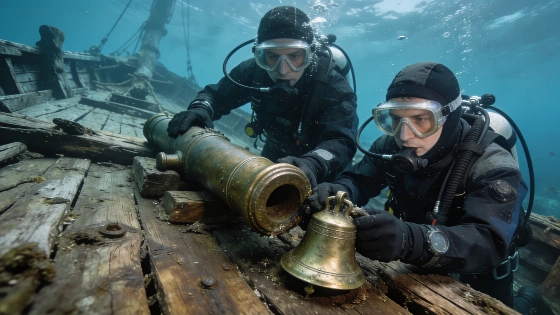
Archaeologists have recovered exceptionally preserved artifacts from two Swedish shipwrecks lost in the Baltic Sea during the Great Northern War, offering rare evidence for naval provisioning and daily life in the early eighteenth century.
Recent underwater investigations off the coast of Rügen have produced a significant assemblage of artifacts from two Swedish vessels lost during the winter of 1714-1715. The frigate Postillion and the armed transport Cecilie, both casualties of the Great Northern War, were located in the Baltic Sea where cold, low-salinity waters have preserved their remains and cargo for over three centuries. These shipwrecks represent a rare opportunity to examine the material culture of early eighteenth-century naval operations in a largely undisturbed context.
Archaeological Recovery and Context
The Postillion was first identified in 2016 during marine surveys for the Nord Stream 2 pipeline, while the Cecilie was found closer to the Baltic shoreline. Both ships are believed to have run aground during severe winter conditions, sinking with much of their equipment and supplies intact. Unlike many historic wrecks, these sites experienced minimal post-sinking salvage, leaving their archaeological context largely preserved. The Swedish National Heritage Board and Stockholm's Vrak - Museum of Wrecks have led recent research efforts, focusing on systematic recovery and documentation of artifacts.
Among the most notable finds are a ship's bell and a bronze cannon barrel, now under study in Schwerin. The cannon, possibly captured during the Thirty Years' War, was already several decades old when the ship sank, illustrating the reuse of military equipment across conflicts. Additional recovered items include weapons, navigational instruments, and personal belongings, providing a detailed view of provisioning and daily routines aboard Swedish naval vessels during wartime.
Material Evidence and Preservation
The Baltic's unique preservation conditions have allowed organic materials and metal objects to survive in exceptional condition. Archaeologists have documented a range of artifacts, from armaments to everyday utensils, that rarely survive in open-sea wrecks. The absence of extensive salvage or disturbance has enabled researchers to reconstruct aspects of shipboard life, provisioning strategies, and the logistical challenges faced by Swedish crews during the final years of the Great Northern War.
Quantitative data from the wrecks remain under analysis, but initial reports indicate a substantial assemblage of artifacts, including at least one complete cannon, a ship's bell, and numerous items of equipment and personal use. The precise number of objects recovered is expected to grow as conservation and study continue. These finds complement other recent discoveries of ancient shipwrecks in European waters, such as the merchant vessel with hundreds of amphorae identified near Andros, which has expanded understanding of maritime trade and cargo transport in the Aegean (see coverage of the Andros shipwreck discovery).
Interpreting Naval Life and Limitations
The material evidence from the Postillion and Cecilie offers a rare window into the provisioning, armament, and daily routines of Swedish naval personnel during a period of intense conflict. However, interpretation is limited by the absence of written records directly associated with the wrecks and by the incomplete recovery of all cargo and personal effects. While the preserved artifacts provide strong evidence for the types of equipment and supplies carried, they cannot fully reconstruct the lived experiences or social organization of the crews. Ongoing analysis may clarify aspects of shipboard hierarchy, provisioning logistics, and the operational challenges of winter navigation in the Baltic, but many questions about individual lives and broader naval strategy remain open.
Researchers emphasize that the integrity of these wrecks is due in large part to the Baltic's cold, low-salinity environment, which inhibits the decay of organic materials and limits the activity of wood-boring organisms. This preservation context is critical for understanding why such a diverse range of artifacts has survived, and it highlights the importance of environmental factors in shaping the archaeological record of maritime sites.
Understanding the preservation of shipwrecks in the Baltic Sea requires attention to taphonomy-the study of processes affecting remains after deposition. The region's cold, brackish water slows biological decay and limits the presence of shipworm, a major threat to wooden wrecks in saltier seas. As a result, both organic and inorganic materials can survive for centuries, allowing archaeologists to recover artifacts in a state rarely seen elsewhere. However, even in these favorable conditions, long-term preservation is not guaranteed, and ongoing monitoring is necessary to protect these sites from environmental change and human impact.