Researchers have used spin-orbit coupled light to enhance the visibility of Boehm's brushes-subtle optical patterns in peripheral vision-demonstrating a method that could enable non-invasive tests of retinal integrity using quantum optics techniques
Researchers at the University of Waterloo have demonstrated that structured light, specifically spin-orbit coupled beams, can be engineered to make previously faint entoptic patterns in the human eye's peripheral vision both vivid and measurable. The study, published in Proceedings of the National Academy of Sciences, explores how manipulating the spatial polarization of light can transform the visibility and shape of Boehm's brushes-bowtie-like patterns that arise from the scattering of polarized light by subcellular structures in the retina.
Human vision is generally insensitive to the polarization of visible light. However, certain internal retinal structures can scatter polarized light in ways that produce subtle visual effects, known as entoptic phenomena. While Haidinger's brushes, a well-known central-vision pattern, have been studied for decades, Boehm's brushes-first described in 1940-are less familiar and typically appear only faintly in peripheral vision under specific conditions. Their weak visibility has limited their use as a diagnostic tool, despite suggestions that changes in these patterns could indicate retinal disease.
Spin-Orbit Coupled Light
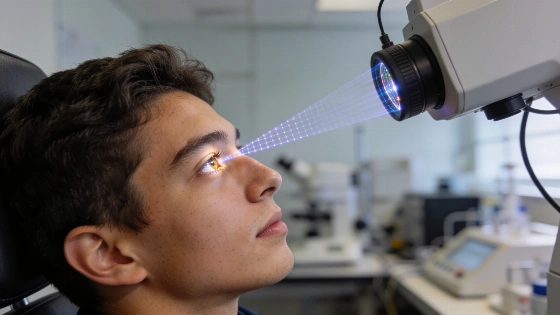
The research team generated beams of light in which the polarization direction rotates across the wavefront, a property known as spin-orbit coupling. By matching the spatial polarization profile of the light to the angular scattering response of the retina, the experiment allowed many weak local scattering contributions to reinforce each other, amplifying the entoptic effect. The structured light was projected through a ring-shaped aperture to target specific peripheral regions of the retina, and the distance from the center of vision could be varied systematically.
In a controlled test involving 11 participants, the researchers measured the minimum contrast required for subjects to reliably distinguish Boehm's brushes from the background at different retinal locations. The use of spin-orbit coupled light not only increased the visibility of these patterns but also altered their geometry, producing multi-lobed shapes whose structure depended on the topology of the light's polarization. Detection thresholds improved exponentially with increasing distance from the center of vision, and the patterns became robustly visible at approximately one degree of retinal angular distance.
Measurement and Diagnostic Potential
The experiment provides quantitative evidence that the topology of structured light can be tuned to enhance and control entoptic patterns in the human eye. The ability to reliably elicit and measure Boehm's brushes in peripheral vision opens the possibility of using these patterns as a non-invasive functional probe of retinal health. Because retinal diseases may alter the scattering properties of the inner retina, a test based on structured light could potentially identify individuals with compromised retinal integrity, even in cases where conventional imaging is inconclusive or impractical.
While the current study was conducted with healthy participants, the authors suggest that further research involving patients with retinal disease will be necessary to validate the diagnostic utility of the method. The approach relies on the participant's subjective perception of the pattern, so its effectiveness may depend on factors such as attention, visual acuity, and the presence of other ocular conditions. Nevertheless, the technique demonstrates how advances in quantum optics and photonics can be translated into practical measurement tools for biomedical applications.
Experimental Details and Limitations
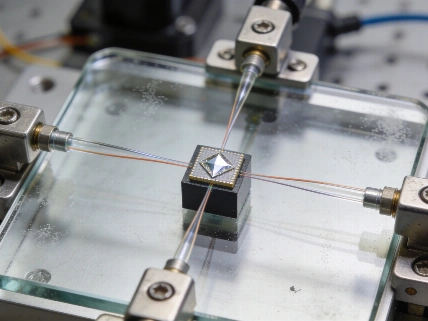
The structured light beams were generated using established quantum optics techniques, with polarization and orbital angular momentum precisely controlled to match the symmetry of the retinal scattering response. The ring-shaped aperture allowed selective stimulation of peripheral retinal regions, and automated testing protocols ensured consistent measurement of detection thresholds. The study reports that the enhanced patterns were robustly visible at angular distances of about one degree, but the sample size was limited to 11 participants and did not include individuals with known retinal pathology.
Key limitations include the reliance on subjective reporting, potential variability in individual retinal structure, and the need for specialized optical equipment. The method's sensitivity and specificity for detecting retinal disease remain to be established in larger and more diverse populations. Additionally, the translation of this laboratory technique into a clinically practical device will require further engineering to ensure ease of use, reproducibility, and accessibility in real-world settings.
Spin-orbit coupling in light refers to the controlled relationship between the polarization (spin) and the spatial structure (orbital angular momentum) of a light beam. By engineering this relationship, researchers can create beams with polarization that varies across the wavefront, enabling new forms of light-matter interaction. In the context of this study, spin-orbit coupled light was used to match the angular scattering properties of the retina, amplifying weak entoptic effects and making them accessible for measurement. This approach illustrates how quantum optics concepts can be applied to biological sensing, offering new possibilities for non-invasive diagnostics based on the fundamental physics of light.