
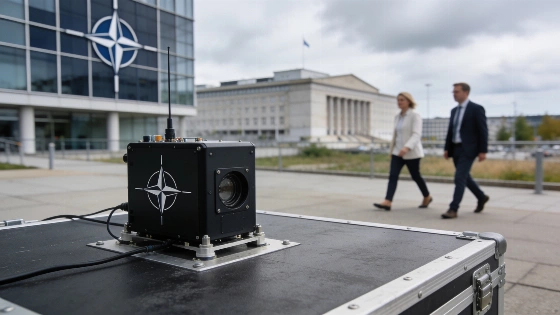
NATO has published an implementation roadmap for quantum computing, sensing and communications, including a Brussels-to-Mons pilot link planned for Q4 2027.
NATO has turned its quantum strategy into an operational timetable with one concrete test already assigned a deadline: the Quantum Zero Beacon Project is scheduled to establish a pilot link between NATO headquarters in Brussels and SHAPE in Mons by Q4 2027. The Alliance publicly released the roadmap on September 29, 2026, after Allies approved it on July 30, 2026.
The roadmap is presented as an implementation instrument for the NATO Quantum Technology Strategy. Its purpose is to translate strategic objectives into practical steps that can make the Alliance quantum-ready while accelerating the understanding, adoption and integration of quantum technologies.
The public summary organizes the work around three principal areas: quantum computing, quantum sensing and quantum communications. It also addresses quantum-enabled threats and the relationship between quantum systems and dual-use technologies, recognizing that the same advances can have both civilian and defense applications.
The significance is administrative as much as technical. The roadmap assigns oversight to the Digital Policy Committee and distributes execution across the NATO Enterprise, including Allied Command Transformation, Allied Command Operations, the NATO Communications and Information Agency, the Science and Technology Organization, the Defence Innovation Accelerator for the North Atlantic and the NATO Innovation Fund.
That structure does not demonstrate a new quantum device or establish a working quantum network. It sets responsibilities and milestones for moving quantum technologies toward defense use while attempting to preserve interoperability among all 32 Allies. NATO also plans a STO Quantum Standardisation Specialist Team and a comprehensive NATO-oriented standardization roadmap, indicating that compatibility and common technical requirements are intended to accompany experimentation.
In scientific terms, the distinction between a technology program and a demonstrated capability is essential. Quantum computing can involve different physical platforms and error-correction strategies; quantum sensing can refer to instruments based on atoms, spins, photons or other controlled quantum systems; and quantum communications can include several architectures that do not all provide the same security properties or networking functions. The NATO document does not report a qubit count, processor benchmark, sensing precision or communications rate.
NATO identifies Positioning, Navigation, and Timing as a priority for quantum sensing in GNSS-denied environments. The roadmap points to QUESTOR trials conducted by the STO Centre for Maritime Research and Experimentation in La Spezia, Italy, as a validation activity for that focus.
Quantum sensing is not a single instrument or performance level. It refers to sensors that use a controlled quantum system or quantum measurement strategy to detect quantities such as motion, acceleration or timing with potentially different limits from conventional equipment. The published material does not provide sensitivity figures, operating conditions, device architecture or a classical comparison for the QUESTOR trials, so it cannot establish how the system performed outside the reported trial context.
The practical test is therefore not whether the word quantum appears in the roadmap. It is whether sensing can maintain useful positioning or timing when satellite navigation is unavailable and whether the equipment can be calibrated, operated and integrated in real environments. Relevant evaluation would normally require controlled comparisons, uncertainty estimates, environmental testing and independent replication, none of which are specified in the public summary.
Research programs at MIT and NASA illustrate why deployment conditions matter: laboratory sensitivity alone does not determine whether a sensor remains useful under vibration, temperature variation, electromagnetic interference, power constraints or the maintenance demands of a field platform. Those engineering questions are especially important for military positioning systems that must function when external signals are degraded or deliberately denied.
The QZBP pilot is the roadmap's clearest communications milestone. Its planned Brussels-to-Mons connection is intended to validate operational quantum-resilient networking frameworks rather than serve as evidence that NATO has completed a scalable quantum internet. The official roadmap describes the project as a pilot pathway toward quantum-resilient communications, with an indicative target in the fourth quarter of 2027.
The document does not specify whether the pilot will distribute keys, quantum states or entanglement. It also gives no channel type, distance, rate, detector performance, repeater architecture or security model. Those omissions matter because a quantum communications demonstration can involve very different technical tasks, and a link between two sites is not automatically a resilient network.
Quantum resilience also extends beyond adding a quantum component to a communications line. It involves preparing cryptographic systems for the possibility that sufficiently capable quantum computers could weaken or break some widely used public-key schemes. The roadmap therefore places communications experimentation alongside measures intended to mitigate quantum-enabled threats while the technology and its risks continue to develop.
The wider security rationale sits beside the Alliance's broader technology planning, much as earlier hardware reporting shows how supporting infrastructure can shape quantum deployment even when the headline system is not yet operational.
Peer-reviewed work reported in journals such as Nature's quantum information collection also helps explain why terms such as entanglement, key distribution and fault tolerance should not be treated as interchangeable. A demonstration can verify one protocol or component without establishing end-to-end security, long-distance scalability or resistance to implementation flaws.
Implementation will be supported by the Transatlantic Quantum Community and its Industry Network, which has expanded to include Belgium and Bulgaria alongside 22 Allies and six partner nations. The roadmap also connects public coordination with organizations focused on innovation, science and technology and investment.
That network may help NATO coordinate procurement, experimentation and standards, but membership is not a technical benchmark. The document supplies no qubit count, processor result, sensing precision, communications rate or independent replication. It should therefore be read as a governance and deployment framework rather than as a report of demonstrated quantum advantage.
The strongest evidence in the announcement is the conversion of broad priorities into named programs and a stated Q4 2027 target. NATO has created a mechanism for testing quantum capabilities across defense institutions; it has not shown that those capabilities are ready for routine operational use. The roadmap is valuable precisely because it makes the next evaluation points visible, and its credibility will depend on measured performance, interoperability and security evidence rather than on the timetable alone.
A physical qubit is an individual controllable quantum system, while a logical qubit encodes information across multiple physical components to manage errors. The roadmap does not report either type for NATO's program. The same distinction applies to communications: a pilot link may test a defined protocol or architecture, but it does not by itself prove scalable networking, secure deployment or resistance to every implementation weakness.
The role of standards will be decisive because quantum components must interact with conventional networks, sensors, timing systems and command infrastructure. CERN's experience with large-scale scientific instrumentation demonstrates the broader engineering principle that complex systems depend on interface rules, calibration procedures and reproducible measurements, not only on the performance of individual components. NATO's planned standardization work is therefore a practical test of whether separate national experiments can become interoperable capabilities.
NATO's stated objective is twofold: accelerate adoption while mitigating disruptive risks arising from strategic competition. The roadmap does not resolve the technical uncertainties by itself, but it establishes named programs, institutional responsibilities and an evaluation horizon against which future results can be judged.