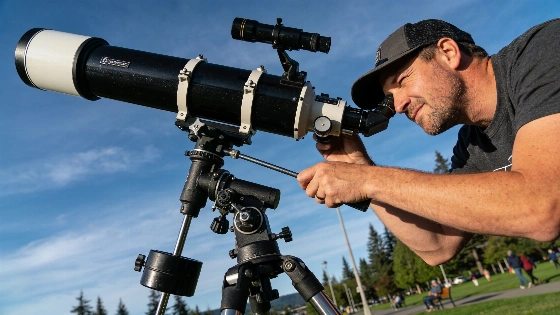
A rare daylight image shows the International Space Station appearing close to Venus, recorded by AJ Smadi using a specialized telescope and camera setup in Washington state
On July 18, 2026, astrophotographer AJ Smadi recorded a striking image of the International Space Station (ISS) appearing to pass near Venus in the daytime sky. The observation, made from Edmonds, Washington, required precise timing and specialized equipment to capture both objects against the bright background of daylight. Such images are uncommon, as most astronomical photography relies on the contrast of night skies to reveal faint or distant objects.
Capturing a Daylight Transit
Smadi used a 9.25-inch (23.5 cm) Celestron Schmidt-Cassegrain Telescope paired with a ZWO ASI662MC camera, along with ultraviolet and infrared filters, to isolate the ISS and Venus from the scattered sunlight. The ISS, a modular research station orbiting Earth at roughly 400 kilometers altitude, moves rapidly across the sky, making its alignment with Venus a fleeting event. The technical challenge lies in both tracking the ISS's swift motion and distinguishing Venus's disk in daylight conditions.
Daylight astrophotography of this kind demands careful planning. The ISS travels at approximately 7.5 kilometers per second, while Venus, though much farther away-about 135 million kilometers from Earth at the time-remains one of the brightest objects in the sky. The apparent proximity of the two in the image is a line-of-sight effect, not a physical closeness, but the visual juxtaposition is rarely documented in daylight.
Instrumental and Atmospheric Challenges
Atmospheric turbulence, or "seeing," can blur or distort images, especially during the day when temperature gradients are strongest. Smadi's setup required not only high optical quality but also rapid image acquisition to freeze the ISS's motion and minimize atmospheric effects. The use of filters helped suppress unwanted wavelengths, improving contrast and clarity.
Smadi has previously succeeded in imaging the ISS near Venus, with one such image selected by NASA as an Astronomy Picture of the Day in 2025. Each attempt is subject to variable conditions, including the ISS's orbital path, Venus's position relative to the Sun, and local weather. The rarity of these alignments, combined with the technical demands, means that even experienced astrophotographers may only capture a handful of such images over many years.
Scientific and Visual Significance
While the image does not provide new scientific data about the ISS or Venus, it demonstrates the capabilities of modern amateur equipment and the potential for public engagement with space science. The ability to resolve the ISS's structure and Venus's phase in daylight highlights advances in detector sensitivity and image processing. Such images can also serve as calibration tests for telescopes and cameras, similar to how NASA's ESCAPADE mission used dual-light imaging of Earth and the Moon for instrument checks, as described in a recent Science Report article.
Smadi's work also illustrates the importance of precise prediction tools and orbital data, which allow observers to anticipate rare alignments. The resulting images are not only visually compelling but also demonstrate the intersection of technical skill, astronomical knowledge, and favorable conditions.
Limits and Opportunities
Despite the visual impact, such images are limited by atmospheric conditions, equipment sensitivity, and the geometry of orbital alignments. The ISS's rapid transit means that exposure times must be extremely short, and even minor tracking errors can blur the station's outline. Venus, while bright, can be difficult to distinguish from the sky background without careful filtering and post-processing.
These challenges mean that successful daylight images of the ISS near other celestial bodies remain rare. However, as amateur and professional equipment continues to improve, more observers may attempt similar feats, contributing to both public outreach and the testing of astronomical instrumentation.
Understanding how astrophotographers capture objects like the ISS and Venus in daylight requires familiarity with the principles of contrast, exposure, and atmospheric interference. Daylight imaging is fundamentally different from night-sky photography, as the overwhelming brightness of the sky can easily obscure all but the brightest objects. Specialized filters, rapid imaging, and precise tracking are essential to isolate targets from the background. The process also serves as a practical demonstration of the limits imposed by Earth's atmosphere and the ingenuity required to overcome them.