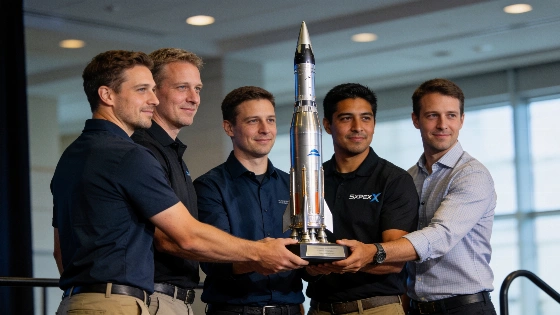
SpaceX's Falcon 9 booster landing team has received the first Neil Armstrong Space Prize, recognizing their work in making large-scale rocket reuse routine and changing the economics of space launches.
The team behind SpaceX's Falcon 9 booster landings has received the inaugural Neil Armstrong Space Prize, a rare formal recognition for the engineers who turned routine rocket reuse into reality. The award was presented in Washington, D.C., and signals a shift in how the space industry values operational breakthroughs that directly affect launch costs. Purdue University, known for its long history in astronautics, created the prize as an annual international honor for achievements in space science and exploration. Neil Armstrong, the first person to walk on the Moon, was a Purdue graduate.
Engineering reuse at scale
The Falcon 9 was designed from the start for reusability, but making that vision work in practice took years of trial and error. SpaceX engineers say early calculations suggested a quick path to success, but it took several years of testing and refinement before the first vertical landing. This process-rapid prototyping, learning from each attempt-mirrors the approach used at places like MIT and NASA, where building and testing are central to aerospace progress.
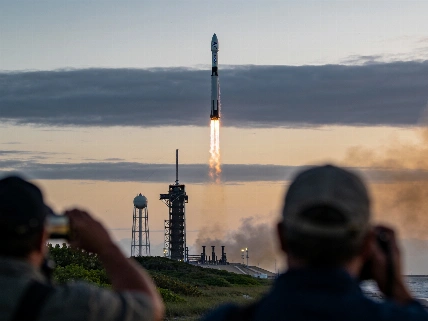
The breakthrough came on December 21, 2015, when a Falcon 9 first stage landed at Cape Canaveral after launching 11 satellites. The next year, the team managed to land boosters on drone ships at sea, expanding what was possible for recovery. Since then, Falcon 9 boosters have landed more than 650 times, with some individual rockets flying over 30 missions each. Independent launch reports confirm that SpaceX's 700th Falcon-family mission took place on September 13, 2026, with booster B1080 landing on A Shortfall of Gravitas after its 29th flight-marking the 661st successful Falcon booster landing. Booster 1067, for example, has completed 37 launches and landings, showing just how routine reuse has become at SpaceX.
In 2025, Falcon 9 flew 165 missions, making up about half of all global orbital launches that year. Every mission was reported as successful, cementing Falcon 9's role as the main workhorse of the current launch era. Peer-reviewed studies, including those published in Nature, have analyzed how reusable rockets have changed the economics and accessibility of space.
Recognition and team structure
Purdue University's Neil Armstrong Space Prize is intended as an annual international award for achievements in space science and exploration. The first recipients are the broader Falcon 9 landing team, represented by Lars Blackmore, Shana Diez, Jon Edwards, Yoshiaki Kuwata, and Eduardo Velazquez. Their work covers Mars landing engineering, Starship reliability, Falcon and Dragon project leadership, guidance and navigation, and Crew Starship engineering. Purdue's dean of engineering, Mark Lundstrom, said the team's work reflects the engineering, teamwork, and courage that defined Armstrong's career.
Purdue's choice to honor the Falcon 9 landing team recognizes that making reusable rockets work has changed how science, exploration, and commercial access to space are approached. The award ceremony at the Cosmos Club made official what had been announced earlier in the year. The five named honorees stand in for a much larger SpaceX team, highlighting the collaborative nature of such projects-a principle also seen at research organizations like CERN.
SpaceX's work has already influenced other launch providers. Recently, two Chinese rockets have achieved first-stage landings, with at least one using foldable landing legs similar to Falcon 9's. The SpaceX team sees this as a sign of progress for the field, since wider adoption of reusable technology could help build a more robust space economy.
Transition to Starship
While Falcon 9 continues to set industry records, SpaceX is preparing to retire it in favor of Starship, a fully reusable rocket designed for Moon and Mars missions. Starship's Super Heavy booster has already been recovered three times using the launch tower's mechanical arms at SpaceX's Texas site, building on lessons from Falcon 9 and Falcon Heavy. NASA and the European Space Agency are closely watching this transition, studying what it could mean for future deep space missions.
Landing and reusing Starship's upper stage, called Ship, is still an open challenge. Simulations show that precision landings are possible, and SpaceX has already demonstrated accurate ocean landings with earlier vehicles, but the team says repeated real-world attempts will be needed to master the process. Moving from expendable upper stages to full two-stage reusability is a major technical leap, and lessons from Falcon 9 are shaping Starship's development.
SpaceX's focus on rapid testing and learning from failure has become a hallmark of its engineering culture, setting it apart from more traditional aerospace programs. This willingness to experiment and adapt has allowed the company to push the limits of what's possible in launch vehicle design.
Broader impact and industry context
The Armstrong Prize for the Falcon 9 landing team reflects a broader change in how the space sector values engineering that delivers real operational results. The ability to recover and reuse large rocket stages has lowered launch costs and made access to orbit more common, with direct effects on science missions, commercial payloads, and exploration. These changes have been explored in detail in Science, which has looked at the operational and economic impact of reusable rockets in the context of global spaceflight.
Other milestones in spaceflight have also been recognized recently, such as NASA's 100th astronaut flight and its role in assembling the space station, as reported in earlier coverage. Together, these advances have created a launch environment where reliability, cost, and frequency are no longer dictated by expendable hardware.
As more launch providers adopt reusable designs, competition in the field is likely to increase. Still, the technical and operational lessons from Falcon 9 remain central to how the industry operates today. The Armstrong Prize's focus on practical engineering, rather than just scientific discovery, shows a growing appreciation for the infrastructure that makes space science possible.
Rocket reusability depends on guidance, navigation, control, and structural engineering that let a rocket's first stage survive reentry, descend in a controlled way, and land vertically for refurbishment and reuse. Doing this at scale requires strong hardware, advanced software, and real-time decision-making systems. Falcon 9's success has set a new standard, but moving to fully reusable two-stage vehicles like Starship will push current engineering further and could reshape launch vehicle design in the coming decade.