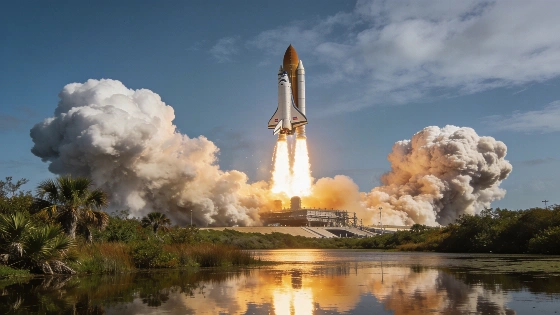
NASA's space shuttle Endeavour launched the STS-69 mission on September 7, 1995, deploying and retrieving two satellites and conducting a spacewalk to test International Space Station assembly techniques
NASA's 100th crewed spaceflight did not simply mark a round number in the agency's launch log. When Endeavour lifted off on September 7, 1995, the STS-69 mission became a proving ground for the operational complexity that would soon define the International Space Station era. The mission's combination of satellite deployment, retrieval, and a nearly seven-hour spacewalk forced the crew and ground teams to coordinate tasks that would become routine-and essential-in the years ahead.
Mission Objectives and Crew
STS-69's five-person crew, led by commander David Walker and pilot Kenneth Cockrell, was tasked with a demanding schedule. Payload commander James Voss, along with mission specialists James Newman and Michael Gernhardt, managed two major satellite operations and a critical extravehicular activity (EVA). The mission's primary goals included deploying and retrieving the Spartan 201-03 satellite, designed to study the Sun's outer atmosphere and solar wind, and operating the Wake Shield Facility, a disk-shaped platform intended to manufacture thin films in the vacuum of space.
Endeavour launched from Kennedy Space Center's Pad 39A and spent 11 days in orbit. The crew's activities required precise timing and coordination, as both Spartan 201 and the Wake Shield Facility had to be released, operated independently, and then recaptured using the shuttle's robotic arm. This marked the first time NASA attempted to deploy and retrieve two separate free-flying payloads on a single shuttle mission.
Satellite Experiments and In-Space Manufacturing
The Spartan 201-03 payload was released to observe the Sun's corona and the transition to solar wind, contributing to a series of solar studies that relied on short-duration, targeted observations. Meanwhile, the Wake Shield Facility-2, a 3.7-meter stainless steel disk, was deployed twice during the mission. Its purpose was to create an ultrahigh vacuum in its wake, enabling the growth of thin semiconductor films for advanced electronics research. The facility successfully produced four thin films out of seven planned and also supported an electrical field experiment for the U.S. Air Force during its second deployment.
Managing two complex payloads in a single mission required careful planning and highlighted the shuttle's versatility as an orbital laboratory. The ability to retrieve and service satellites in orbit was a capability unique to the shuttle era, and STS-69 demonstrated the operational maturity needed for future assembly and maintenance of large structures in space.
Spacewalk and Station Assembly Techniques
One of the mission's most consequential activities was a 6-hour, 46-minute spacewalk by Voss and Gernhardt. The astronauts tested new thermal upgrades to NASA's extravehicular mobility units (spacesuits) and evaluated tools and procedures for assembling modular structures in orbit. These tests directly informed the techniques later used to build the International Space Station, where astronauts would need to connect trusses, modules, and power systems during extended EVAs.
The spacewalk also provided valuable data on suit performance and astronaut workload, helping engineers refine both hardware and operational protocols. The lessons learned from STS-69's EVA contributed to the development of safer, more efficient assembly methods for the ISS, which began construction just three years later.
Operational Legacy and Cultural Footnotes
STS-69's operational complexity set a new standard for shuttle missions, foreshadowing the multi-faceted demands of space station construction. The mission's success in managing simultaneous satellite operations and a major EVA demonstrated that NASA could coordinate intricate tasks in orbit, a capability that would become central to the agency's ambitions for permanent human presence in space.
Beyond its technical achievements, the mission is remembered for its crew's informal "Dog Crew II" moniker, with each astronaut adopting a canine nickname. While this detail is a footnote, it reflects the camaraderie and adaptability required for extended missions in confined environments. For context on how earlier missions tested the limits of deep space navigation, see this reported earlier account of Pioneer 11's Saturn flyby.
STS-69's legacy is not in a single experiment or record, but in the operational groundwork it laid for the International Space Station and future crewed exploration. The mission's blend of technical rigor and adaptability remains a benchmark for evaluating the readiness of human spaceflight programs to handle the unpredictable demands of orbital operations.
Spacewalks, or extravehicular activities (EVAs), are among the most technically challenging aspects of human spaceflight. Astronauts must operate in microgravity, relying on pressurized suits that provide life support, thermal regulation, and mobility. Every EVA is carefully choreographed, with tasks rehearsed on Earth in neutral buoyancy pools to simulate weightlessness. The performance of spacesuits and tools during real missions informs ongoing improvements, ensuring that astronauts can safely assemble, repair, and upgrade complex structures such as the International Space Station. The experience gained from shuttle-era EVAs continues to shape the design and execution of spacewalks for current and future missions.