SpaceX and Nvidia have announced Starmind AI1, a satellite designed to run advanced AI workloads in low Earth orbit using Nvidia's latest space-grade processors, with ambitions for a vast orbital computing network
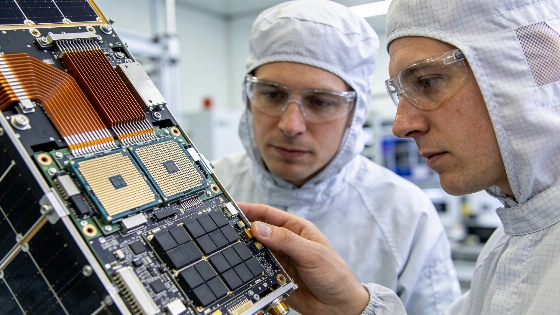
SpaceX and Nvidia have disclosed plans to develop Starmind AI1, a satellite intended to process artificial intelligence workloads directly in low Earth orbit. The announcement, made on August 4, outlines a partnership in which SpaceX will integrate Nvidia's Vera CPUs and Rubin GPUs into the satellite's compute payload. The companies describe Starmind AI1 as a prototype for a potential large-scale orbital network, with the stated goal of creating a distributed AI computing infrastructure outside terrestrial data centers.
According to the companies, the Starmind AI1 satellite will use Nvidia's Vera Rubin module, which Nvidia claims can deliver up to 25 times the AI processing performance of its H100 GPU. The hardware is part of Nvidia's recently announced space computing portfolio, and commercial shipments are expected to begin later in 2026. SpaceX has committed to using Nvidia GPUs exclusively for this project, citing performance advantages, but has not disclosed independent benchmarks or third-party evaluations of the system's reliability in the space environment.
Orbital Data Center Ambitions
SpaceX has filed regulatory documents with the US Federal Communications Commission (FCC) seeking approval to deploy up to one million satellites in low Earth orbit, at altitudes between 500 and 2,000 kilometers. The company's filings describe a petabit-scale optical communications network, relying on high-speed laser links to transfer data between satellites. If realized, this would represent a dramatic increase in off-Earth computing capacity, far exceeding the roughly 15,000 active satellites currently in orbit. The regulatory process is ongoing: the FCC has granted an initial application, but a final decision on the full constellation has not been issued.
Space-based AI computing offers several potential advantages. Satellites in sun-synchronous orbits can access continuous solar power, reducing dependence on Earth's electrical grid. The Starmind architecture is designed to be hardware-flexible, allowing future satellites to incorporate updated processors from different suppliers without requiring a complete redesign. However, the technical and operational challenges of maintaining, upgrading, and securing such a vast network remain unresolved.
Prototype Testing and Market Response
Prototype testing for Starmind AI1 is scheduled to begin in early 2027, with mass production targeted for later that year if development proceeds as planned. The companies have not released details on the specific AI workloads to be tested, nor have they provided information on the software stack, data management, or fault-tolerance mechanisms for in-orbit operation. The announcement coincided with a positive market response: Nvidia shares rose by approximately 3%, and SpaceX stock increased by nearly 9% during the day's trading. The news also arrived ahead of SpaceX's first quarterly earnings report as a public company, with investors monitoring the financial implications of its expanding AI and satellite ambitions.
While the Starmind program is at an early stage, it signals a shift in how AI infrastructure could be distributed. Rather than relying solely on terrestrial data centers, future AI workloads may be processed by platforms operating hundreds or thousands of kilometers above the planet. This approach raises new questions about data security, regulatory oversight, and the environmental impact of large-scale satellite deployments. Related efforts to address the energy and thermal management challenges of AI infrastructure have also emerged, such as recent developments in battery technology for AI data centers.
According to Nvidia, the Vera Rubin module is designed to withstand the radiation and temperature extremes of space, but no independent testing data has been published. The companies have not detailed how they will address potential risks such as orbital debris, satellite failure, or unauthorized access to distributed computing resources. The scale of the proposed constellation would require unprecedented coordination among hardware, software, and regulatory systems, and the long-term sustainability of such a network remains uncertain.
Distributed AI computing in orbit introduces new technical and governance challenges. Unlike conventional data centers, satellites must operate autonomously for extended periods, manage limited physical access for maintenance, and contend with communication delays and potential hardware failures. The regulatory environment for space-based computing is still developing, with questions about data jurisdiction, cross-border data flows, and liability for failures or security breaches yet to be resolved. As the Starmind AI1 project moves from concept to prototype, its progress will serve as a test case for the feasibility and risks of large-scale orbital AI infrastructure.
To understand the significance of this development, it is important to distinguish between conventional cloud computing and distributed AI processing in space. Traditional data centers rely on stable power, controlled environments, and rapid physical intervention in case of failure. In contrast, orbital AI platforms must be engineered for resilience, remote management, and minimal human intervention. The shift to space-based AI infrastructure will require advances in hardware durability, autonomous fault recovery, secure communications, and regulatory frameworks capable of addressing the unique risks of off-Earth computing.