Highstar has introduced a new portfolio of battery cells designed to address the power and thermal management challenges in AI data centers, with custom chemistries for different operational layers and a focus on grid resilience
China-based energy storage company Highstar has announced a new suite of battery cells intended to address the growing power and thermal management demands of artificial intelligence (AI) data centers. The launch, presented at the 2026 GGII Energy Storage Industry Summit, targets the increasing strain on data center infrastructure as AI workloads drive up rack density, power volatility, and heat generation. According to the company, the portfolio is designed to provide rapid response, reliable backup, and improved thermal control across the distinct operational layers of modern data centers.
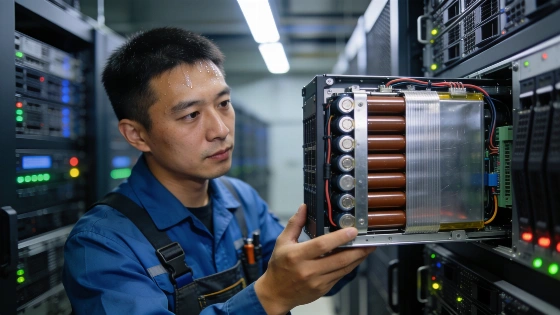
Highstar's approach divides the data center environment into three main power layers: rack-level backup units, facility-wide uninterruptible power supply (UPS) and high-voltage direct current (HVDC) systems, and grid-side storage. For the server racks-where high-density GPU clusters are most vulnerable to power spikes and outages-the company has developed tabless cylindrical cells in 18650 and 21700 formats. By eliminating internal tabs, these cells reduce electrical resistance and internal heat buildup, which is critical for tightly packed computing environments.
Layered Battery Design
In the facility's central power infrastructure, Highstar has introduced two cell types: an 85 ampere-hour (Ah) high-rate lithium iron phosphate (LFP) cell for frequent, rapid pulse loads, and a 50Ah sodium-ion cell engineered for stable operation across a wide temperature range. For grid-level storage, the system incorporates large-format 314Ah lithium-ion and 160Ah sodium-ion cells, intended to buffer the grid from sudden surges in data center demand and to store bulk energy for regional load balancing. The company claims that this multi-tiered design enables coordinated protection from the rack to the grid, but independent verification of these claims has not yet been reported.
Measured figures provided by Highstar include the use of 18650 and 21700 tabless cylindrical cells for rack-level backup, 85Ah LFP and 50Ah sodium-ion cells for facility UPS and HVDC, and 314Ah lithium-ion and 160Ah sodium-ion cells for grid-scale storage. These capacities are consistent with current industry standards for high-rate discharge and utility-scale energy storage, but operational performance in live data center environments remains to be independently evaluated.
Dual Chemistry and Integration
Highstar's system combines lithium-ion and sodium-ion chemistries to address both energy density and thermal stability. Lithium-ion cells are used where high energy density is required, while sodium-ion cells are selected for their resilience to temperature extremes and reduced supply-chain risk. The company emphasizes that its unified architecture standardizes current collection, venting, and pressure relief across all layers, aiming to simplify integration for equipment suppliers and data center operators. However, the complexity of integrating multiple chemistries and cell formats may present challenges for maintenance and long-term reliability.
Globally, data center operators face delays in grid connections due to transformer shortages and capacity constraints, particularly in regions with rapid AI infrastructure expansion. Highstar positions its on-site battery storage as a means to mitigate these delays by allowing operators to manage power ramp-up without overloading local substations. While this approach could provide short-term flexibility, it does not eliminate the need for robust grid infrastructure or address the underlying causes of grid congestion.
Operational and Safety Considerations
The deployment of high-density battery systems in data centers introduces new safety and operational risks, including the potential for thermal runaway, fire, and hazardous failure modes. Highstar's tabless cell design is intended to reduce internal resistance and heat, but the effectiveness of these measures under real-world fault conditions has not been independently tested. The use of sodium-ion cells may offer improved thermal stability, but sodium-ion technology is less mature than lithium-ion and has not yet been widely adopted in critical infrastructure.
Integration of battery systems at multiple layers also increases the complexity of monitoring, maintenance, and emergency response. Data center operators will need to ensure that safety protocols, fire suppression systems, and regulatory compliance measures are updated to reflect the new risk profile. The company's claims of simplified integration and lifecycle performance will require validation through operational experience and, ideally, independent safety certification.
As AI training and inference workloads continue to grow, the reliability of power infrastructure will remain a central concern for data center operators. Highstar's multi-layer battery portfolio represents a technical response to these challenges, but its real-world impact will depend on independent evaluation, regulatory acceptance, and the ability to manage new operational risks.
Battery systems for data centers are typically designed to provide short-term backup power, absorb load spikes, and support controlled shutdowns during outages. Lithium-ion batteries offer high energy density but can be sensitive to temperature and overcharging, while sodium-ion batteries are less energy-dense but more stable under extreme conditions. The integration of multiple chemistries and cell formats requires careful engineering to ensure compatibility, safety, and maintainability. As data centers become more critical to AI infrastructure, the standards for battery safety, monitoring, and certification are likely to become more stringent.