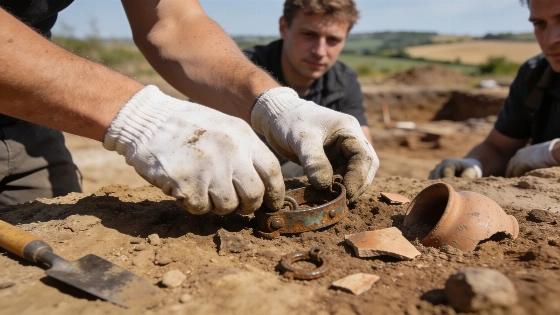
A Celtic spear, complete shield assemblage and associated finds recovered near Erdőbénye provide rare evidence of Iron Age activity in northeastern Hungary while leaving the deposit's date and purpose unresolved.
A spear and what the Hungarian National Museum describes as a complete shield assemblage have been recovered together near Erdőbénye in northeastern Hungary. The objects are the first known find of their kind from the area and provide unusually direct material evidence for Celtic activity in a region where settlement evidence remains limited. The discovery was presented on 24 September 2026 as the result of joint fieldwork by archaeologists and volunteers.
The discovery is important because the objects were found together rather than as isolated pieces. The reported assemblage includes the spear, the complete shield equipment, other metal objects and fragments of pottery. That association may eventually clarify whether the material formed part of a deliberate deposit, a damaged context, or another episode of activity, but the present evidence does not establish why the objects were placed in the ground.
The Hungarian report describes the work as part of a broader archaeological topography project around Erdőbénye rather than a single isolated excavation. Archaeologists and local volunteers have been combining field research with the documentation of artifacts across the landscape. The project's wider scope matters because the value of a weapon assemblage depends not only on the objects themselves, but also on the distribution of nearby material and the history of land use at the findspot.
That method makes location and association central to interpretation. The position of the metalwork, its relationship to nearby finds, and the condition of the surrounding deposit will matter more than the objects' visual appeal alone. Further analysis is expected to refine their date and archaeological context. No final dating, laboratory study or official archaeological report had been reported in the available coverage.
The find also has a useful regional comparison. Excavations elsewhere in northeastern Hungary have identified Late Iron Age cemeteries and artifacts linked with Celtic communities that settled in the region during the fourth and third centuries BCE. Erdőbénye now adds weapon-related material to that uneven record, although it does not by itself demonstrate the presence of a large settlement or define the identity of the people who deposited it.
In archaeological reporting, this distinction between observation and interpretation is essential. A documented association can support a historical hypothesis, but it does not automatically prove a single event, ethnic identity or political structure. The same principle governs evidence-based reporting in journals such as Nature, where the strength of a conclusion must remain proportionate to the data behind it.
The artifacts belong within the wider spread of communities archaeologically associated with the La Tène culture. During the fourth century BCE, Celtic groups expanded into the Carpathian Basin, including territory in modern Hungary. Migration was one part of that process, but settlement, agriculture, trade, exchange and interaction with existing populations also shaped the archaeological record.
The Carpathian Basin occupied a strategic position between Central Europe, the Balkans and the Greek world. Mediterranean objects found in Celtic contexts demonstrate contact across those regions, although an imported item cannot by itself distinguish trade from exchange, migration or warfare. The Erdőbénye assemblage should therefore be read as evidence of participation in a connected Iron Age landscape rather than as a simple marker of military movement.
The surrounding centuries brought repeated conflicts involving Celtic groups and Mediterranean powers. A Celtic army defeated Rome at the Battle of the Allia in 390 or 387 BCE according to differing ancient chronologies, and Celtic forces later invaded Greece in 279 BCE before advancing toward Delphi. Other groups crossed into Asia Minor and became known as the Galatians. These events establish the broad scale of movement and conflict, not the specific circumstances behind the Erdőbénye deposit.
Comparative landscape research, including work associated with institutions such as the Max Planck Society, treats artifact distributions as evidence that must be integrated with chronology, environmental data and site formation processes. That approach is especially relevant here: the discovery shows that metalwork connected with La Tène communities occurred at Erdőbénye, but it does not yet show whether the objects came from a settlement, burial, hoard, battlefield or another type of context.
The most defensible claim is also the most local: northeastern Hungary now has a new, documented concentration of Celtic-associated metalwork. The objects strengthen the case that communities connected with La Tène cultural networks were active in the region, while leaving open whether the deposit reflects combat equipment, storage, abandonment, exchange or a practice with a meaning that cannot be recovered from the objects alone.
That restraint matters because weapons can have social and symbolic significance as well as practical use. A spear and shield fittings may indicate martial activity, but they cannot identify their owner, prove that a battle occurred nearby or establish that the objects were used together. As another Hungarian investigation shows, archaeological interpretation depends heavily on context when an unusual object or structure has more than one plausible explanation.
The Erdőbénye project's continuing survey work is therefore as important as the headline find. Recording where each object lies, how it relates to pottery and other metalwork, and whether the deposit has been disturbed can separate a meaningful archaeological association from a convenient but unsupported story. In practical terms, researchers will need to document the spatial pattern, examine corrosion and preservation, compare the fittings with dated Iron Age material and establish whether the objects share a common depositional history.
For now, the discovery does not rewrite the history of Celtic expansion. It does something more valuable: it supplies a securely documented local data point in a part of Hungary where the evidence is sparse, and it gives researchers a better basis for testing how migration, settlement, exchange and conflict operated on the ground.
Archaeological provenance means more than finding an object in a particular country. It includes the object's exact location, its association with nearby material, the deposit or layer in which it was found and the possibility of later disturbance. A group of artifacts lying together may represent one event, but that interpretation must be tested against their condition and surrounding context.
In this case, the field survey provides the starting evidence rather than a finished explanation. Without a reported laboratory analysis or a more precise dating method, the assemblage can be placed within the broader Iron Age and Celtic expansion described by the project, but not assigned to a narrowly defined event. No sample size, statistical test, confidence interval or peer-reviewed analytical result has been reported, so such measures cannot yet be used to quantify the interpretation.
That limit is not a weakness in the discovery; it is the boundary between what the objects show and what archaeologists still need to establish. Continued recording and analysis may determine whether the spear, shield equipment, other metal objects and pottery fragments belong to one episode, and may clarify how this first known Erdőbénye weapon assemblage fits into the better-documented Late Iron Age networks of northeastern Hungary.