Skyloom Global, now part of IonQ, has installed 84 optical communication terminals in low-Earth orbit, supporting the U.S. Space Development Agency's secure mesh network for military data transfer and future quantum networking applications
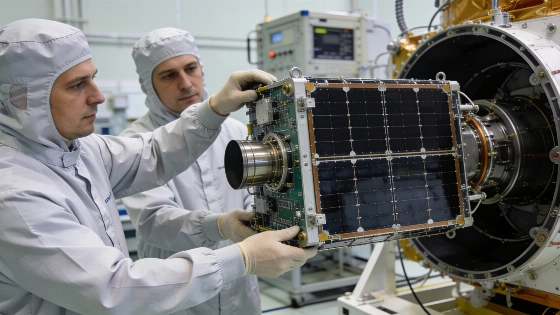
Skyloom Global, a developer of space-based optical communications and a subsidiary of IonQ, has expanded its operational presence in low-Earth orbit (LEO) with the deployment of 84 optical communication terminals. These terminals, launched aboard a SpaceX Falcon 9 from Vandenberg Space Force Base and integrated onto York Space Systems satellites, are designed to support the U.S. Space Development Agency's (SDA) Proliferated Warfighter Space Architecture (PWSA) and its Tranche 1 Transport Layer. The deployment aims to provide high-throughput, low-latency mesh networking for secure military and national defense communications.
Optical Terminal Deployment
The latest launch brings the total number of Skyloom's on-orbit optical communication terminals to 84, making it one of the largest operational laser communication payload footprints in LEO. Each terminal is engineered to conform to SDA's interoperability standards, enabling optical inter-satellite links (OISLs) between satellites and direct optical downlinks to ground stations. The integration with York Space Systems platforms is intended to facilitate rapid scaling and modular deployment across the SDA's expanding constellation.
Technical Capabilities and Standards
Skyloom's optical terminals are designed to operate within the SDA's defined interoperability framework, which specifies requirements for cross-vendor compatibility and secure data transfer. The terminals use free-space optical links to transmit data at high rates, with the mesh network architecture intended to reduce latency and increase resilience against signal disruption. While the company has not disclosed detailed performance metrics such as data rate, link distance, or error rates, the deployment scale suggests a focus on robust, repeatable manufacturing and integration rather than isolated laboratory demonstration.
Quantum Networking Roadmap
Following IonQ's acquisition of Skyloom in January 2026, the company has positioned its optical transport layer as a foundation for future quantum networking applications. This includes potential support for distributed quantum entanglement, free-space quantum key distribution (QKD), and space-to-ground quantum interconnects. However, the current deployment is limited to classical optical communication; the transition to quantum-secure or entanglement-based networking will require additional hardware, protocol development, and rigorous validation. The company's roadmap aligns with broader industry efforts to move from classical optical links toward quantum-secure infrastructure, but practical quantum networking in orbit remains an open engineering challenge.
Industrial Manufacturing and Deployment
The expansion, led by IonQ's President of Quantum Platform, Jordan Shapiro, demonstrates the ability to manufacture and deploy U.S.-built optical space communications hardware at industrial scale. The integration of 84 terminals across multiple satellites reflects progress in modular payload design, supply chain coordination, and launch logistics. While the company reports successful deployment, independent verification of system performance, long-term reliability, and interoperability across the full constellation will be necessary to establish operational readiness.
For context, the scaling of quantum and photonic infrastructure in space parallels recent advances in terrestrial quantum processors, where verification and benchmarking remain central. For example, IBM and collaborators have demonstrated quantum processors performing tasks beyond the reach of classical supercomputers, as discussed in this analysis of quantum processor verification. Both fields face similar challenges in moving from laboratory demonstration to reliable, scalable deployment.
Optical communication in space relies on the transmission of data via laser beams between satellites or from satellites to ground stations. Free-space optical links offer higher data rates and lower latency than traditional radio-frequency systems but are sensitive to alignment, atmospheric conditions, and optical loss. In quantum networking, these links could be used to distribute entangled photons or quantum keys, enabling secure communication protocols that are fundamentally resistant to eavesdropping. Achieving practical quantum networking in orbit will require advances in photon source reliability, detector efficiency, error correction, and network synchronization, as well as robust engineering to withstand the space environment.