Archaeologists at Ani in eastern Türkiye have uncovered a decorated Seljuk-era stone fragment inscribed with the name of the Prophet Muhammad in Kufic script, offering new evidence for religious and funerary traditions in medieval Anatolia
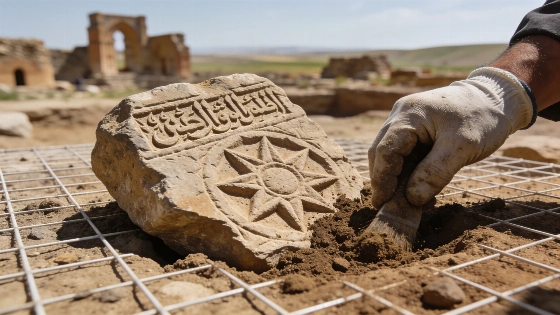
A fragment of a carved stone, once part of a Seljuk tomb monument, has been recovered from the medieval cemetery at Ani in eastern Türkiye. The surviving piece, measuring 51 by 21 centimeters, preserves three repetitions of the name of the Prophet Muhammad in Kufic script, arranged around an eight-pointed star motif. This find provides rare physical evidence for the integration of Islamic religious expression into funerary architecture during the early centuries of Turkish presence in Anatolia.
The stone was discovered during ongoing excavations at the Seljuk Cemetery within Ani, a site recognized for its role in the expansion of Turkish-Islamic rule following the city's conquest by Sultan Alp Arslan in 1064 CE. The cemetery is considered the earliest known Turkish-Islamic burial ground in Anatolia, and its monuments have become central to understanding the region's mortuary practices after the Seljuk arrival.
Inscription and Artistic Context
The fragment's Kufic inscription, originally repeated six times but now visible in three instances due to breakage, is carved in relief and encircles a geometric star. Kufic, an early angular form of Arabic script, was widely used in Islamic architectural decoration and is known for its visual clarity and adaptability to geometric ornamentation. The use of this script on a tomb monument at Ani demonstrates the adoption of Islamic calligraphic traditions by Seljuk artisans and patrons in the region.
Researchers believe the stone was once part of the architectural decoration of a mausoleum within the cemetery. Comparable decorative programs, combining religious text and geometric motifs, are documented at other medieval Anatolian sites, including the Mama Hatun Mausoleum in Tercan and the Malatya Grand Mosque. The Ani fragment stands out for its early date and the explicit repetition of the Prophet's name, which may reflect particular devotional practices or beliefs among the community responsible for the monument.
Archaeological Context and Preservation
Excavations at Ani's Seljuk Cemetery have been underway since 2021, with the aim of documenting the site's funerary architecture and associated material culture. The newly recovered stone was found in a disturbed context, and only half of the original object survives. Despite this, the preserved inscriptions and motif provide secure evidence for the monument's original design and religious function. The fragment's survival is notable given the vulnerability of carved stone to weathering, reuse, and destruction over centuries of occupation and abandonment at Ani.
According to Türkiye's Ministry of Culture and Tourism, the find is significant for its combination of religious inscription, geometric ornament, and stone craftsmanship. The explicit invocation of the Prophet Muhammad's name in a funerary context offers a direct material link to the beliefs and commemorative practices of the medieval community at Ani. While the stone's original architectural setting cannot be fully reconstructed, its association with the cemetery and its iconography support its interpretation as part of a tomb monument.
Comparative Evidence and Interpretation
The use of Kufic script and geometric ornamentation in funerary monuments is attested at several sites across Anatolia, reflecting broader trends in Seljuk and early Turkish-Islamic art. The Ani fragment's closest parallels are found in mausoleums and mosques dating from the late twelfth and early thirteenth centuries, where religious inscriptions were integrated into architectural decoration as both a visual and devotional element. The repeated inscription of the Prophet's name may have served to invoke blessing or protection for the deceased, though the precise theological or ritual significance remains open to interpretation.
Physical evidence from the cemetery at Ani, including the newly discovered stone, contributes to a growing body of data on the development of Turkish-Islamic mortuary culture in the region. As with other recent discoveries, such as the gold diadem from Crimea, the context and preservation of the find are critical for interpreting its meaning and significance. The fragment's incomplete state limits the reconstruction of its original appearance, but its inscription and motif remain legible and securely attributable to the Seljuk period.
Historical Significance and Limitations
Ani's status as a UNESCO World Heritage Site reflects its importance as a crossroads of medieval cultures, with architectural remains spanning Armenian, Byzantine, and Islamic traditions. The Seljuk Cemetery, in particular, offers a rare opportunity to study the earliest phases of Turkish-Islamic burial practice in Anatolia. The inscribed stone fragment adds to the evidence for the integration of Islamic religious identity into the material culture of death and commemoration at Ani.
However, the fragmentary nature of the find and the lack of associated human remains or undisturbed burial context mean that broader conclusions about individual identity, social status, or specific funerary rituals must remain provisional. The stone's inscription provides direct evidence for religious expression, but its meaning for the community that commissioned it can only be inferred from comparative material and the broader archaeological context. As with many early Islamic monuments in Anatolia, the evidence is strongest for the adoption of new artistic and epigraphic forms, while the details of belief and practice remain less accessible.
Kufic script, used on the Ani stone, is one of the earliest forms of Arabic calligraphy and is characterized by its angular, linear style. In Islamic art and architecture, Kufic inscriptions often served both decorative and communicative functions, conveying religious messages while integrating seamlessly with geometric ornamentation. The script's adaptability made it a favored choice for monumental inscriptions on buildings, tombs, and objects across the Islamic world. In the context of medieval Anatolia, the use of Kufic on funerary monuments reflects both the spread of Islamic religious identity and the local adaptation of artistic traditions.