Archaeologists at Ani in eastern Türkiye have uncovered a Seljuk-era food storage facility with five large ceramic jars, offering new evidence for food preservation and urban organization in the medieval city
Archaeological excavations at the UNESCO World Heritage Site of Ani, located in present-day Kars Province near the Turkish-Armenian border, have revealed a Seljuk-period food storage facility containing five large ceramic jars. The discovery, made during the 2026 field season, provides new evidence for how food was preserved and managed in the medieval city during Seljuk rule.
Excavation Context and Material Evidence
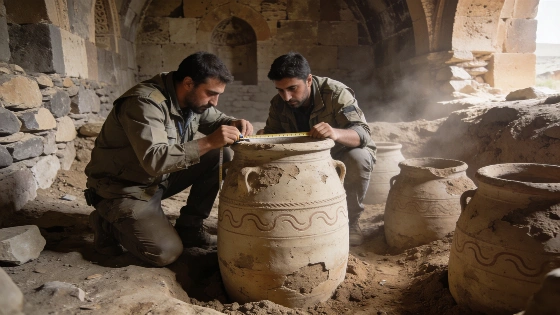
The storage facility was identified within the Seljuk Bazaar, one of six areas currently under investigation at Ani. The excavation is part of a research program led by the Turkish Ministry of Culture and Tourism in partnership with Kafkas University. The jars, known as pithoi, are large earthenware vessels typically used for storing dry agricultural produce such as legumes. Each vessel measures over one meter in height, with openings approximately 50 centimeters in diameter, and is made from unglazed terracotta decorated with S-shaped appliqué motifs characteristic of the period.
In total, five pithoi were found in situ within the storage area, suggesting a deliberate architectural arrangement for bulk food storage. The presence of similar installations in previous excavation seasons indicates that organized food storage was a recurring feature of Ani's urban infrastructure during the Seljuk period. Around 100 specialists, including archaeologists, architects, conservators, and art historians, are participating in the current excavations, which also target residential buildings, a cemetery, and an oil mill.
Interpreting Storage Practices and Urban Life
The jars' size and construction suggest they were intended for long-term storage of dry goods, likely to buffer the city's food supply against seasonal shortages or market fluctuations. The use of pithoi for food preservation is consistent with practices documented at other medieval urban centers in the region. The repeated discovery of such facilities at Ani supports the interpretation that food storage was not only a household concern but also an organized aspect of urban planning and commercial activity.
While the jars themselves do not preserve direct evidence of their original contents, their context within the bazaar and their association with other commercial structures point to a role in supporting both local consumption and trade. The architectural integration of storage spaces within the city's commercial district reflects the importance of managing surplus and ensuring food security in a densely populated medieval settlement.
Chronology, Preservation, and Research Limitations
The storage facility is attributed to the Seljuk period based on its architectural context and the typology of the ceramic vessels. No direct radiocarbon dates from the jars or associated deposits have been reported, so the dating relies on stratigraphic association and ceramic style. The pithoi are well preserved, with minimal post-depositional disturbance, allowing for detailed study of their form and manufacturing techniques. However, the absence of organic residues or botanical remains limits the ability to reconstruct the precise contents or storage duration.
Ani's archaeological record is complex, reflecting successive occupations by Armenian, Byzantine, Seljuk, and Ottoman authorities. The city's role as a major commercial center on regional trade routes is well established, but the organization of its food supply and storage infrastructure remains an active area of research. Comparable discoveries at other sites, such as the recovery of urban infrastructure spanning several centuries in Königsberg's Far Forstadt district (see related research on urban change in historic Königsberg), highlight the value of integrating material evidence with broader questions of urban development and economic organization.
Implications for Medieval Urban Organization
The identification of multiple storage facilities at Ani contributes to a growing body of evidence on how medieval cities in the region managed food resources. The architectural and material features of the pithoi suggest a standardized approach to storage, likely coordinated at the community or institutional level. This organization would have been essential for supporting a large urban population and facilitating trade along the city's commercial routes.
Further analysis, including residue studies and comparative research with other medieval sites, may clarify the range of goods stored and the social or economic mechanisms governing their use. The ongoing excavations at Ani continue to refine our understanding of how urban centers in the medieval Caucasus balanced subsistence, commerce, and resilience in the face of environmental and political change.
Understanding the archaeological context of storage facilities like those at Ani depends on careful stratigraphic excavation and typological analysis. Stratigraphy-the study of layered deposits-allows archaeologists to establish the relative sequence of construction and use, while ceramic typology provides clues to dating and cultural affiliation. However, without direct dating or preserved organic remains, interpretations of function and chronology remain provisional. The integration of multiple lines of evidence is essential for reconstructing the organization of medieval urban life and the strategies communities used to manage essential resources.