

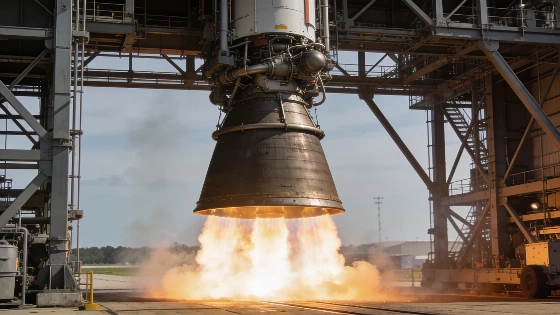
At Stennis Space Center an RS-25 development engine ran for 500 seconds and reached 111% power. The firing also tested flight components and a new nozzle thermal protection system for future Artemis missions
NASA's Oct. 21, 2026, RS-25 test used a development engine that will not fly, but its firing put flight components and a new nozzle thermal protection system through a 500-second run. The test gave NASA and its contractors operating data from an engine running for about as long as RS-25 engines fire during an SLS launch.
Full-duration firing
Test teams ran RS-25 engine No. 10001 for 500 seconds on the Fred Haise Test Stand at NASA's Stennis Space Center in Mississippi. That is about eight and a half minutes, matching the approximate firing time of the four RS-25 engines on an SLS launch. Operators also took the engine to 111% of its rated power, the level specified for new production engines intended for SLS missions carrying the Orion spacecraft.
The test's objectives included acceptance testing RS-25 flight components intended for future Artemis missions. NASA also used the firing to validate a new thermal protection system for the engine nozzle. Engine No. 10001 is developmental hardware and is not slated for flight; the test platform allows engineers to operate flight components and gather data without using the test engine on a launch vehicle.
Protecting the nozzle
The nozzle thermal protection system is designed for the heat environment around the engine during launch. The RS-25 burns liquid hydrogen and liquid oxygen, and its nozzle is exposed to the intense thermal conditions of operation. The test ran the engine at a duration and power level relevant to SLS launch demands while NASA and L3Harris Technologies collected data for evaluating engine performance and reliability.
Thermal protection is also relevant to a separate Orion system designed for a different part of a mission. A previous Orion heat-shield review covered protection during atmospheric reentry. The RS-25 system discussed here protects the engine nozzle during launch, rather than Orion during its return.
Role in Artemis
Four RS-25 engines power the core stage of NASA's Space Launch System, which launches Orion on Artemis missions. Together, the engines produce up to 2 million pounds of thrust; coverage by Louisiana station WBRZ has described thrust of about 1.6 million pounds at liftoff, rising to as much as 2 million pounds as the rocket climbs. NASA and Aerojet Rocketdyne adapted 16 engines previously flown on the Space Shuttle for the early Artemis missions. The engines were updated for SLS, including with revised electronics, and RS-25 engines are tested at Stennis before flight.
NASA, L3Harris Technologies, and Nova Space Solutions operators carried out the Stennis firing. L3Harris is NASA's prime contractor for the RS-25 program, and the hot-fire data will support work on engines and flight components for future Artemis missions. The 111% power level also corresponds to the capability planned for the new production series of RS-25 engines.
The RS-25 test was one part of the broader preparation for Artemis. By Oct. 15, 2026, all four RS-25 engines had been installed on the SLS core stage being prepared for Artemis III, while teams prepared for a launch-pad fueling test. One installed engine, E2048, had previously flown on space shuttle Atlantis during the 2009 STS-129 mission.
A hot-fire test runs an engine on a ground stand rather than during a launch. Engineers can operate the hardware and collect data under controlled test conditions while the engine remains attached to test infrastructure. The 500-second firing exercised the developmental engine at a duration comparable to an SLS launch and included a run at 111% power, alongside testing of flight components and the nozzle protection system.







