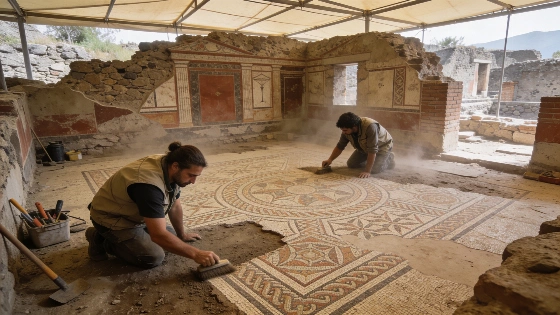
Archaeologists in northern Türkiye have revealed extensive Roman mosaics during renewed excavations at Pompeiopolis, offering new evidence for elite architecture and decorative practices in Anatolia's Roman period
Archaeological teams working at Pompeiopolis, an ancient city in Türkiye's Kastamonu Province, have exposed large sections of mosaic flooring from a Roman villa dating to the second century CE. The villa, located in the Taşköprü district, is estimated to cover at least 3,000 square meters, making it one of the largest known Roman residential structures in Anatolia. Excavations are led by a team from Karabük University in collaboration with the Turkish Ministry of Culture and Tourism, with support from Italian specialists and local authorities.
Excavation and Conservation
This season's work has focused on carefully lifting, cleaning, and stabilizing the villa's mosaic floors, which are at risk of further deterioration if left exposed. The mosaics, composed of thousands of small tesserae, display geometric and figurative designs consistent with high-status Roman domestic architecture. Conservation efforts are currently concentrated on the triclinium, or formal dining room, which measures approximately 112 square meters. In 2025, around 10 square meters of mosaic were restored, with the current campaign aiming to preserve additional sections over a four-month period.
Excavations at Pompeiopolis have been ongoing for 25 years, with the villa first identified in 2006. The current project involves 45 specialists, including 15 archaeologists from Italy, reflecting the international significance of the site. The villa's scale and preservation have drawn comparisons to other major Roman sites in the region, such as Zeugma, known for its elaborate mosaics. However, researchers caution that only a portion of the villa has been revealed, and the full extent of the complex remains uncertain.
Architectural Context and Dating
Based on stratigraphic evidence and architectural analysis, the villa is believed to have been constructed in the second century CE and remained in use until the sixth century. This provides a continuous archaeological record spanning roughly 400 years, offering insight into changing domestic practices and elite life in Roman Anatolia. The mosaics' craftsmanship and iconography are consistent with other high-status Roman residences, but the specific motifs and construction techniques are still under study.
Officials emphasize the urgency of conservation, noting that some mosaic sections could be lost within a few years without continued intervention. Funding for the project comes from the General Directorate of Cultural Heritage and Museums, with additional support from Acacia Mining and local government bodies. Excavations are scheduled to continue through October, though future work will depend on available resources.
Regional Significance and Comparative Evidence
The discovery of such an extensive villa in northern Anatolia challenges previous assumptions about the distribution of elite Roman architecture in the region. While large villas are well documented in western and southern Anatolia, few have been identified in the Black Sea area. Researchers suggest the Pompeiopolis villa likely belonged to a member of the Roman provincial elite, based on its size, decorative program, and location within the ancient city.
Beyond its archaeological value, the site is being developed with the aim of supporting cultural tourism in Kastamonu Province. Infrastructure improvements are underway to facilitate future public access, though the primary focus remains on research and conservation. The ongoing work at Pompeiopolis adds to a growing body of evidence for complex settlement and elite presence in Roman Anatolia, complementing recent finds elsewhere in the region. For example, the recovery of high-status artifacts from a Byzantine shipwreck in the Adriatic, as reported in Science Report's coverage of elite regalia from Mljet island, highlights the broader patterns of wealth and connectivity across the Roman and Byzantine worlds.
Preservation Challenges and Future Research
While the villa's mosaics are exceptionally well preserved in some areas, other sections have suffered from environmental exposure, root damage, and previous disturbance. Conservation teams are employing reversible stabilization methods to ensure that future research and potential public display remain possible. The full documentation and analysis of the villa's decorative program, construction phases, and associated finds are ongoing, with preliminary results expected to inform broader interpretations of Roman domestic life in the region.
Researchers acknowledge that the current understanding of the villa's function, ownership, and social context remains provisional. Further excavation and analysis will be required to clarify the relationship between the villa and the wider urban landscape of Pompeiopolis, as well as its place within the economic and political networks of Roman Anatolia.
Establishing the chronology and context of ancient structures relies on a combination of stratigraphy, architectural analysis, and, where possible, direct dating methods such as radiocarbon or luminescence dating. Stratigraphy involves recording the sequence of soil layers and construction phases, allowing archaeologists to reconstruct the relative order of events at a site. In the case of the Pompeiopolis villa, the association of mosaics with specific architectural features and occupation layers helps to anchor the building within the broader history of the city. However, the absence of direct dating for some elements means that chronological estimates remain subject to revision as new evidence emerges.