NASA's Nancy Grace Roman Space Telescope launched successfully, marking a milestone for infrared astronomy after years of budget uncertainty and political debate over its funding and future
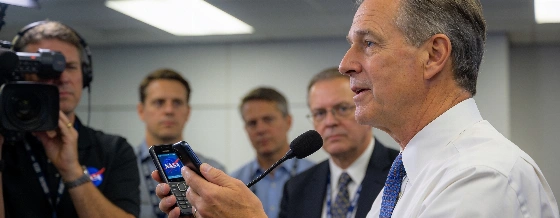
The Nancy Grace Roman Space Telescope has entered orbit following a successful launch from Cape Canaveral, Florida, on August 30, 2026. The mission, designed to investigate dark energy, exoplanets, and cosmic structure, reached a new milestone as NASA officials confirmed the spacecraft's deployment and initial systems checks. The launch was notable not only for its scientific promise but also for the political attention it attracted, including a direct call from President Trump during NASA's post-launch press briefing-a striking reversal after years of proposed funding cuts to the mission.
Mission Status and Scientific Goals
The Roman Space Telescope, previously known as WFIRST, is NASA's latest flagship observatory for wide-field infrared astronomy. Its primary objectives include mapping the distribution of dark energy, surveying exoplanets using microlensing, and conducting deep imaging of distant galaxies. The observatory's 2.4-meter primary mirror and advanced detectors are designed to deliver a field of view 100 times greater than that of the Hubble Space Telescope at comparable resolution, enabling large-scale surveys of the cosmos.
Launched aboard a SpaceX Falcon Heavy rocket, the Roman telescope was placed into a stable orbit and is now undergoing commissioning. Over the coming months, engineers will calibrate its instruments and verify performance before routine science operations begin. The mission is expected to operate for at least five years, with the potential for extension depending on spacecraft health and scientific return.
Political Context and Funding Challenges
The Roman mission's path to launch was shaped by repeated attempts to restrict or eliminate its funding. Between 2019 and 2021, the White House proposed canceling the project in three consecutive budget requests, citing cost concerns and shifting priorities. Each time, Congress restored funding, recognizing the mission's scientific value. In 2025, draft budget documents again suggested deep cuts to NASA's science programs, raising the possibility of cancellation. Ultimately, Congress approved a $24.4 billion budget for NASA for fiscal year 2026, preserving support for Roman and other science missions.
The political reversal was underscored during the post-launch press conference, when President Trump called to congratulate the mission team. The call, broadcast to the assembled journalists, focused on the success of the launch and the administration's support for NASA, despite the earlier proposals to terminate the mission. The episode highlighted the complex relationship between scientific priorities and political decision-making in large-scale space projects.
Technical Milestones and Next Steps
With the spacecraft now in orbit, Roman's commissioning phase will involve a series of technical milestones. These include the deployment and alignment of the primary mirror, activation of the Wide Field Instrument, and calibration of the Coronagraph Instrument, which will enable direct imaging of exoplanets and circumstellar disks. Only after these steps are completed will the telescope begin its primary science surveys, which are expected to yield new insights into the expansion history of the universe and the demographics of planetary systems.
Initial science images are not anticipated until 2027, as the mission team completes the necessary calibrations and performance checks. The Roman telescope's wide-field capabilities are expected to complement the narrower but deeper observations of the James Webb Space Telescope, providing a broader statistical context for studies of galaxy evolution and dark energy. For a detailed account of the mission's development and the funding challenges it overcame, see this analysis of Roman's journey from budget uncertainty to launch.
Uncertainties and Scientific Potential
While the successful launch marks a major milestone, Roman's ultimate scientific impact will depend on the performance of its instruments and the stability of its orbit over time. The mission's ability to constrain the properties of dark energy, for example, will rely on the precision of its supernova and weak lensing surveys, as well as the accuracy of its calibration procedures. Similarly, the detection of exoplanets via microlensing will require careful analysis of crowded stellar fields and robust statistical modeling.
As with all large observatories, unforeseen technical issues or environmental factors could affect data quality or mission duration. The Roman team has built in redundancy and flexibility to address potential anomalies, but the full scope of the mission's discoveries will only become clear after science operations commence. The project's history underscores the importance of sustained funding and policy support for ambitious scientific missions.
Space telescope commissioning is a critical phase in which engineers and scientists verify that all systems and instruments are functioning as intended after launch. This process includes aligning mirrors, calibrating detectors, and testing onboard software to ensure the observatory can achieve its scientific objectives. Only after successful commissioning can a telescope begin collecting calibrated data for research. The duration and complexity of commissioning depend on the mission's technical requirements and the performance of its hardware in the space environment. For Roman, this phase will determine when the first science-quality images and measurements become available, setting the stage for its contributions to cosmology and exoplanet science.