The 2026 equinoxes mark the moments when the Sun crosses Earth's equatorial plane, revealing why the seasons reverse between hemispheres and why day and night are never perfectly equal.
Earth's equinox is not simply a date on a calendar. It is a precise geometric event: the moment the center of the Sun crosses the plane of Earth's equator. In 2026, the March equinox occurs on March 20 at 14:46 UTC, while the September equinox occurs on September 23 at 00:05 UTC. This definition follows the astronomical geometry used in calculations by NASA and other observatories rather than local weather or the civil calendar.
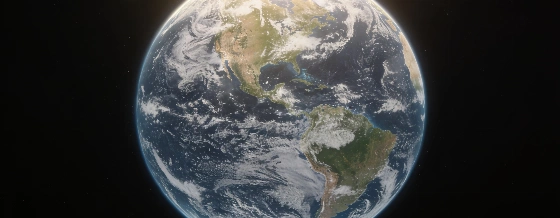
Earth's axis is tilted as the planet travels around the Sun. That tilt changes which hemisphere receives the more direct share of sunlight during the year. At an equinox, neither hemisphere is tilted toward the Sun, so sunlight is distributed symmetrically between the Northern and Southern Hemispheres in the large-scale geometry of the event. The Sun is crossing the celestial equator, the sky-based projection of Earth's equatorial plane.
For an observer at the equator, the Sun appears directly overhead at noon on the equinox. After the March event, the Sun's apparent path continues northward each day until the June solstice. Following the September crossing, that path moves southward until the December solstice. This directional motion gives the March equinox its alternative description as the northward equinox and the September event its description as the southward equinox.
The dates are fixed by astronomy rather than by local weather. The March equinox occurs at 7:46 a.m. EDT, while the September event takes place at 5:05 p.m. PDT on September 22 even though it is September 23 in UTC. In New York, the same September instant appears as 8:05 p.m. EDT on September 22; in Britain, it is listed as 1:06 a.m. BST on September 23. The difference is a reminder that an equinox is one instant shared by the planet but displayed on clocks according to location.
For the Northern Hemisphere, the September crossing marks the beginning of astronomical autumn; in the Southern Hemisphere, it marks the beginning of astronomical spring. The March event reverses those labels. The International Astronomical Union and ESA use this hemispheric convention because the seasonal change follows the changing declination of the Sun, not a simultaneous shift in temperature everywhere.
Despite its Latin name meaning equal night, an equinox does not produce exactly twelve hours of daylight and twelve hours of darkness everywhere. The date on which day and night are closest to equal depends on latitude and may fall several days before or after the equinox itself. In parts of the mid-Atlantic and most southern United States, regional calculations place this practical equal-day-and-night point, known as the equilux, around September 27 in 2026 rather than on the equinox.
Two physical effects account for the mismatch. The Sun is a disk rather than a point of light, so sunrise begins when its upper edge appears and sunset ends only after that edge disappears. Earth's atmosphere also bends incoming sunlight, allowing the Sun to remain visible when its geometric position is slightly below the horizon. Together these effects add several minutes of apparent daylight, a distinction discussed in astronomical explanations and summarized in an equinox overview.
The result is a useful correction to a familiar shortcut. "Equal night" describes the event's orbital geometry, not a universal stopwatch reading at every location on Earth. Atmospheric composition, local horizon height, latitude, and the convention used to define sunrise and sunset can all affect the measured interval.
The same equinox produces opposite seasonal signals in the two hemispheres. In March, the Northern Hemisphere moves toward longer and warmer days as it approaches summer, while the Southern Hemisphere enters autumn with shortening days and lengthening nights. In September, those seasonal directions reverse. The astronomical transition is global, but its environmental consequences unfold differently according to latitude, ocean circulation, land cover, and regional climate.
That reversal is not caused by Earth being substantially closer to or farther from the Sun during the year. The decisive factor described here is the planet's axial tilt and the changing angle at which sunlight reaches each hemisphere. The equinox is therefore the cleanest point in the annual cycle for seeing how orbital geometry drives the seasonal pattern. Introductory explanations from NASA commonly use the same distinction to separate axial tilt from the misleading idea that seasons are controlled primarily by orbital distance.
Modern calendars make the event easy to anticipate, but the observation itself is ancient. Many early observatories around the world tracked equinoxes alongside the more pronounced solstices. Their interest was practical as well as astronomical: the changing position of sunrise and sunset provided a dependable marker within the year. Today, precise ephemerides allow researchers to calculate the crossing to the second, while observational networks verify how the ideal geometry appears from particular locations.
The equinox also provides a useful reference for thinking about other changes recorded in the sky. A lunar impact event described in the earlier lunar report concerns a sudden alteration on the Moon, whereas an equinox is a recurring consequence of Earth's orbital position and axial orientation. The contrast matters: one is a surface event detected through spacecraft observations, while the other is a predictable alignment in the Earth-Sun system.
Near the equinoxes, sunlight reaches both polar regions at a very shallow angle, and the poles pass through their seasonal transitions between prolonged daylight and prolonged darkness. At the exact geometric crossing, the idealized Sun lies on the horizon for an observer at either pole, although refraction, terrain, and the Sun's visible disk complicate what a person would see. This is different from ordinary mid-latitude daylight and illustrates why a global alignment does not create identical local conditions.
The scientific value of the equinox lies in its precision. It turns an apparently simple calendar label into a measurable relationship among Earth's tilt, its orbit, the Sun's position, the atmosphere, and an observer's latitude. For readers watching the seasons change, the event is best understood not as a day when darkness and light divide perfectly, but as the exact planetary alignment that sets the next seasonal movement in motion.
Axial tilt controls the changing distribution of sunlight, while atmospheric refraction and the Sun's visible disk shape the daylight measured from the ground. That distinction separates idealized geometry from the experience of sunrise and sunset. Research traditions represented by NASA, ESA, and journals such as Nature rely on the same separation between a precisely defined astronomical event and the conditions under which it is observed. The equinox therefore remains a rigorous reference point rather than a promise of identical daylight at every location. Its lasting importance is that one precise crossing explains why spring begins in one hemisphere as autumn begins in the other.