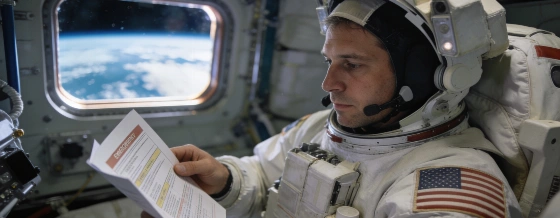
A live NASA stream will carry prerecorded STEM questions from New Hampshire students to astronaut Anil Menon aboard the International Space Station on Thursday, Sept. 24, offering students a direct view of science and space careers in orbit.
Students in New Hampshire are preparing to send their questions into orbit. NASA astronaut Anil Menon will answer prerecorded STEM questions from aboard the International Space Station during a live event streamed on NASA's Learn With NASA YouTube channel.
Because the questions are prerecorded, the exchange will not be an open-microphone conversation between classrooms and orbit. It is a curated educational broadcast that gives students a direct view of how an astronaut communicates from a working research platform beyond Earth.
That distinction matters. The event is not a new experiment or a mission milestone, and the announcement does not identify the questions or provide new scientific results. Its value is practical: students can connect classroom STEM topics with a real astronaut carrying out a long-duration science and research mission.
Menon is participating in MIYOKA welding and soldering experiments designed to examine how electronics work can be performed safely in microgravity. The tested samples are expected to return to Earth for comparison with terrestrial specimens, allowing researchers to assess differences between orbital and ground-based work rather than treating the activity as an immediate technological breakthrough.
His schedule also includes cargo preparation and training for rendezvous operations with a Dragon spacecraft. NASA expects the Dragon Crew-13 vehicle to arrive at the station in early October 2026, placing the student broadcast within an active period of logistics, research, and crew operations.
Menon is also reviewing procedures for emergency scenarios aboard the station. That detail places the broadcast within the operational reality of human spaceflight, where research activity takes place alongside preparation for events that could threaten crew safety.
For more than 25 years, people have lived and worked continuously aboard the International Space Station. During that time, the station has supported scientific research and technology development that cannot be performed in the same way on Earth, while also giving NASA experience with the physical and operational demands of sustained human activity in orbit. The station's research role is summarized in the ESA research overview.
The station's role extends beyond individual demonstrations. NASA uses it to investigate challenges associated with human spaceflight, expand commercial opportunities in low Earth orbit, and build experience for longer missions to the Moon under the Artemis program and eventually to Mars. The student event does not itself advance those missions, but it brings the infrastructure behind them into a classroom setting.
Work aboard the station also illustrates how space research is organized. A crew member may move between human-health investigations, materials and electronics tests, vehicle preparation, and safety procedures within the same week. Results are interpreted through controlled comparisons and operational records; they are not automatically evidence of a clinical therapy or a broadly validated engineering solution. This distinction is central to the scientific standards followed by NASA and peer-reviewed journals such as Nature.
The timing is precise: 11:35 a.m. EDT on Sept. 24, with the stream available through NASA's Learn With NASA YouTube channel. Media outlets seeking to cover the event must RSVP to Kelly Thompson at kthompson@starhop.com by 5 p.m. EDT on Wednesday, Sept. 23.
The broader educational context is visible in NASA's effort to connect students with multiple routes into space science and engineering, including its earlier space academy coverage. Here, the mechanism is simpler and more immediate: prerecorded questions move from New Hampshire classrooms to an astronaut working in orbit, then return as answers that can be shared with a wider audience.
NASA's in-flight calls page at https://www.nasa.gov/stemonstation provides further information about these events. For readers and educators, the important point is clear: this broadcast is an access opportunity, not evidence of a new discovery. Its strongest contribution is to make the working environment of human spaceflight tangible for students who may later become the scientists, engineers, and operators that future missions require.